Full control

There is a popular meme that tells about the relationships between a job done fast, well, and cheap. You can do a job fast and well, you can do it well and cheap, you can do it cheap and fast. What you can’t do is fast, well, and cheap at the same time.
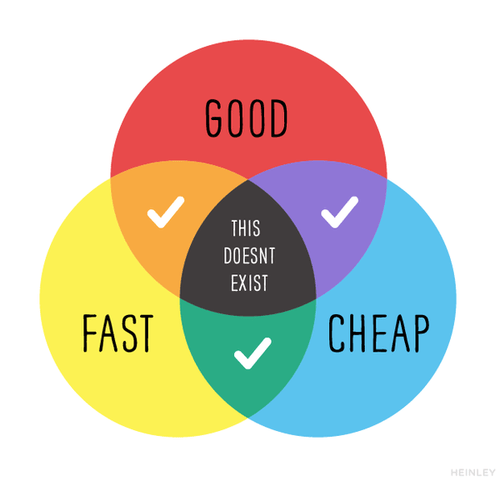
Source: The Developer Society, Good/Cheap/Fast

The meme fails to tell another truth, though. A bane to many companies. That is: you can’t do a job fast, well, or cheap if you want to maintain full control on the outcome.

You can’t do fast, because when the job is ready, there are still review phases to go through. Often featuring vague feedback, last minute changes, and unsubstantiated personal opinions.

You can’t do cheap, because all the layers you are adding have a cost. And even more expensive is the price you pay for the people who leave once they realize their talent comes after tenure.

You can’t do well, because by the time you get to the finish line, what you have is a frankestein that satisfies everyone and excites no one.

So, if your goal is to maintain full control on the outcome, any of the combinations in the meme is a much better path to execution. Change, or be prepared to be kicked out of the game.

A practice of research

What you create is not going to be consumed the way you thought it would.

There is no education. There is no explaining. There is no walkthrough. The only way you address this is by committing to a practice of research.

Ask.

Listen.

Aggregate.

Adjust.

Ask.

Listen.

Aggregate.

Adjust.

It might be that at some point what you create is no longer what you want to create. It is not likely, but it is a possibility.

In that case, move a step away and start over.

Ask.

Listen.

Aggregate.

Adjust.

The dumber marketer

Is being dumb giving you an edge in marketing?

I am not talking about a lack of intelligence, but rather of a genuine, näive ignorance around topics you probably can never be very sure about.

Why is this campaign working?

What do you mean by that word you are using so frequently in your copy?

What is our ideal customer? Where do they hang out? What do they care about?

Why is this blog post performing way above average?

Do our visitors approach our resources in terms of “case studies”, “videos”, and “whitepaper”, or are they seeking information about what type of customer, what use cases, what pain points?

Are we expressing our product this way because it is comfortable for us or because it makes sense to our target customers?

I am not sold on the idea that being certain and confident is a good thing in marketing. What worked yesterday, what is working today, will probably not work tomorrow. What worked for that campaign, will probably not work this time. What worked in one company, will probably not work in the new one.

So, is the dumber marketer the one who is going to ask those questions?

The receiver

In University, I was taught that communication, in its most basic form, is the cooperation between a sender and a receiver to get a message through a shared environment.

And while that certainly holds true still today, I am more and more convinced that in business, communication is in the hands of the receiver.

Think about marketing: the receiver is forced through a myriad of messages and decides what to dedicate attention to in a matter of seconds. Think about internal communication: the receiver can call bullshit on any message management is sharing if that does not reflect their day-to-day experience. Think about presentations: the receiver is so fed up with bullet points and animations (particularly after one year of virtual meetings) to the point they can check emails or write a report while you are struggling to make a case.

The receiver is central in any form of corporate communication.

And the fact that we spend so little time trying to figure them out is the most widely overlooked device a professional has to leverage to get their messages through.

Villain turned hero

Many business books (strategy books, leadership books, self-improvements books) present their ideas in a villain vs hero way.

On one side, there are undesirable strategies, leadership styles, behaviours, tactics and on the other are desirable strategies, leadership styles, behaviours, tactics.

And this is where they fail to inspire change, for two reasons mainly. First of all, very few people identify with the villain – I am not the villain, then why should I change?. And secondly, the positive features of the hero are presented as innate, almost magical – I am not a demi-god, so why bother?.

A villain turned hero approach would probably be more effective. It would humanize failure, introduce shades of grey, and make the whole story more approachable and relatable.

This is something to keep in mind also for the next story you are going to tell.