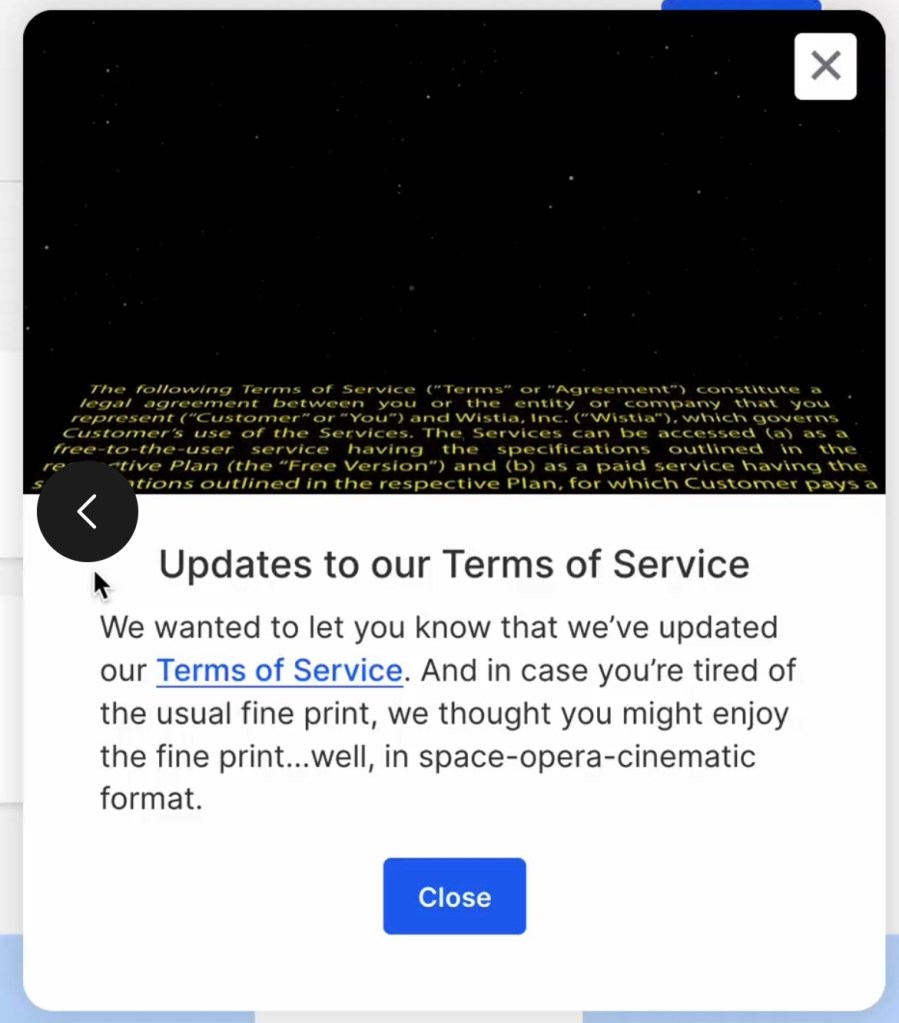
Most things are boring.
Like Terms of Service.
That doesn’t mean you can’t have fun while doing them. Or be proud of them. Or make somebody enjoy them.
The guys at Wistia know this well.



A positioning statement is not for everybody.
It’s supposed to divide, in order to conquer. It’s supposed to draw a clear line between trite practices and a new way. It’s supposed to be met with opposition, disdain, surprise, resistance – first of all, from those who are supposed to approve and support it.
If a positioning statement does not do that, it’s not a positioning statement.
This IS a positioning statement.
Love it or hate it. That’s the whole point.

If you are going to interview for a startup, between 30 and 100 employees, spend your focus probing one thing: what is the role of the founders?
That’s a critical phase for a founder to change their role: from guiding force to supporting resource. All the energy, the motivation, the knowledge, the urge that has led the founders to start the company needs to be passed over for it to scale, and the only way to do that is if the founders are capable to take a supporting role and let go of things, responsibilities, decisions.
It’s not really a matter of roles or of titles, but a matter of attitude. Look at three things.
It’s important, because when founders act as a support to a growing company, it can be a beautiful opportunity. When they aim at retaining control, instead, well that’s not for everybody.

I started posting on this blog almost exactly four years ago. And with one exception only, I have posted every day since then.
So, how do you make resolutions that stick and that become habits?
There’s no magic, and if you have already cracked your code, no need to go looking for something else.
If you haven’t though, here you can read about the importance of not waiting, here you can read about how to make strong resolutions, and here you can read about how to make even stronger resolutions.
Happy 2023, my fifth year of blogging.

Many restaurants claim the serve Italian food. Few actually do.
Many managers claim they give freedom to their employees. Few actually do.
Many start-up claim they are out to change the world. Few actually do.
Many people claim they are the best in their field. Few actually are.
Many influencers claim they have influence over their audience. Few actually do.
As it turns out, the more you claim, the less you do.
 You've got this