You choose to lie

It is possible, some would say even easy, to lie when you advertise something. When all you care about is getting few more clicks, a bunch more registrations, a bump in your growth line.

There are different types of lie.

The first type of lie is the one that promises. “Buy this and you can be this”, “Register to our webinar and you will find your path”, “Become a pro in few steps”. It is a pretty common strategy, not inherently bad, and it becomes a lie when the promise is simply too much to deliver for what you have to offer.
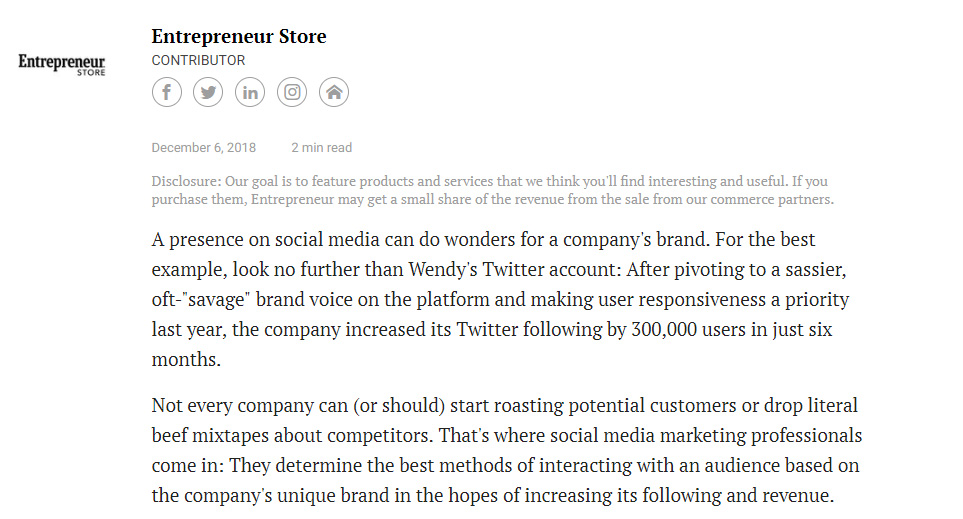
The second type of lie is the one that misdirects. Wendy’s did not get 300,000 more followers on Twitter after their social media marketing people attended the promoted course. Not to mention that, without context, we do not really know if those 300,000 more followers were or were not a good thing for the company.

The third type of lie is the one that seeks approval. 508 people rewarded this course with 5 stars out of 5 (in average). Of course, there is not way to read the reviews, or the feedback given by any of the 508 people. Be it enough for us to know that’s the case.

It is indeed easy to lie when you advertise something. Is it worth it? Does it get you to where you want to be at the end of the game? That is a whole different matter, one that should get most of your attention.
Do you have anything to say?

Few things you might want to consider if you have something important to communicate inside your organisation over a certain amount of time. It might be a project, a change, a new tool, an improved process, a different structure.

First of all, be ready to reiterate the message. Do not expect everybody to be on the same page after you have sent out an email or updated the internal communication tool. It will take time, so prepare to have something to say about it in different occasions.

And (secondly), prepare to do so on different types of media. People absorb information in different ways. Some prefer to read, some to watch a video, some to watch an infographic. With modern tools, it is very easy to be creative in many forms, make sure you are considering the various ways you can reach your audience with.

Thirdly, pace your communication with a schedule. It’s not ideal to receive 27 notifications from you in 1 single day. As you are working on something that will take time, you should factor time in. What do you have to say today? What this week? What this month? What next month? After all, you’ll have different formats and occasions to talk about what you care, do not overload everybody on the starting line.

Finally, ensure some kind of space for feedback. Communication is never one way, as you progress in your journey, people will have things to say, questions to ask, doubts to raise. Set up occasions for this to happen, and be ready to follow up on what is said. Wait there: “follow up” does not mean “change your plans according to (what is said)”, I hope we are clear on that.

And since a couple of interesting words have (fortunately) crept in the paragraphs above, before you even start make sure you have very clear who your audience is (the whole company? for real?), and what the message you want them to get is (probably, not just how things are going with this or that).

Good luck!

A beautiful note

The way you treat people that gravitate around your business is as important as the way you treat people that are at the core of it.

This below costs nothing, is caring and generous. It is beautiful, and tells a lot about how this company does work.

We are all main characters …

… to our own story.

And yet, there’s a tendency to read too much in the actions of others. As if they are mere extras in our lives, their only purpose being confirming (or more often denying) what we feel about ourselves or the way we’d like to be perceived. 

When we realise that others are the main characters to their lives, just as much as we are to our own, we understand that when they act, they do so most likely because of something that is happening to them. Not because of us, the way we are, the things we do.

If we are in doubt, we could be humble and ask.

Did you do this because of that?
Was that what you meant when you said this?
Can you explain why you acted like that?

More often than not, we’ll get confirmation that our script – the one in which they are trying to get ahead of us or stab us in the back – is just one of the millions of scripts that run in parallel in the world.

Marketing problems

I have worked with start-ups and SMEs for most of my career (about 14 years now), and up to this day, it is difficult for me to explain why there is a general lack of interest towards marketing in these contexts.

There is plenty of evidence out there that tells that startups often fail for reasons that good marketing would address. Be it focusing on building the product/service and not the customer, lack of market need and pricing issues, product market fit or plainly bad marketing.

Perhaps the most reasonable explanation for why this is happening is that people still equate marketing to advertising. If you fall into this trap, it’s easy to believe that marketing is something to take care of only once you get traction (i.e. you have cash).

In one of his most recent posts, Seth Godin suggests a list to understand what a marketing problem looks like.

. There are people who would benefit from your work who aren’t engaging with you.
. There’s a change you seek to make in the culture, but it’s not happening.
. You’re having difficulty persuading other people of your point of view.
. The service or product you make isn’t resonating with those you seek to serve.
. You’re fighting in a race to the bottom, and it’s wearing you out.

Seth Godin

I would add:

  • The story people tell about you is not the story you tell about yourself.

Be sure to give these issues a thought if you are starting something important, and be sure to have somebody close to you who can help you investigating a solution. Marketing has moved a long way past advertising, and continuing promoting that false equation will just drive your enterprise into one of the future articles about why startups fail.