I am not here for that

When I moved to Finland seven years (and some months) ago, I did that primarily to find a better quality of life for my future family.

Throughout the years, particularly during the two long periods (about 10 months at the beginning and 12 months more recently) during which I have struggled to find a job, I had to remind myself of this quite many times.

The reason why I am here is NOT professional.

There is some debate these days about how difficult it is for foreigners to find a job in this country. Indeed, if you do not speak Finnish, or if you don’t have good connections, or if you do not know how the job industry works here (for example, in terms of being bold in your applications vs being honest), it is quite the challenge to be employed. Sometimes, accepting a job below your education level will help, sometimes it won’t.

The reason why I am bringing this up, even though it might seem like a local issue, is that we often define ourselves, our lives, our satisfaction in terms of the job we have. For good reasons, of course, but we should be more careful about that.

People do not come to Finland because of its amazing economy, the infinite professional possibilities the country has to offer, the openness of its society.

People come to Finland because schools are excellent and education is free, because the work culture permits to go home at 16.00 without feeling guilty, because there is a well-maintained playground in every courtyard, because public transportation can reliably take you basically everywhere you need to go, because of its stunning nature, some also because they enjoy spending winters under 60 centimetres of snow.

We should refocus the way we think about life and satisfaction. Having a job is important, but it does not end there. If, for any reason, it does instead, then unfortunately Finland is not the best option on your list. And I am sure it’s their loss.

Bias

It takes mental effort to identify our own bias.

Few months ago, I was putting together a presentation about Coaching and Leadership. I wanted to have one slide to stimulate some discussion, and I wanted to ask people in the audience to describe leadership with one single word.

Along with the question, the slide was supposed to feature a collage of known leaders. To my dismay, I quickly realised I was victim to bias. The first few names that came to mind were (in order) Steve Job, Mark Zuckerberg, Barack Obama and Jack Welch. All male. All American.

I could have certainly stuck with those, and probably nobody would have complained. Yet, as I knew by then I was biased, I forced myself to do a better research (both in my memory and on the Internet), and eventually came up with the following collage.

Leadership-bias

It was great to do that. Not only because I had a far better depiction of what a leader is and might be, but also because I had the chance to identify bias at work. At least, a certain type of bias. Perhaps next time, this list will come more naturally. And perhaps, I will be able to identify similar bias in other situations more easily.

By the way, in case you are wondering who some of the leaders in the collage are, here is the full list (from top left).

Perfect

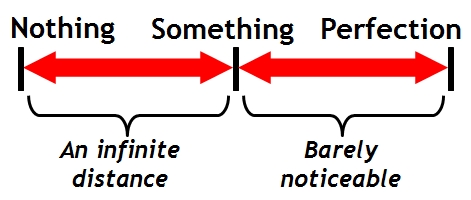
This week, I have found this beautiful graphic depiction of how resistance works at times.

Do-Something-Ed-Batista

It’s from Ed Batista’s blog (that is strongly recommended, by the way), and it displays how it is incredibly more important to move from doing nothing to doing something, than it is to move from doing something to doing something perfect.

The greatest of intentions pale in comparison to the smallest of actions.

Noah Lomax

Very often, we get stuck in search of perfection. That is useless, as most of the time the difference between something and something perfect is barely noticeable. I like to represent it slightly differently with the following chart.

Do-Something

The fact is, perfection is often an excuse do escape doing. It’s been for me for years, it still is sometimes. But eventually, we’ll have to stop hiding and start shipping stuff that is As Close to Necessary to Perfect. Make a habit of it, it’ll be liberating.

There’s always a reason

Why are things the way they are?

This is a question we often fail to ask. Yet it is so important to address that before we even attempt change.

Is there something I am not seeing? Is the current situation serving somebody’s purpose? What would the reaction be if I would change that? What is the type of behaviour I should expect once the change has been implemented? Have I talked and listened to people that are involved? Did I consider the different aspects that have contributed in building the context?

Clearly, it is a thin line between asking and remaining stuck. We need to know when we have enough information to take a considerate decision about moving forward (or not). And asking that question will help us being more thoughtful and kind towards those who will see the change as a threat.


Exceptions and rules

If a customer (or a potential one) shows up with a request that is not in line with your procedures, processes, habits, or even product or service, the generous thing to do is to make an exception.

If that requests gets asked more and more, than you have two options.

Change your procedures, processes, habits, product or service to incorporate the request. You invest time and energy in making a change, as you see that the customers that are asking for it are the ones you want to serve.

Or you say, “thanks, but that’s not what we do.” Not all customers are your customers after all, so it is ok to decide that those asking for that additional feature are not the ones you want to serve.

There’s actually a third option, one you should avoid, the worst one. Not do anything. Keep getting the request, leaving its satisfaction to the moment, juggling about without any clear indication if that’s something that belongs to you or not.

This wastes your time and that of your customers, and time is not something anybody has to spare.