I am not here for that

When I moved to Finland seven years (and some months) ago, I did that primarily to find a better quality of life for my future family.

Throughout the years, particularly during the two long periods (about 10 months at the beginning and 12 months more recently) during which I have struggled to find a job, I had to remind myself of this quite many times.

The reason why I am here is NOT professional.

There is some debate these days about how difficult it is for foreigners to find a job in this country. Indeed, if you do not speak Finnish, or if you don’t have good connections, or if you do not know how the job industry works here (for example, in terms of being bold in your applications vs being honest), it is quite the challenge to be employed. Sometimes, accepting a job below your education level will help, sometimes it won’t.

The reason why I am bringing this up, even though it might seem like a local issue, is that we often define ourselves, our lives, our satisfaction in terms of the job we have. For good reasons, of course, but we should be more careful about that.

People do not come to Finland because of its amazing economy, the infinite professional possibilities the country has to offer, the openness of its society.

People come to Finland because schools are excellent and education is free, because the work culture permits to go home at 16.00 without feeling guilty, because there is a well-maintained playground in every courtyard, because public transportation can reliably take you basically everywhere you need to go, because of its stunning nature, some also because they enjoy spending winters under 60 centimetres of snow.

We should refocus the way we think about life and satisfaction. Having a job is important, but it does not end there. If, for any reason, it does instead, then unfortunately Finland is not the best option on your list. And I am sure it’s their loss.
Bias

It takes mental effort to identify our own bias.

Few months ago, I was putting together a presentation about Coaching and Leadership. I wanted to have one slide to stimulate some discussion, and I wanted to ask people in the audience to describe leadership with one single word.

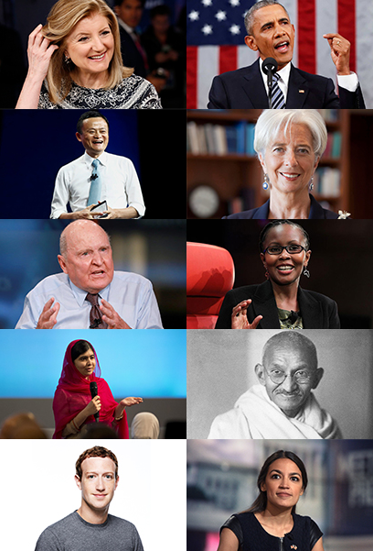
Along with the question, the slide was supposed to feature a collage of known leaders. To my dismay, I quickly realised I was victim to bias. The first few names that came to mind were (in order) Steve Job, Mark Zuckerberg, Barack Obama and Jack Welch. All male. All American.

I could have certainly stuck with those, and probably nobody would have complained. Yet, as I knew by then I was biased, I forced myself to do a better research (both in my memory and on the Internet), and eventually came up with the following collage.

Leadership-bias

It was great to do that. Not only because I had a far better depiction of what a leader is and might be, but also because I had the chance to identify bias at work. At least, a certain type of bias. Perhaps next time, this list will come more naturally. And perhaps, I will be able to identify similar bias in other situations more easily.

By the way, in case you are wondering who some of the leaders in the collage are, here is the full list (from top left).

Perfect

This week, I have found this beautiful graphic depiction of how resistance works at times.

Do-Something-Ed-Batista

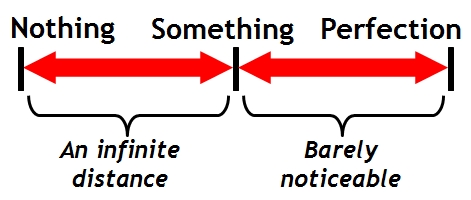
It’s from Ed Batista’s blog (that is strongly recommended, by the way), and it displays how it is incredibly more important to move from doing nothing to doing something, than it is to move from doing something to doing something perfect.

The greatest of intentions pale in comparison to the smallest of actions.

Noah Lomax

Very often, we get stuck in search of perfection. That is useless, as most of the time the difference between something and something perfect is barely noticeable. I like to represent it slightly differently with the following chart.

Do-Something

The fact is, perfection is often an excuse do escape doing. It’s been for me for years, it still is sometimes. But eventually, we’ll have to stop hiding and start shipping stuff that is As Close to Necessary to Perfect. Make a habit of it, it’ll be liberating.

Happiness and satisfaction

Last year, I had the chance to finally read Thinking, Fast and Slow, by Daniel Kahneman. It is a wonderful book about how our mind works, and I will at some point share my notes about it on this blog.

One of the most fascinating ideas by Kahneman is the distinction between happiness and satisfaction – or between experience and memory (as presented in his must-watch TedTalk).

We often worry about being happy, but according to Kahneman we first need to agree on what happiness is. Happiness is a short-term, experiential concept. We can be happy (or unhappy) as we live in the moment. But as we move past it (and this happens quite fast), what really matters is the memory we have of the experience. That is, in a way, a more complex idea. It has to do with the experience itself, particularly with how it ended (on a positive vs on a negative note), but it also has to do with the story we tell about the experience, the way we elaborate what happened and we fit it in the broader story of our life.

Happiness feels good in the moment. What you’re left with are your memories. And that’s a very striking thing — that memories stay with you, and the reality of life is gone in an instant. So memory has a disproportionate weight because it’s with us. It’s the only thing we get to keep.

Daniel Kahneman, in Conversations with Tyler

I find this to be extremely fascinating. My opinion is that it represents a clear shift of responsibility from the external and experiential world to the internal and narrative self.

We all have a story. A story of who we are and who we are not, of who we want to be and of how we are getting there. This story would help pick situations and contexts that align with the broader narrative.

So that, for example, if I think of myself as a considerate and careful father and husband, I would probably try to avoid situations that would have me end up drunk and naked in public.

But also, and probably more importantly, the main story arc of our life could be an anchoring frame for experiences and circumstances that go beyond our will. When something good or bad happens to us, that is not a result of our choices, I feel we can elaborate it so that it better fits with the view we have of our lives. And in doing that, we increase our general degree of satisfaction.

The same considerate and careful father and husband that is stuck in a job he does not like, for example, could frame the situation as a way to provide for his family, as well as spend time with his kids and wife without additional job-related worries (instead of beating himself up because he needs to find a better job to match a view of himself as an ambitious and career-driven professional, that is clearly not primary in his life).


About entrepreneurship

Entrepreneurship is overrated. And it is underestimated.

Wanting to be an entrepreneur is great. But.

Don’t be one if you want more freedom. Being an entrepreneur does not mean being free, you still have to abide to quite many written and unwritten rules. And eventually, many entrepreneurs feel that they are slave to their work, much more than employees often do.

Don’t be one if you want more time. I don’t even know why this is still a myth, but people actually say that. You will work 24/7. Making your own day does not mean that you will be home every evening by 18 to spend time with the kids and that you will have two days a week to dedicate to family and hobbies. Your work is your family, your hobby, your only thing.

Don’t be one if you want to be rich or successful. We only read the stories of (and idolize) those who make it, and of course we want to walk in the path they cleared. Truth is, most entrepreneurs fail. And fail again. And again. Without ever seeing an inch of success.

Don’t be one if you are tight financially. This links to the paragraph above. Even in the remote scenario your company will be actually successful and profitable, and you can pay yourself and your people a honest and decent salary, you will be personally busted before that happen if when you start you do not have a solid financial basis.

I understand this might sound harsh, yet if there is something I heartily hope for everybody is to do things mindfully. To actually look at their own situation and decide, for themselves, without the influence of some idle stereotypes, what they can and want to do.

Being entrepreneurial does not have to necessarily translate into being an entrepreneur. There are plenty of works out there that demand entrepreneurial skills, and at the same time give a solid salary, chances for success, acceptable work-life balance and the freedom to take responsibility over your work.

Be ready and make your choice.