Self-development time

Most companies allow employees to allocate time for self-development. In some cases, you can use up to 20% of your time (1 day per week) for that. You won’t probably get much guidance on the development path, and I don’t see your boss complaining if you forfeit that time and decide to finish a couple of tasks and answer a bunch of emails (they should complain – if you stop developing, it is bad for them too).

For this reason, you need to be ruthless with self-development. Make it a regular appointment on your calendar (mine is on Friday morning), and defend it. Decide what you want to learn, register to an online course, or collect some material, and then take that time, just do it. At the end of the day, you will feel much more accomplished: you will feel better with yourself, your work, your company and everything else.

Shifting attitude

Everyone who is involved in a business, has the interest of the business at the top of their mind.

Of course, this is rarely 100% true. And yet, we should assume it is, and act as if. This would open us up for opportunity. Instead of spending our time trying to second guess others and protect our position against invisible threats, we could approach things from different perspectives, learn something about our colleagues, their work, their priorities and how they believe the business should move forward.

It’s a shift in attitude that would greatly enrich our view. It is worth making.

By the way, if you replace “business” with “family”, “friendship”, “community”, “team”, “neighbourhood”, and so on, it still works.

Associations

A while back, somebody asked me to introduce their start-up to a friend of mine who is also a successful entrepreneur and investor.

I did not do it.

Not out of spite or malice, simply because I did not trust the idea, the people, the business model enough to attach my name to it in front of a person I trust and think highly of. A person that has helped me develop professionally and that I am sure will be there if and when I need it.

Plenty of people believe that being an advisor, a board member, a promoter, an advocate is something to stuff in a curriculum or on the LinkedIn profile. Yet I believe you have to be mindful about what you associate your name with.

The key question for me is: is this idea something I would gladly promote if there would be nothing in it for me? Most often than not, you’ll find the answer is no. And then, better move on in search of something that really matters.

There’s a time for everything

In the past, we used to go the office from 9 to 5. Most had very little responsibilities, as they were told what to do. Our professional life was figured out at graduation (for some, even earlier), and the personal life was fairly standard for the majority of people. We were closely in touch with our colleagues, friends and family, and the number of acquaintances was quite low. The most we got into an argument was probably once a year, perhaps at Christmas over some sport-related topic.

Today our lives are infinitely more fluid. Personal and professional are mixed. We answer work emails while we sit on the sofa close to our dear one, watching the latest episode of True Detective. At the same time we have an ongoing conversation on Instagram with a friend we have not met since high school, and we are arguing on Twitter on who is the best Democratic candidate for 2020. We are acquainted to many more people than we are closely in touch with, and we are constantly asked to make decisions, take responsibilities, change who we are and the context in which we live.

In this scenario, we have to be careful to pick only the battles that make sense for us in a specific period, as we cannot deplete our mental and physical energy on many different fronts simultaneously. Chances are that if you are going through a divorce, or having a kid, or moving to a new town, you will not be able to give your best at work or to come up with the ultimate idea for your next novel. The opposite is true as well.

The bad news is, there’s not time for everything.

The good news is, there’s a time for everything.

Despite what the sense of urgency that is imposed on us for any little unimportant thing, if we can discern what really matters and give it our attention to the highest possible level, we’ll eventually get it done and be able to pass on to what’s next. And of course, we need to be able to say a whole lot of “no, thanks”. Some things are simply not for us. It is ok to be able to say it out loud.

Distracted

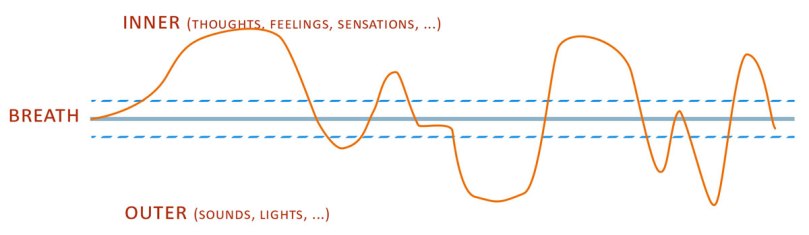
A typical meditation session looks something like the following.
fabrizio-trotti-blog-meditation

You set out to meditate, and you begin by putting your attention on your focus (breath in my case, for some it’s a mantra, or the body, or something else).

Very soon, a distraction appears. This might be something coming from within you, for example a thought (“I’ll do this after I am done”, “Why did I say something so stupid?”, “What am I going to do about that?”), a feeling (tiredness, sadness, anger, disappointment, hunger, thirst), a sensation (“My back hurts”, “My foot is sore”, “The cat is on my lap”, “The sun is warm today”). Or something that comes from the outside world, for example your phone ringing, somebody suddenly switching the light on, your kids shouting your name as the episode of their favorite cartoon series has ended and the new one does not start automatically.

Some distractions are stronger, some are weaker. Some are longer, some are shorter. Eventually, what you are supposed to do is to gently acknowledge the distraction, letting it go, and go back to the source of attention, your focus.

If you think about it, this is something that happens everytime we set out to do anything. Even if we are very careful managing our attention (for example by sitting without our phone in view, or by chosing to work from a library), distractions will happen. All the time. The quality of what you do and the amount of time you spend doing it depends on how good you will become at acknowledging the distraction, letting it go and going back. And meditation is an excellent exercise.

In meditation and in our daily lives there are three qualities that we can nurture, cultivate, and bring out. We already possess these, but they can be ripened: precision, gentleness, and the ability to let go.

Pema Chödrön