Patches

Many organisations mistake customer centricity for customer support or customer success.

Yet, having the customer at the core of what you do is not about being there when they need help and collecting high scores on a satisfaction survey. It is actually more about aiming at getting rid of those things, because when the customer is embedded in the business, you know already if they need help and when, whether they are happy or not, what they want to see in the product next and how their businesses are developing.

You actually know, in many cases, before they do.

So, instead of putting patches on the relationship with those who determine your (organisation’s) success, start investing time and resources in crafting the relationship. Listen. The rest will follow.
Simplify

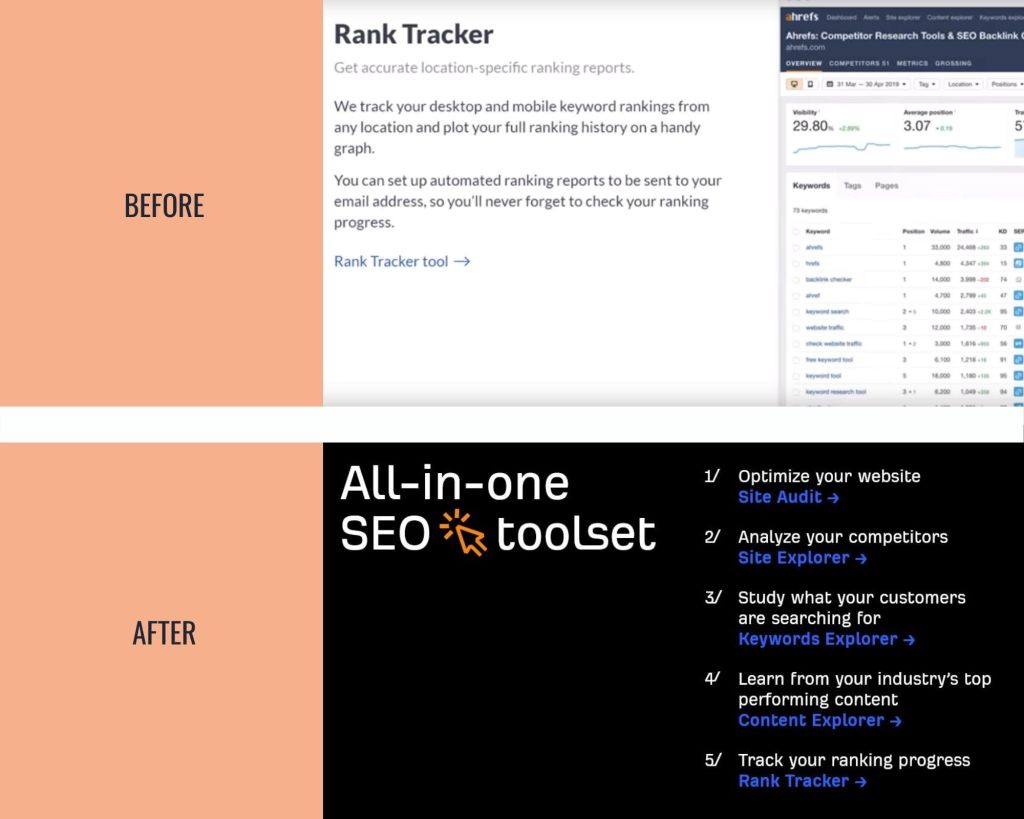
This is a very well crafted video that tells of how ahrefs went about redesigning their home page.

It is about the company, but it is not about the product. It is something the target audience wants to know about (web page redesign). It has a twist right at the beginning (the 3 copywriters) that makes sticking around until the end more likely.

And by the way, if you plan to redesign your website, three questions worth asking.

1. When do we show the product? It is a fairly common practice in B2B to feature loads of videos and screenshots on the website, but as the guys at ahrefs realised, perhaps opening the home page with a hero screenshot of a dashboard might put off many visitors who are just problem-aware.

2. How much information is enough? Getting lost in details is easy, and getting lost trying to expres details is even easier. A waste of space and attention, so just stick to what is needed to catch the interest of your target audience.

3. How long should a A/B test be? For many things, measuring the real impact on business metrics takes time. A/B testing in 1-2 week-long sprints is probably focusing on the wrong metrics. Marketing is a long A/B test.

Do not bother asking

If at the end of a fairly long and ambiguos onboarding, you are displayed the following message, chances are you are going to abandon the product and never come back.

Of course, there’s the fact that automatically charging the customer’s credit card after a free trial period is a truly bad practice, and a way to signal you do not trust they would subscribe otherwise.

And there’s also a bigger failure, a messaging failure. Details are presented in a long, complex, repetitive way. A way that does not belong in an onboarding. Because what it says is not “trust us!”, but rather “no refund after the trial, even if you are no longer interested, so do not bother asking!”

What if, instead ..

Your own program is ready!

We are offering a 7-day free trial, that should give you plenty of time to complete your first lessons and get going.

After that, the cost of your own learning program is €9,99 per month (charged automatically to your Google Play account).

You can cancel anytime by following the instructions in the app, and we will send you a reminder before charging your credit card for the first time, to make sure you really want to continue. No surprises!

Get started!

Say it isn’t so

I have always been fascinated and vaguely astonished by the fact that, at times, communication is successful.

We do not put enough emphasis and preparation into it, and we have so many different ways to look at the world and interpret it, that it is quite a thing that two persons can come together at some point and understand each other.

What is your mental image of a tree? Of a car? Of a house? Of course, with such physical objects we often get past the ambiguity. But what with more complex concepts?

What do you think when you hear about honesty? And productivity? And work-life balance? What is your intent when you use words such as “democrat” and “republican”, “conservative” and “progressive” and “liberal”, “capitalist” and “communist”?

I promise you, it is different from how the person sitting next to you thinks about them.

And so, why are we not training for better communication? Why is this not a matter taught in school? Why are we left growing up under the false impression that everyone around us understands what we mean? And shares our same set of assumptions and priorities?

Communication is unorganized chaos for the most part, and when it succeed it truly is a work of magic.

Mantra

This is a mantra worth reminding, as marketers seem to forget it all the time.

No one wants to hear about your product.

And there are beautiful examples of what can be achieved when this becomes an assumption underlying your content strategy.

It also works, by the way.