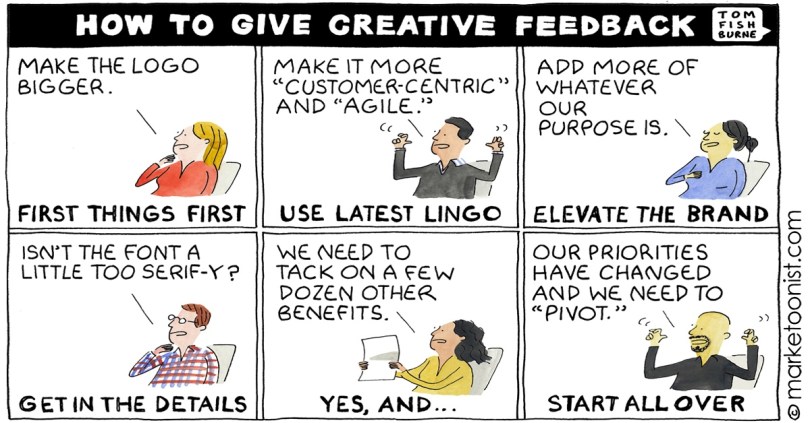
The committee

All great marketing was challenged. At some point, by someone.

And so, if everybody likes what the marketing team produces, they are probably on the wrong track.

The truth is, you don’t know what is going to work or what will be great. So never have a committee preemptively trying to determine that.

Image from Marketoonist.

Reconsider the system

If you miss your targets once, it’s good to try with more time, more resources, more of whatever you think was missing, without touching the system.

If you miss your targets consistently, then more is just going to be an excuse to delay something inevitable. You have to reconsider the system.

Responsibility avoidance

Companies have plenty of sacks of responsibility avoidance. They exist and grow in the space between two poorly designed processes, or between well designed processes that are way past their best before date.

In a way, it’s impossible to avoid. Companies will get to a point where, to a given issue, different people will answer systematically with: it’s not my responsibility.

But if you don’t leave enough space for those who care enough to actually do something about the issue, that’s where the real failure is.

The edge

A 3-step way to establish a new, healthy professional relationship.

Start with “here’s what we are dealing with”. Be thorough and fully honest. Unearth everything and establish authority by showing that you are not afraid to face facts.

Continue with “here’s what we are going to do about it”. Think in incremental steps rather than big reveals. Be detailed, put everything on a calendar, and use some system to assign responsibility.

Finish with “here’s what can go wrong”. No idea, plan, or project is flawless. And you know that many things can and will go wrong. Just put them out there, be on top of it.

Overcompensating

It’s tempting to set up a general rule to avoid a nuisance that is due to a few negative experiences. The problem is that the rule does not consider the vast majority of experiences that are positive, and therefore it ends up fixing an issue that, in most cases, is not an issue.

That’s the case of the employer setting up very rigid working hours because two people (out of tens or hundreds of employees) usually start working after lunch. What happens the next an employee is 10 minutes late? What if it’s their first time?

Overcompensating is rarely a good idea.