Perfect

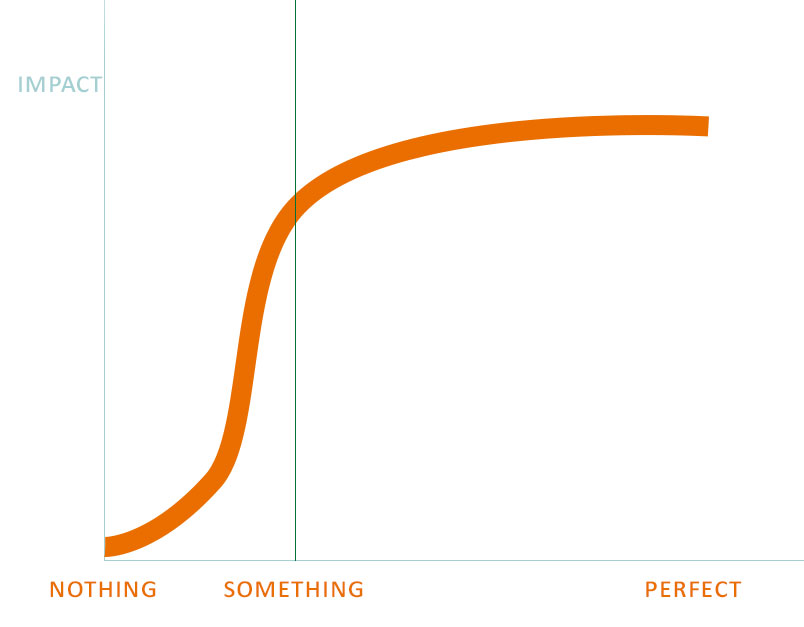
This week, I have found this beautiful graphic depiction of how resistance works at times.

Do-Something-Ed-Batista

It’s from Ed Batista’s blog (that is strongly recommended, by the way), and it displays how it is incredibly more important to move from doing nothing to doing something, than it is to move from doing something to doing something perfect.

The greatest of intentions pale in comparison to the smallest of actions.

Noah Lomax

Very often, we get stuck in search of perfection. That is useless, as most of the time the difference between something and something perfect is barely noticeable. I like to represent it slightly differently with the following chart.

Do-Something

The fact is, perfection is often an excuse do escape doing. It’s been for me for years, it still is sometimes. But eventually, we’ll have to stop hiding and start shipping stuff that is As Close to Necessary to Perfect. Make a habit of it, it’ll be liberating.

Happiness and satisfaction

Last year, I had the chance to finally read Thinking, Fast and Slow, by Daniel Kahneman. It is a wonderful book about how our mind works, and I will at some point share my notes about it on this blog.

One of the most fascinating ideas by Kahneman is the distinction between happiness and satisfaction – or between experience and memory (as presented in his must-watch TedTalk).

We often worry about being happy, but according to Kahneman we first need to agree on what happiness is. Happiness is a short-term, experiential concept. We can be happy (or unhappy) as we live in the moment. But as we move past it (and this happens quite fast), what really matters is the memory we have of the experience. That is, in a way, a more complex idea. It has to do with the experience itself, particularly with how it ended (on a positive vs on a negative note), but it also has to do with the story we tell about the experience, the way we elaborate what happened and we fit it in the broader story of our life.

Happiness feels good in the moment. What you’re left with are your memories. And that’s a very striking thing — that memories stay with you, and the reality of life is gone in an instant. So memory has a disproportionate weight because it’s with us. It’s the only thing we get to keep.

Daniel Kahneman, in Conversations with Tyler

I find this to be extremely fascinating. My opinion is that it represents a clear shift of responsibility from the external and experiential world to the internal and narrative self.

We all have a story. A story of who we are and who we are not, of who we want to be and of how we are getting there. This story would help pick situations and contexts that align with the broader narrative.

So that, for example, if I think of myself as a considerate and careful father and husband, I would probably try to avoid situations that would have me end up drunk and naked in public.

But also, and probably more importantly, the main story arc of our life could be an anchoring frame for experiences and circumstances that go beyond our will. When something good or bad happens to us, that is not a result of our choices, I feel we can elaborate it so that it better fits with the view we have of our lives. And in doing that, we increase our general degree of satisfaction.

The same considerate and careful father and husband that is stuck in a job he does not like, for example, could frame the situation as a way to provide for his family, as well as spend time with his kids and wife without additional job-related worries (instead of beating himself up because he needs to find a better job to match a view of himself as an ambitious and career-driven professional, that is clearly not primary in his life).



Promises

We all make promises. Sometimes we say we will do something, other it’s just the mere fact that we are in a certain position that “promises” we will act in certain ways and not in others.

Promises are extremely complicated. Once a promise is made, a pact is established. Nobody likes to be break pacts, yet it is a fact of every day life that most promises are not kept. We forget about them, we do not have time to actually stand by them, we change our mind, we probably did not intend to commit in the first place but thought it was nice or appropriate in the moment.

I found few things to help when it comes to promises and acting on one’s words.

Promise little. Wanting to please people around us is normal, and so we tend to say we will do things even when we already know we don’t have enough time or energy, we don’t really care, we have not the skills to, and so on. Be honest with yourself in the first place, and promise only what you know you can deliver.

Be specific with the promise. Tell what you will do, how, when, with whom, add as many details as you possibly can. This will help you set a plan in your mind that will eventually make it easier to stick to your word. This is particularly helpful also when the promise is done because of the position you are in: if you start in a lead role, it is for example very useful to sit down with the people you will lead and set clear expectations about your role.

Remember and do. This is the tricky bit. Promising little will help you remember, and being specific will help you with doing. Yet eventually, you will still have to follow up on the promise. Doing it is ideal, yet if for any reason you realise you can’t, you will still have to openly and candidly tell something like: “I know I said I would, and for this and that reason it is not possible right now”.

About entrepreneurship

Entrepreneurship is overrated. And it is underestimated.

Wanting to be an entrepreneur is great. But.

Don’t be one if you want more freedom. Being an entrepreneur does not mean being free, you still have to abide to quite many written and unwritten rules. And eventually, many entrepreneurs feel that they are slave to their work, much more than employees often do.

Don’t be one if you want more time. I don’t even know why this is still a myth, but people actually say that. You will work 24/7. Making your own day does not mean that you will be home every evening by 18 to spend time with the kids and that you will have two days a week to dedicate to family and hobbies. Your work is your family, your hobby, your only thing.

Don’t be one if you want to be rich or successful. We only read the stories of (and idolize) those who make it, and of course we want to walk in the path they cleared. Truth is, most entrepreneurs fail. And fail again. And again. Without ever seeing an inch of success.

Don’t be one if you are tight financially. This links to the paragraph above. Even in the remote scenario your company will be actually successful and profitable, and you can pay yourself and your people a honest and decent salary, you will be personally busted before that happen if when you start you do not have a solid financial basis.

I understand this might sound harsh, yet if there is something I heartily hope for everybody is to do things mindfully. To actually look at their own situation and decide, for themselves, without the influence of some idle stereotypes, what they can and want to do.

Being entrepreneurial does not have to necessarily translate into being an entrepreneur. There are plenty of works out there that demand entrepreneurial skills, and at the same time give a solid salary, chances for success, acceptable work-life balance and the freedom to take responsibility over your work.

Be ready and make your choice.


There’s always a reason

Why are things the way they are?

This is a question we often fail to ask. Yet it is so important to address that before we even attempt change.

Is there something I am not seeing? Is the current situation serving somebody’s purpose? What would the reaction be if I would change that? What is the type of behaviour I should expect once the change has been implemented? Have I talked and listened to people that are involved? Did I consider the different aspects that have contributed in building the context?

Clearly, it is a thin line between asking and remaining stuck. We need to know when we have enough information to take a considerate decision about moving forward (or not). And asking that question will help us being more thoughtful and kind towards those who will see the change as a threat.