Details matter

Details matter. Nowadays more than ever.

Particularly in marketing, in content marketing, details are a big part of the story your brand wishes to tell. It is difficult to fake details, and so they end up being the best representation of what an organisation stands for. They are what you do when nobody is watching.

Details set the tone for the conversation with your audience, they are how others look at you and remember you. And equally important, they are what makes you feel better about the work you do.

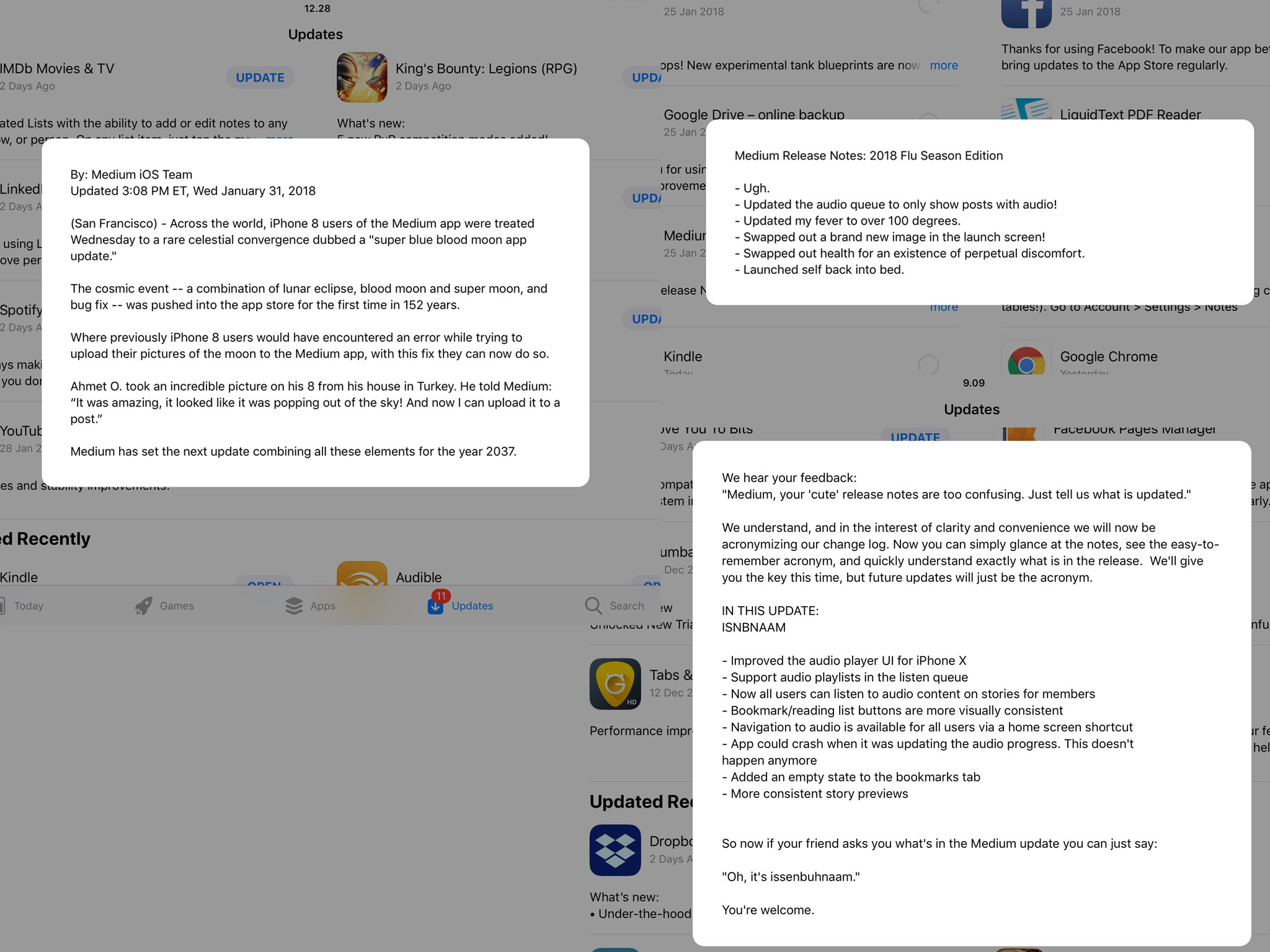
This is why I stop in awe when I see examples such as these.

Velocity-Partners-Email-Subscribtion
Velocity Partners – Mailing List Subscription
Medium-App-Store-Release-Notes
Medium.com – App Store Release Notes

Leave some empty space

We used to have three hangers on the wall of our hallway, mainly to hang the kids’ outdoor clothes. We soon realized they were not enough, as some of the clothes inevitably ended up on the floor. We added two, and yet a jacket or some outdoor trousers were still continuosly out of place. We now have seven (and a wicker basket), and you can imagine it is still tricky to walk in our hallway without stepping on a hat, a pair of gloves or a reflective vest (very much needed during the dark winters in Finland).

The fact is, we tend to fill the space we are given. In an unusual application of Parkinson’s law, if we have an additional room, we end up buying more stuff to put into it. Similarly, if we are given more and unexpected time, we probably end up wasting it with activities we would not have done otherwise (social media, anyone?); and if an organization is gifted with growth, it most likely invests it in achieving even more growth (more personnel, more offices, more complexity).

What if, instead, we would leave some empty spaces in our lives? What if the next time we have five extra minutes before the following appointment, we just sit down and think? What if we say no to that customer, or to expanding to a new market, or to launching yet another product line, so that the people that are already in can actually enjoy the moment of success?

Would that be so dramatic? Or would we be more rested, prepared and galvanized for what comes next?

The practice of empathy

A while back, I have written about empathy and about how it is not something that comes natural to most people (me included).

But what does empathy look like in practice?

It is certainly not to feel sorrow for someone’s issues. When we do, we tend to approach the relationship from a position of strength, it is kind of a top-down feeling. We do not really empathize with the other person, as we are not in the same “frame of reference”. Feeling sorry is more sympathy or compassion, and as Brené Brown brilliantly puts it, it is not something someone who is in trouble wants to receive.

Empathy is also not giving people a free pass for their problems. Again, this is an approach that assumes a position of power, and it is not fundamentally different from sympathy: we feel sorry for our colleague, and therefore we close an eye to the fact they are making a poor job.

Empathy is acknowledging the other person’s situation from a neutral, non judgemental position. In Ed Batista’s words, “we comprehend their perspective and emotions, and we are able to envision ourselves experiencing that perspective and those emotions under similar circumstances”.

And then, it is suspending our natural inclination to suggest a course of action, or give an advice to “fix” the situation based on our own experience. We stay there in their world, and we acknowledge it as it is. And if the time comes when it is expected of us to say something, paraphrasing a beautiful thought by Seth Godin, we do that from their own place.

When you have to do with somebody, you have no idea how many times this person has been kicked in the teeth. All you know is that they act in ways you would not. If you care about the outcome, the question is not ‘What would I do?’. The question is ‘If I had been exposed to what you have been exposed to, what story would resonate with me?’

It is possible to get better at empathy, and by doing that you will find you can establish more meaningful and stable connections. It is an investment worth doing.


Time

Time is limited and it is one of the most critical resources.

Contrary to money, that can be spent on multiple different things (when you have it), time is a trade-off matter. And for this reason, how it is invested is extremely important.

I do not have time to develop my team members. I am overworked and overwhelmed, there’s absolutely no chance I can dedicate time to that.

This is a perfectly possible and understable scenario. In the short-term, there might be more important things than a meaningful conversation, a career development discussion, a training to organise or a coaching session.

Or might they?

Consider the following:

  • Do you have time to answer all the questions?
  • Do you have time to take all the decisions?

If your people is not empowered and developed, most likely they will continue to come to you every time they have a doubt, a concern, a request. Every time there is a decision to make, important or not.

Of course, this is the best case scenario. The alternative would be that they’d simply ignore their questions and the needs for new decisions, and carry on with whatever it is that they are doing. Good or bad. Until they’ll leave, that will be rather sooner than later. And then:

  • Do you have time to keep hiring continuosly?

An apparently intelligible decision (I am now focusing on everything but developing my team) can lead to a counter-intuitive consequence (I only have time to answer to my team’s short-term needs).

What we spend time on, not only determines our priorities today, but will also determine our priorities tomorrow. To take control of both, it is worth spending some more time figuring out how our decisions are going to play out in the long-term. This is something worth making some space in your calendar for.

100 days of blogging

Today marks my 100th day of blogging. 100 consecutive days.

It’s just been a bit more than three months, and already I can identify some pretty good benefits from my practice.

First of all, I am getting better at fighting resistance. Resistance is with me basically every day I open the WordPress app on my PC, it is with me even before that. I have stopped listening to it. Even though a post is not the best possible I could write, even when I have no idea what I will blog about, even when I am tired and drained. I go on.

Then, I am less and less critical of what I write. This is, and will probably always be, a difficult balance to strike for me. I do not want to write shit, I want to make sure my thoughts are clear and digestible, and at the same time I need to not over worry about the content I am putting out here (if I’ll do, I’ll get stuck). So far, it worked.

And finally, my opinions and ideas are crystallizing. I have started writing things down few years back to make sure I could be more comfortable when speaking, for example before important conversations or meetings. Yet blogging every day allows me to clarify my thoughts on a wider range of topics, and this is something that I feel will continue to add up as I keep at it.

Very happy to have made it this far. Now, let’s go on.