On getting stuck

One week ago I got stuck.

I had 98 blog post published, and was about to write number 99. The night before, I had prepared a LinkedIn article to celebrate post number 100. I was quite proud of the result, and I felt on a roll with writing. I started thinking that perhaps I could regularly write longer articles, both on LinkedIn and Medium. Who knows, with a bit of luck I could also publish on some of the local webzines, just to have an additional outlet for the need to share my ideas.

And I got stuck.

It was the first time in more than three months writing every day I felt like I had a completely blank mind. No ideas. I started writing two or three times, on two or three different topics. Some paragraphs, I actually got a post almost complete, and then I realized it was not good enough. I deleted it and started from scratch. The blinking cursor was a terrible countdown.

I breathed. I remembered the reasons why I am doing this. And I took a break. I also told my wife I was stuck, and that helped elaborating the frustration and the dissappointed. After about twenty minutes, I went back to the computer and I wrote blog post number 99.

There are so many elements of resistance in this brief moment of panic. I had set an unimportant target that put pressure on me (the blog post 100 meant I could publish my first article on LinkedIn); suddenly, I had started overworrying about the quality of my posts, and of course I had immediately turned hypercritical (the deleted post would have probably been good enough on a different day); and eventually, my mind shut down completely, refusing to produce any idea to put into words.

These type of moments happen all the time you have to use consistently your brain to achieve something that matters. Be aware and kind to yourselves, and remember that more often than not, taking a deep breath and a break will get you unstuck.

100 days of blogging

Today marks my 100th day of blogging. 100 consecutive days.

It’s just been a bit more than three months, and already I can identify some pretty good benefits from my practice.

First of all, I am getting better at fighting resistance. Resistance is with me basically every day I open the WordPress app on my PC, it is with me even before that. I have stopped listening to it. Even though a post is not the best possible I could write, even when I have no idea what I will blog about, even when I am tired and drained. I go on.

Then, I am less and less critical of what I write. This is, and will probably always be, a difficult balance to strike for me. I do not want to write shit, I want to make sure my thoughts are clear and digestible, and at the same time I need to not over worry about the content I am putting out here (if I’ll do, I’ll get stuck). So far, it worked.

And finally, my opinions and ideas are crystallizing. I have started writing things down few years back to make sure I could be more comfortable when speaking, for example before important conversations or meetings. Yet blogging every day allows me to clarify my thoughts on a wider range of topics, and this is something that I feel will continue to add up as I keep at it.

Very happy to have made it this far. Now, let’s go on.


Back to the basics

A couple of old frameworks to help think about communication, at a moment when communication is everything and is greatly misunderstood.

First, the maxims of Grice.

Quality – Make your contribution one that is true.
Quantity – Make your contribution as informative as is required (no more).
Relevance – Make your contribution relevant, pertinent to the discussion.
Manner – Make your contribution clear, brief, orderly, avoid obscurity and ambiguity.

Then, the Buddhist four gates of speech.

Is what I have to say true?
Is what I have to say necessary?
Is what I am saying kind?
Is it the right time?

Writing, speaking, in general communicating without having these in mind generates weak and unaffecting communication.

Perfect

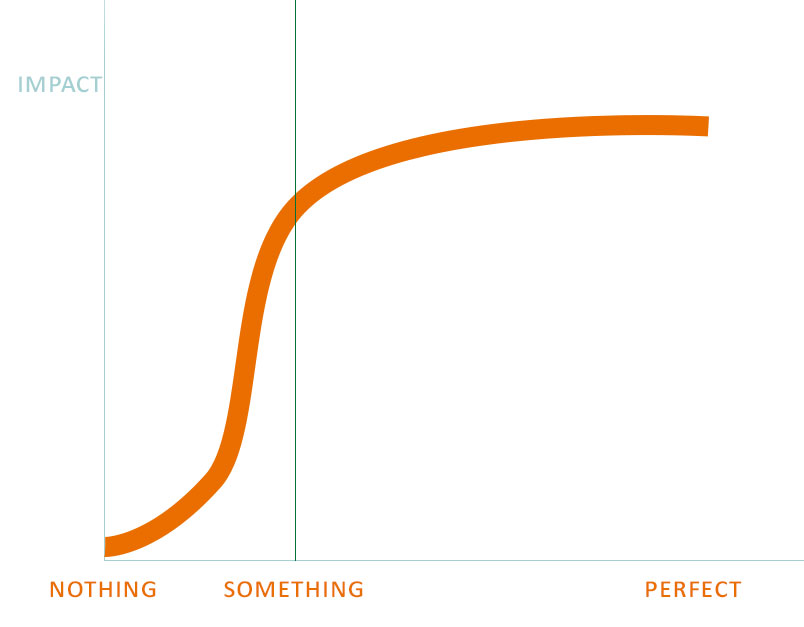
This week, I have found this beautiful graphic depiction of how resistance works at times.

Do-Something-Ed-Batista

It’s from Ed Batista’s blog (that is strongly recommended, by the way), and it displays how it is incredibly more important to move from doing nothing to doing something, than it is to move from doing something to doing something perfect.

The greatest of intentions pale in comparison to the smallest of actions.

Noah Lomax

Very often, we get stuck in search of perfection. That is useless, as most of the time the difference between something and something perfect is barely noticeable. I like to represent it slightly differently with the following chart.

Do-Something

The fact is, perfection is often an excuse do escape doing. It’s been for me for years, it still is sometimes. But eventually, we’ll have to stop hiding and start shipping stuff that is As Close to Necessary to Perfect. Make a habit of it, it’ll be liberating.

Write it down

If I am consistent enough this year and I stick to my resolution, by January next year this blog will have around 400 posts. That’s a lot of content, yet I am fairly positive that if there is one single idea you should take from this page, it is the following.

When you have something on your mind, write it down.

It might sound extreme, and I don’t mean you should write down everything that comes to your mind. Neither I am talking about to-do lists or grocery store items you need to remember next time you go to the shop.

If something sticks in your mind long enough to make it relevant for you, put it on paper (or on screen). It is valid with ideas, no matter how early stage they are. It is valid with impressions, feelings, talks, chats we want to have, changes we want to make.

When we keep things in our mind, they always make sense, as our brain automatically fills in any gap there might be to make it reasonable for us. This happens very fast, without us even noticing it. And it is dangerous, because when we eventually speak our mind, those gaps are not that easily filled with words and sensible concepts. They become chasms, and we fall into them.

Writing things down forces us to take an additional step. It not only makes space in our mind. It will also help us crystallize our thoughts, make it more likely we will take action (or not), and improve our chances to be successful with that action (or inaction).

Start here. Next time you have an important meeting, a conversation in which you want to deliver your point, a chat with a colleague you want to ask to change their mind. Write it down. Read it. Is it clear enough? What is missing? What else could you add? Write it again. Read it again. Repeat. Until you are ready.

It is one of the reasons why I re-started blogging after that long. And it’s the most important message I can leave behind.

Write it down.