Renewing trust

The automatic renewal feature, enabled by default in plans that seal an agreement between a service company and the final consumer, is not designed to improved the user experience.

Despite the bullshit about “continuity of service”, that particular feature is designed (and enabled by default) to leverage our tendency to forget, and therefore fictitiously increase the recurring revenue metric.

It feels like yet another instance in which companies that invest loads of money in second-guessing personalisation of marketing messages (ads, newsletters, offers, etc.), fail to design their services and operations in a personal way when it would actually be easy.

Hi there, we have noticed that your plan is expiring in 30 days.

We do not do automatic renewal, as we believe in how good our service is. And on this note, this is what we have done for you this past 11 months (*list of features that the user has used, articles the user has read, videos the user has watched, …).

We’d like to continue delivering this and more, and to renew we ask you to answer two questions on this online form (the questions being: Do you want to renew? Is your credit card still valid?).

On the other hand, if you decide not to continue with us, we respect your decision and hope to have you back soon. We would still like to know if it’s something we’ve done (link to online feedback for churn).

Thanks for being a valuable member of our community. For any question on renewals, just reply to this message or call us at xxx.xxxxxxx.

Have a wonderful day!

Marketing and social media

Gary Vaynerchuck often repeats that as a marketer, the only thing he cares about is where the attention of the people is.

This is something I very much respect. Marketers should not be in a personal relationship with any platform, tool, channel. They should care about finding ways to establish a connection with their audience. What Gary Vee says is particularly important in a World in which many marketers still think that they _NEED_ a Facebook page, an Instagram account or a Pinterest strategy.

But I am struggling more and more to distinguish my identity as a marketer and my identity as a (decent) human being.

So, what happens if the attention of the people is on a channel that is increasingly damaging shares of the population and of society?

It is not my intention to be paternalistic nor bigot in approaching such dilemma. I just want us to consider when we should start caring about the fact that our marketing money is feeding unhealthy behaviour, toxic and dangerous ecosystems or openly wrong actions.

I have no answers, unfortunately. Yet these are questions of growing importance for me.

Should we care? Probably yes.

Should our business targets make us blind towards this (or this)? Probably not.

Is there a way to be relevant marketing-wise if we remove the most popular tools a marketer has in this age and time? That deserves a lot more consideration, and I hope this blog will help me elaborate in that direction.

Emotions and rationality

If you are using emotional tools to address a rational problem, chances are you are going to struggle in the medium/long-term.

Say you are at a meeting discussing how many new hires you need for the next project. Since you know that hiring people, onboarding and training them is a lot of work, and you’d rather focus on something different, you leverage the fear of taking risks of your boss, throw some numbers in the air to make your point, and end up scoring a point. In the medium term, your team will be understaffed.

This is the same mechanism we are seeing at work with Brexit and most of the populism around the World. A real, concrete, rational problem (i.e. an increasing part of the population is being left behind) is addressed leveraging emotions (fear, anger, hatred). Good results in the short-term (Brexit was voted, many populists are being elected), but when it comes to putting together concrete acts to move past the feelings, not much can be done.

Something similar happens with the opposite. If one of your team members is struggling to share ideas and participate in team meetings (an emotional problem), and you decide that from now on meetings will feature a “let’s go around the table” moment (a rational tool), you will force the team member to speak, yet not necessarily get the best ideas out of them.

Facebook is in the process of understanding this very thing. In trying to cope with the spread of hate speech and inappropriate content on their platform (emotional problem), they have decided to ramp up the number of moderators and feed them 14,000 pages of instructions on what is acceptable and what is not (rational tool). Clearly, it is not working.

Beyond malice and opportunism, make sure you know on which level your problem is, and come up with a solution that speaks the same language. Your chances to make an impact and be trusted (forever?) will increase dramatically.

Why is AI assuming to know us?

The problem with Artificial Intelligence and Machine Learning, at the moment, is a problem of use, not of technology.

Companies mainly implement AI in their products and services to maximise economic results, and they fail (mostly) to actually deliver value to their users.

Take the advertising industry, for example. AI and ML are used by platforms to predict interests and needs based on data collected from your online behaviour. It is currently a widely inaccurate utilisation of the technology, that’s why you get exposed for months to ads from that site you visited once while you were researching your competitors for the next management meeting.

It is so because what currently matters is not that you get an ad that is relevant to you or that the advertisers message gets exposed to the correct audience. What matters, at this particular moment in history, is for the platforms to sell as many ads as they can. And since their competition is even less accurate or completely unmeasurable, they thrive with very little conversion rates while they make the rules they feel are more appropriate to achieve what they want.

Now, imagine a slightly different application of the same technology.

We have noticed that in past weeks, you have visited sites of car dealers. Would you like us to push some car offers from local dealers to your timeline?

You have visited this restaurant three times in the last month, would you like me to add it to your favourite restaurants in town? I could push some of their lunch offer to your inbox, if you want me to. Just tell me how frequently you’d like to receive them.

I see you’ve been at events about business and management in the past six months. Here are a bunch of groups you might be interested in. Also, there is a special deal on the Business and Management magazine if you subscribe by the end of the year. Do you want to take it?

Asking questions instead of assuming, is a great rule of thumb for interpersonal relationships. The same should be valid for interactions with a machine.

You choose to lie

It is possible, some would say even easy, to lie when you advertise something. When all you care about is getting few more clicks, a bunch more registrations, a bump in your growth line.

There are different types of lie.

The first type of lie is the one that promises. “Buy this and you can be this”, “Register to our webinar and you will find your path”, “Become a pro in few steps”. It is a pretty common strategy, not inherently bad, and it becomes a lie when the promise is simply too much to deliver for what you have to offer.

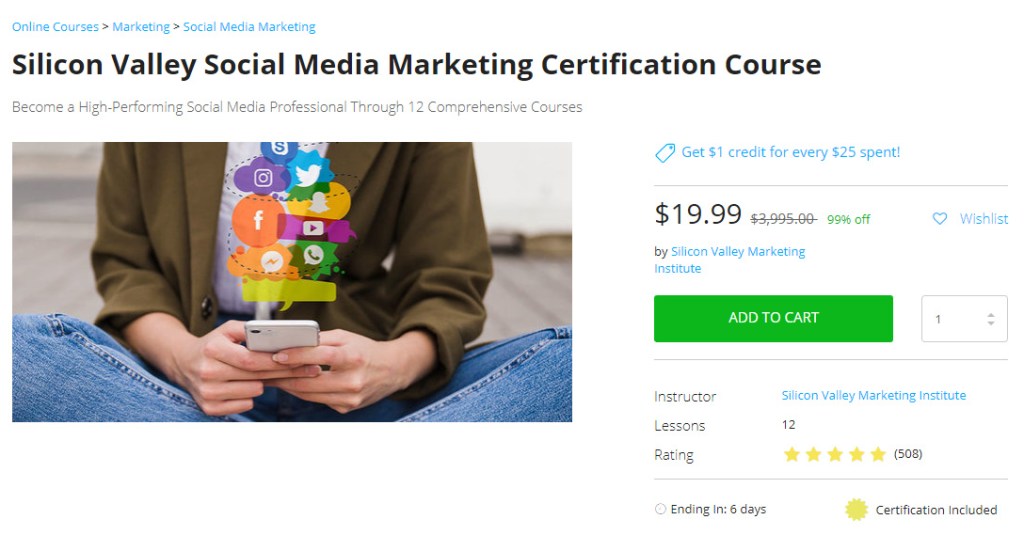
The second type of lie is the one that misdirects. Wendy’s did not get 300,000 more followers on Twitter after their social media marketing people attended the promoted course. Not to mention that, without context, we do not really know if those 300,000 more followers were or were not a good thing for the company.

The third type of lie is the one that seeks approval. 508 people rewarded this course with 5 stars out of 5 (in average). Of course, there is not way to read the reviews, or the feedback given by any of the 508 people. Be it enough for us to know that’s the case.

It is indeed easy to lie when you advertise something. Is it worth it? Does it get you to where you want to be at the end of the game? That is a whole different matter, one that should get most of your attention.