Assuming good intentions

Assuming good intentions is truly the only way to build relationships and stay sane.

Some people might act out of malicious intents, trying to manipulate others in order to get ahead. Most though go about their lives in the exact same way as we do. They might have different ideas, points of view, preferences. But they are trying to do their best with the cards they have been dealt.

The alternative is to question everything and doubt everyone.

It is possible, and some choose that. I am not sure though they understand how much energy, attention, resources that is taking from them.

Make it better

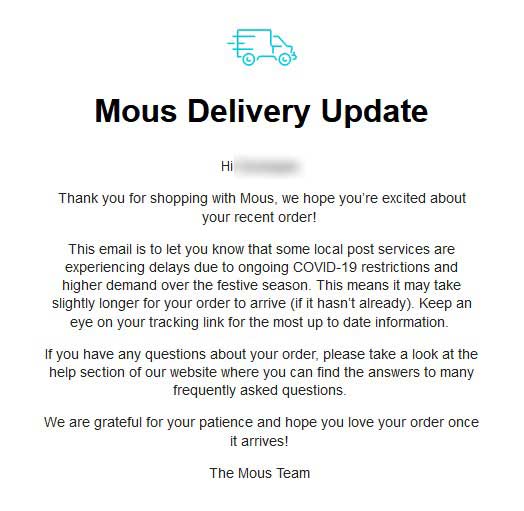
Customer communication is an opportunity to establish and strengthen a relationship. Not just a way to deflect a possible inquiry.

You should know (and tell) whether a package has been delivered or not. And if it has, spare the customer the clutter in their inbox.

You could add the link to track the delivery. And spare the customer the trouble to dig into their incoming messages to find it.

You could suggest a direct way to ask a question. And spare the customer the time to go through the website, the help section, the knowledge base articles, and the feedback form.

Good customer communication often goes unnoticed, because it makes the experiences smooth and does not impose additional tasks on the receiver.

It’s not impossible, and can be achieved with some intention.

Living through this

As the holidays get close and the news fill once more with variants and spikes, it is worth reminding that it is ok not to be ok.

It is ok to be anxious, stressed, demotivated. It is ok to not feel like doing anything. It is ok to be languishing and just wanting to give up. It is ok to take days off, to go for a walk in the middle of a busy day, to want to meet others and at the same time dread the moment when that will happen.

All of this is ok, and the moment you are fine with it, you can start expressing how it is. People will feel a little less afar. You will be a little less alone.

We are living through this.

You’ve got this.

Thin line

There is a thin line between your fragility and other people’s fragility.

They often live in the same space.

I don’t like this project – It can be interpreted as an attack, a lack of trust, a doubt on your skils, a revenge for something you once said (your fragility); and at the same time, it can be a manifestation of fear, uncertainty, adversity to risk, a different mindset (other people’s fragility).

Someone not returning your greeting – It can be interpreted as a dislike, a judgement, a strong preference to not spend time with you, a way to send a clear message about the meeting that is about to begin (your fragility); and at the same time, it can be a manifestation of a cluttered mind, uneasiness around others, a disinterest towards socialization, tension for the meeting that is about to begin (other people’s fragility).

Your role is to understand the boundaries of your fragility, the words and actions that trigger it, so that you can extend from there and accept other people’s fragility and their own effort to understand them.

Take the comment on the project and appreciate that it is feeding your lack of trust in your own skills; then move towards the other and sit with them as they explore their own side.

Take the greeting that was not returned and appreciate that it is triggering your struggle to belong, then move towards the other and sit with them as they explore their own side.

When you don’t do this, the thin line grows into a thick wall.

Satisfied

Most of your satisfaction is due to the effective application of three interrelated things.

  1. Knowing what is important.
  2. Not allowing any space for what does not belong to number 1.
  3. Giving yourself some slack when you fail at number 2.

This is true in your personal and your professional life. At the office, in your free time, and at the gym. When you are on your own, with your partner, with your friends, or with your kids.

It is a matter of awareness, of choices, and boundaries.

It is a matter of saving resources and investing them in the things that have the highest potential.

It is a matter of acknowledgement and empathy.