Every person wants progress, and when we design or market products and services we should focus on the progress we are enabling customers to make.
This is the foundation of Jobs To Be Done (JTBD).
With this approach, two things happen.
First, value is no longer seen as a transaction. It does not run out the moment a purchase is done or a service is delivered. Progress extends over time. The best way for a company to serve their customers is to understand the system of progress they are in – a good example being Weber, that does not stop at producing high-quality grills, and completes the offer with tools and resources to make the customer the grill master they want to be.
Design your product to deliver customers an ongoing feeling of progress – Alan Klement
Second, competition is no longer restricted to products or services that have a similar functionality or physical appearance. Anything that helps the customer achieve the progress they have envisioned (or might envision) for themselves is competition.
A Job To Be Done is the process a consumer goes through whenever she aims to transform her existing life-situation into a preferred one, but cannot because there are constraints that stop her
Despite thousands of years of evolution, we are still pretty primitive in our behavior. We seek what makes us survive and thrive, and we stay away from what puts our lives through any kind of hassle.
And so, companies do two big mistakes when they talk about what they do. First, they forget that they are not the hero. Second, they ask prospects to burn too many calories to understand why they should become customers.
The result is that people run.
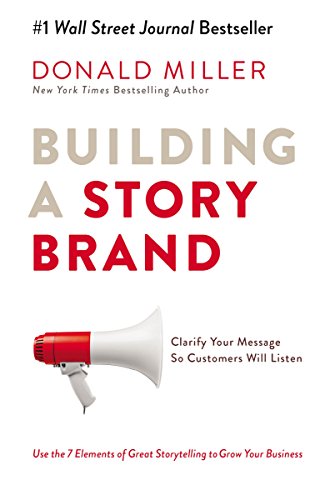
The way companies tell their story can follow a consolidated way of storytelling.
A CHARACTER who wants something encounters a PROBLEM before they can get it. At the peak of their despair, a GUIDE steps into their lives, gives them a PLAN, and CALLS THEM TO ACTION. That action helps them avoid FAILURE and ends in a SUCCESS.
The character is the customer. And the engine of the story (the story gap) is the thing the customer wants. Of course, you need to know your customer very well to start from here. In particular, you need to know:
What do they want to become?
What kind of person do they want to be?
What is their aspirational identity? (i.e., How do they want their friends to talk about them?)
Once this research is done, it should become clear that what they want is something relevant for them. They do care deeply about closing the gap and joining with the object of their desire (if they do not, there is no story).
The problem is both external (e.g., a bomb, skyrocketing costs, increased competition) and internal (e.g., failed detective, inability to grow, staff leaving). In fact, companies should strive to frame their product as a resolution for both the external and the internal problem.
The guide is you (finally!). For your product to be a reliable guide, it needs to communicate empathy – we understand how it feels ..; like you, we are frustrated by .. – and competence – we know what we are doing (testimonials, logos, statistics).
The plan can either be a process plan, that describes the steps the hero needs to take to buy the product (and achieve success), or an agreement plan, that lists the major concerns of the hero and counters them with agreements that alleviate the fear – if you buy our product, we will do this; in case you need help, we offer 24/7 service.
The call to action can either be direct – buy now, schedule an appointment – or transitional – download the whitepaper, get started with the free trial.
The dodged failure needs to be expressed. Many refrain from doing this, because they feel they might be perceived as negative guides. Yet people are motivated by loss aversion: if there is no loss your product helps them avoid, they will avoid the loss (i.e. expenditure) represented by buying your product.
And finally, the success. Just be very clear what it looks like, how it feels like, what the end vision is. You can’t get too specific.
If you have an idea to spread, a change you care to see happening, a product to market, the first question should not be “where is my audience?”.
The first question should be “who is my audience?”.
It is a shift in perspective.
From desperately moving from one channel to the next (and mastering none), with messages that are ineffective (because they are either about you or they aim to appeal to too many), to already knowing where you will be tomorrow.
It is the way to become master of your own future.
It is not enough to say that your company focuses on delivering values to customers.
What is value?
If you don’t stop for a long moment considering this question, you are not focused on value. Value is economical, and it is also technical, social, personal, functional, aspirational. Value takes into consideration material costs, and also possible issues, adoption, expansion, scale. Value is transactional and relational. Value is co-operative.
And once you have identified all the elements that make up your value, you still have two steps to take.
First, you have to understand the why of value. Why does it matter. Not tomorrow, not one year from now, not one day maybe. But now.
Then, you have to build a system that constantly delivers on the elements across the various departments, that captures and measures the elements, that continues assessing them, that creates incremental evidence for them, and that ensures that they are not replicated by competitors and new entrants.
Value is a complex concept, not another organisational buzz word.


 You've got this