Your audience

Imagine if you would have to act as the perfect employee to impress your boss and at the same time as a lazy employee to get along with your peers. If you would have to pretend to be the family man at home and at the same time the ruthless playboy with your friends. If you would have to be sloppy and quick at work and at the same time meticulous and detailed in your free time.

At best, everyone (including you) would have some serious issues figuring out who you are.

This is the same impression many B2B companies give.

They have one story for the investors, one for the customers, one for the partners, one for the analysts. Each department tells it in a different way, using different language, and focusing on different themes. The result is total confusion.

If you want your brand to be authentic, define what that means, check regularly whether the definition is still relevant, and stick to it.

That’s how you find your audience.
Digest

If you lead a team, you typically have 30-minute (minimum) weekly meetings where you do most of the talking and then go around the room.

Why not trying a weekly digest instead?

You send it out once a week.

You share key decisions from management and executive team.

You highlight important messages (from internal communication systems) that are relevant to your team and that might have been missed.

You update on your main focus for the week and praise people’s achievement from the previous week (you should be able to get that from a project management tool).

You add a personal touch, a story from your weekend, something you have learned, a practice you are developing.

Would that be a time saver?

Assumptions

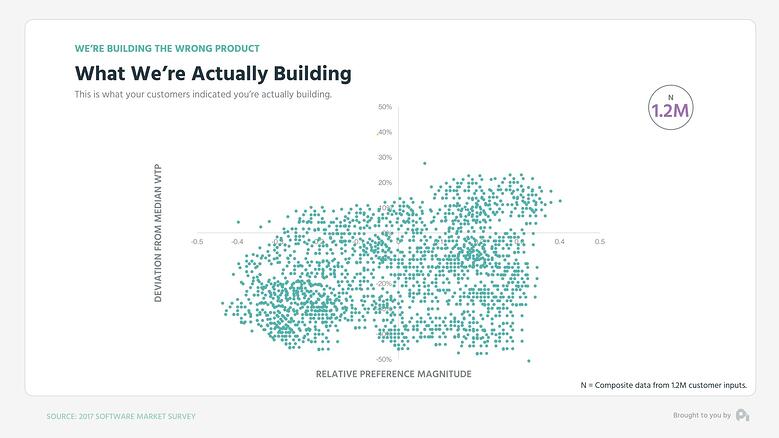
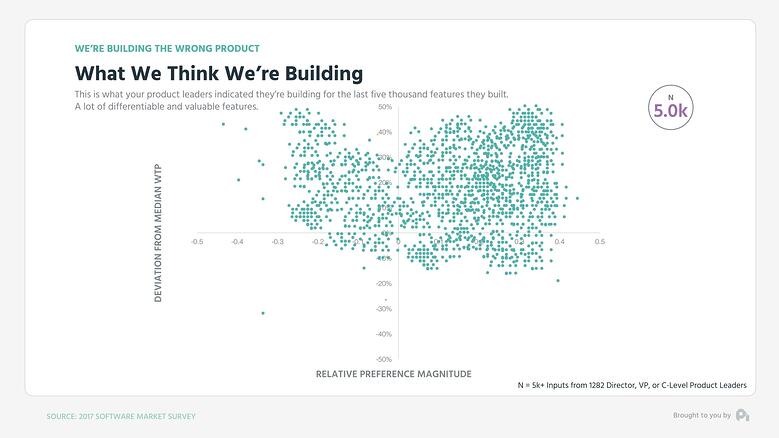
If you want to get an idea of how dangerous (for a business) assumptions and groupthink are, have a look at the two graphs below (research by Profitwell).

What 1,200 product leaders think of the last 5,000 features they released.
What 1.2M customers think of those features (in terms of Willingness to Pay and Preference).

We think we are building products and services that deliver high value and for which customers are willing to pay premium price. In reality, customers perceive those products and services as average and not particularly worth of their money.

The executives and leaders at a company are rarely the ideal audience for what they are buiilding. This is true when the company is young, and it is even more true once the company gets traction and grows.

You ought to free your decision-making process of assumptions and start looking at qualitative and quantitative data that come from customers. You should have done that yesterday. You can still make it happen today and have a huge competitive advantage nonetheless.

When coffee and kale compete

Every person wants progress, and when we design or market products and services we should focus on the progress we are enabling customers to make.

This is the foundation of Jobs To Be Done (JTBD).

With this approach, two things happen.

First, value is no longer seen as a transaction. It does not run out the moment a purchase is done or a service is delivered. Progress extends over time. The best way for a company to serve their customers is to understand the system of progress they are in – a good example being Weber, that does not stop at producing high-quality grills, and completes the offer with tools and resources to make the customer the grill master they want to be.

Design your product to deliver customers an ongoing feeling of progress – Alan Klement

Second, competition is no longer restricted to products or services that have a similar functionality or physical appearance. Anything that helps the customer achieve the progress they have envisioned (or might envision) for themselves is competition.

A Job To Be Done is the process a consumer goes through whenever she aims to transform her existing life-situation into a preferred one, but cannot because there are constraints that stop her

Alan Klement, When Coffee and Kale Compete
When Coffee and Kale Compete – Book Cover

Someone else

There is always someone else.

No matter how skilled you are, no matter how wonderful your product is, no matter how supposedly unique your culture is. There is someone else out there offering the exact same thing, covering the exact same spot, addressing the exact same problem.

And you have two things to do to mitigate this problem.

First, understand who someone else is – and by the way, this is a decision of those you are serving.

Second, be as specific as possible in figuring out and expressing what you are.

The alternative is most of B2B marketing nowadays: companies with fantastic products and services playing in broad and fuzzy markets to increase their customers’ productivity. All the same type of better, faster, cheaper.

Pass.