Aspiring

If you are starting in marketing today, whether you are a fresh graduate or you are changing career, the best way for you to employ your (free) time is creating content.

Show us that you have ideas and creativity (you do!), that you are methodical and consistent (you can be!), that you can try, fail, learn and repeat (that’s all marketing is about!).

There is nothing more deadly for the career of an aspiring marketer than thinking they have nothing to tell, nothing to share with the world, nothing to master.

The world is yours, go get it!

Mess

What HBO is doing with their streaming offering is the perfect example of how bad marketing can ruin a great product.

Having three brands (HBO Max, HBO Go and HBO Now) to essentially serve the same audience has created a lot of distraction and confusion, and it has not helped one bit in delivering the image of quality HBO is recognized for worldwide.

They will fix it sooner or later, and they will most likely get past it, because they are HBO. Your organisation, though, is not. Take marketing seriously.

Data

Data is everywhere these days, that also means we got accustomed to looking at data to find meaning in situations that are difficult to interpret.

And so, if you present numbers or percentages, be aware of two things.

First, if that is all you have to say, people will get bored fast. If you do not have a story to accompany your data, if you cannot tell what the data means to you, to your organisation, to your purpose, if you cannot express how things could look different in case an alternative path had been chosen, then the time is pretty much wasted. Sure, you can look at history and see how those numbers and percentages have evolved, compare them with similar ones, but eventually none of that will inspire action.

Second, what numbers and percentages mean to you is not necessarily in line with what they mean to somebody else. Data might be universal, their interpretation is not. And so, be prepared at being challenged and having to inspire people to believe the story you read is more accurate than others. Follow up on that, repeat, look at it from different angles, and be consistent over time.

Data can change your world, but as a matter of fact it probably isn’t now. It’s up to you to fix that.

Brand

A part of marketing is generating sales. And a part of marketing is fostering brand.

There are some myths around this that should be debunked.

Starting with the fact that the two things are separated and can live independently. Perhaps that is true in the short term, but building a business is a long term effort, and eventually brand and sales need to go hand in hand. Brand is what gets you your best-fit customers after all.

Then, there is the idea that sales is (mainly) for the early stages of a company, and brand is for when a company already controls a certain share of the market. This is a belief that comes from an era (and we are talking about probably 10-15 years ago) when markets featured a bunch of players (say between 10 and 50 – now there are hundreds, thousands in some cases). It is also backed by the assumption that investing in brand is something only bigger companies can afford, probably because when talking about brand one thinks at tactics.

Finally, there are many who argue that generating sales is infinitely more measurable than fostering brand. And there is some true to it. But of course, the reality is that most sales-focused activities end up being not measured, mismeasured, unoptimised, and eventually most organisations just throw money at a problem without really understanding what is going on. And on the other hand, we still get emotional in front of marvellously crafted brands and often decide to buy A instead of B in the heat of the moment.

So, perhaps instead of saying that a part of marketing is generating sales and a part of marketing is fostering brand, we could say that marketing is both.

The sooner we get to look at the two things together, the sooner we will stop wondering why the 105th whitepaper is not driving pipeline or why the new logo is not resonating with our audience.

That is a waste of time.
Simplify

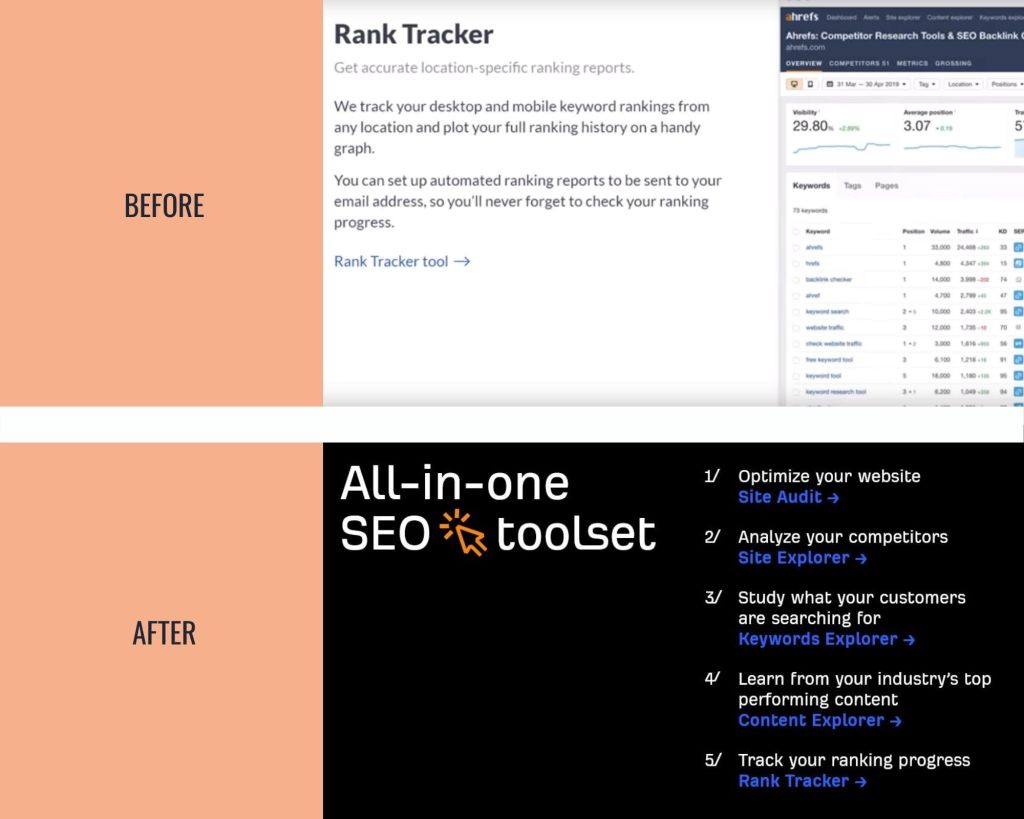
This is a very well crafted video that tells of how ahrefs went about redesigning their home page.

It is about the company, but it is not about the product. It is something the target audience wants to know about (web page redesign). It has a twist right at the beginning (the 3 copywriters) that makes sticking around until the end more likely.

And by the way, if you plan to redesign your website, three questions worth asking.

1. When do we show the product? It is a fairly common practice in B2B to feature loads of videos and screenshots on the website, but as the guys at ahrefs realised, perhaps opening the home page with a hero screenshot of a dashboard might put off many visitors who are just problem-aware.

2. How much information is enough? Getting lost in details is easy, and getting lost trying to expres details is even easier. A waste of space and attention, so just stick to what is needed to catch the interest of your target audience.

3. How long should a A/B test be? For many things, measuring the real impact on business metrics takes time. A/B testing in 1-2 week-long sprints is probably focusing on the wrong metrics. Marketing is a long A/B test.