Promote mistakes

Speak about your mistakes often, particularly if you are in a position of power. Tell about what went wrong and what you did learn. Anticipate how the next time will be.

It’s also a great way to assess people around you and the environment you are in. If you recently joined a company, and nobody talks about mistakes ever, particularly when everyone is listening, that is not a company that knows how to learn and promote innovation.

Mistakes are essential. Promote them to become better.

Own your meetings

When you send an invite for a meeting, you make two promises to those invited.

  1. You promise that you will be respecting the timing of the meeting – the time the meeting will start, the time allocated to the different items in the agenda, the time the meeting is supposed to end.
  2. You promise that you will be prepared to deliver on the agenda, or that those presenting/discussing will have the information they need to prepare to deliver on the agenda.

Many meetings fail because they are considered a way to come together and express opinions, thoughts, ideas. Some might be, but even in that case it is a responsibility of the organizer to manage a right pace to the conversation, to send out information that can help drive the conversation, and in general to be the owner of the conversation.

If there is one gift you feel like giving to your colleagues in 2022, let it be this one.

Own your own meetings.

Insecurity

We lash out at people, we judge, we confine, we define, we spend most of our days commenting and evaluating what others do. And the truth is, we do not know any better.

It is perhaps our insecurity that makes us feel so certain when it comes to others.

Stand out

One of the things that will make you stand out most in business (and not only) is to close the circle on your promises.

This is true for individual contributors, teams, departments, and organizations as a whole.

If you promise something that you know you can’t deliver, or that you consistently don’t deliver over a period of time, the promise is most likely a way for you to get out of a difficult conversation, an awkward moment, a temporary discomfort.

It is not worth it.

Say only what you know you’ll do. And if you end up not doing it, give a reason and follow up.

When you meet your commitments, you build trust, gain confidence — look, you really can do it! — and grow the kind of backbone needed to say no when you truly can’t take something on.

Whitney Johnson, You Have to Stop Canceling and Rescheduling Things. Really.

Make it better

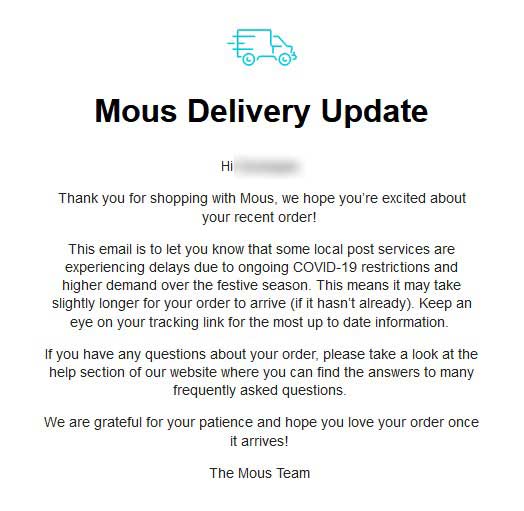
Customer communication is an opportunity to establish and strengthen a relationship. Not just a way to deflect a possible inquiry.

You should know (and tell) whether a package has been delivered or not. And if it has, spare the customer the clutter in their inbox.

You could add the link to track the delivery. And spare the customer the trouble to dig into their incoming messages to find it.

You could suggest a direct way to ask a question. And spare the customer the time to go through the website, the help section, the knowledge base articles, and the feedback form.

Good customer communication often goes unnoticed, because it makes the experiences smooth and does not impose additional tasks on the receiver.

It’s not impossible, and can be achieved with some intention.