Tension

We live in the tension between a version of us we despise and a version of us we would like to become.

And we also live in the tension between our failures, which we see so vividly, and other people’s successes, which we fantasise a lot about.

When we get going, we often reach for the positive extreme. We are at our best and we aim to emulate those who have succeeded before. We know we can. Then we meet criticism, bad weather, rejection, difficulties of various kind, and we fall to the negative extreme. We are suddenly incapable to complete the most trivial task, unworthy of anybody’s attention, care, empathy.

Most reality, though, happens in the middle. And that’s also where we can anchor to achieve real and incremental progress.

It’s when we embrace the version of us we are today and the work we are doing today – neither bad nor good – that we get rid of the tension and we can start enjoying the journey.


Too serious

Don’t take yourself too seriously. Make sure you have enough space to even make fun of your failures, your fears, your weaknesses.

We are wired to spot the threatening, the bad, the negative. But for most of us, in our modern world, that is very often overreaction. Bombing a presentation, missing a quarter’s goals, getting rejected is not going to be defining our own persona.

Unless you let it.

Being fair

A big problem with offering $85,000 for a position budgeted at $130,000 is that very soon the person to whom you are offering the position is going to find out (even if you do not tweet about the whole situation).

And when they do, two things will happen.

First, they will feel cheated, demotivated, disengaged. They won’t be able to perform at their best, because nobody does when the counterpart sees the relationship as a mere transaction.

Second, they will start spending most of their resources to be paid what it is fair for them to be paid, whether that is at the company or somewhere else.

Was the hustle worth it?

What do they care about?

When you think of differentiating from the competition, whether it is for a product or a job application, the question you should focus on is:

What does my customer most care about?

You might be absolutely the best at doing something, have more vision than anyone else in the market, be the cheaper option. But if that’s not THE critical thing for your customer, you will lose nonetheless.

And perhaps your customer still does not know that your uniqueness is something they will greatly benefit from.

In this case, you have a choice to make: you can try to educate them or you can leverage their emotions with a powerful story of how the future looks like.

Educating very rarely works.

Figure it out

The current situation is unprecedented. The pandemic is putting a strain on everybody. A huge amount of people have suffered serious consequences.

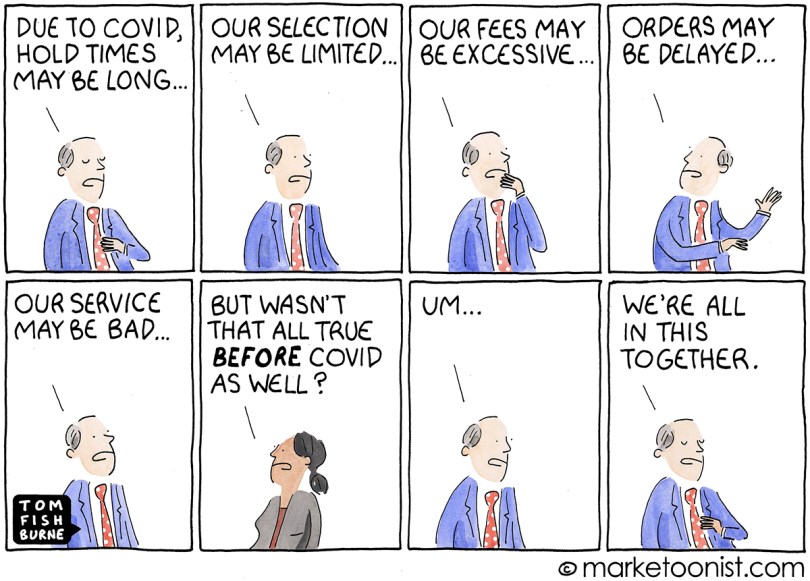
And if after two years your company is still using Covid as a tentative reason to excuse poor customer service, delayed deliveries, price increases, product shortages, it’s time for you to stop.

Rethink your business, instead, and figure out a way to provide the experience people expect.

That’s your responsibility.

Note: the image of this post is from Tom Fishburne @Marketoonist.