Ask, resist, and frame

Three things you can start doing right away to unlock other people’s potential.

  1. Ask clear, open questions – Abuse what and how, get rid of be and do. One example: instead of are you happy with the project? ask what are you happy about with this project?
  2. Resist giving answers – Even when you know and are sure, an answer not given gives the possibility to the other person to figure it out. Go back to #1 and ask things like what will do with this information? or how do you plan to tackle this issue? or what’s the next step to figure this out?
  3. Frame everything – Help others put what they do in perspective, anchor the day-to-day in the broader picture, make evident the link with company goals, community goals, life goals. If you do #1 and #2 you should maintain the distance necessary to focus exactly on #3.

On people and communities

It does not matter if you are a billionaire.

It does not matter if your new enterprise is going to make you a few more billions.

It does not matter if you are moved by mixed motives.

What matters is the impact you have on people and communities. And some enterprises have this much clearer than others.

The committee

All great marketing was challenged. At some point, by someone.

And so, if everybody likes what the marketing team produces, they are probably on the wrong track.

The truth is, you don’t know what is going to work or what will be great. So never have a committee preemptively trying to determine that.

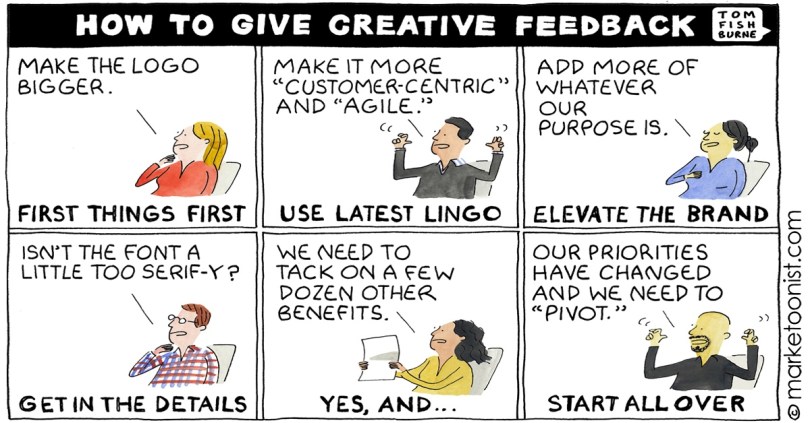
Image from Marketoonist.

When emotions are involved

When a person comes to you with a problem, pointing at the fact that they are the reason behind the problem is not going to set them at ease or help them get past it.

When a customer comes to you with a problem, telling them that their behaviour is why the problem exist is not going to set them at ease or help them get past it.

Reality and facts are really of little help when emotions are involved.

Elaborate

The Flickr for videos.

A Netflix for video games.

The Airbnb for parking.

It’s a great way to describe what your product does, but do you and your team understand what that means? What are the characteristics of the original that you believe you have? What will ensure that you will still be in that same game in the future? Or is it a trick to cheat your stakeholders into believing you will get to a similar valuation?

It is a useful exercise to clarify what you mean by taking this useful shortcut. It brings your team together and creates alignment throughout the company. It gives you milestones to look forward to and a manifesto customers can buy into.

Start with:

  • What features matter to the original and to us alike.
  • What parts of both stories are common and what are not.
  • How do we ensure we continue on the same path.