Building a StoryBrand

Despite thousands of years of evolution, we are still pretty primitive in our behavior. We seek what makes us survive and thrive, and we stay away from what puts our lives through any kind of hassle.

And so, companies do two big mistakes when they talk about what they do. First, they forget that they are not the hero. Second, they ask prospects to burn too many calories to understand why they should become customers.

The result is that people run.

The way companies tell their story can follow a consolidated way of storytelling.

A CHARACTER who wants something encounters a PROBLEM before they can get it. At the peak of their despair, a GUIDE steps into their lives, gives them a PLAN, and CALLS THEM TO ACTION. That action helps them avoid FAILURE and ends in a SUCCESS.

Donald Miller, Building a StoryBrand

The character is the customer. And the engine of the story (the story gap) is the thing the customer wants. Of course, you need to know your customer very well to start from here. In particular, you need to know:

  • What do they want to become?
  • What kind of person do they want to be?
  • What is their aspirational identity? (i.e., How do they want their friends to talk about them?)

Once this research is done, it should become clear that what they want is something relevant for them. They do care deeply about closing the gap and joining with the object of their desire (if they do not, there is no story).

The problem is both external (e.g., a bomb, skyrocketing costs, increased competition) and internal (e.g., failed detective, inability to grow, staff leaving). In fact, companies should strive to frame their product as a resolution for both the external and the internal problem.

The guide is you (finally!). For your product to be a reliable guide, it needs to communicate empathy – we understand how it feels ..; like you, we are frustrated by .. – and competence – we know what we are doing (testimonials, logos, statistics).

The plan can either be a process plan, that describes the steps the hero needs to take to buy the product (and achieve success), or an agreement plan, that lists the major concerns of the hero and counters them with agreements that alleviate the fear – if you buy our product, we will do this; in case you need help, we offer 24/7 service.

The call to action can either be direct – buy now, schedule an appointment – or transitional – download the whitepaper, get started with the free trial.

The dodged failure needs to be expressed. Many refrain from doing this, because they feel they might be perceived as negative guides. Yet people are motivated by loss aversion: if there is no loss your product helps them avoid, they will avoid the loss (i.e. expenditure) represented by buying your product.

And finally, the success. Just be very clear what it looks like, how it feels like, what the end vision is. You can’t get too specific.
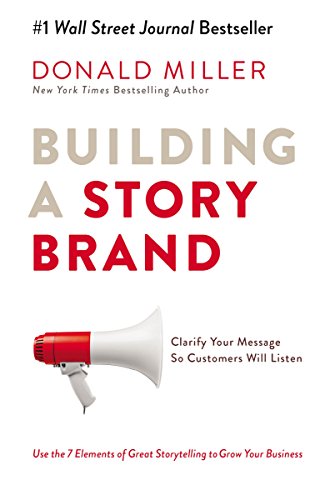
Donald Miller, Building a StoryBrand book cover

Jabbering

Your company was established in 1845 by your great-great-great-grandfather and has, since then, achieved tremendous success all over the world.

You have a cutting edge technology that future proofs companies and enhances workforce efficiency and productivity of front-end and back-end employees.

You are going to revolutionise the industry and establish your organisation as the de facto leader in a niche that is recording a CAGR of 55%.

Your team is composed of digital artisans, experts who are passionate about creating bespoke websites and experiences.

Your event features panelists and thought leaders from 126 countries and 456 organisations across 59 industries.

And all everyone else hears is the following.

Note: they focused on customer success too!

Full control

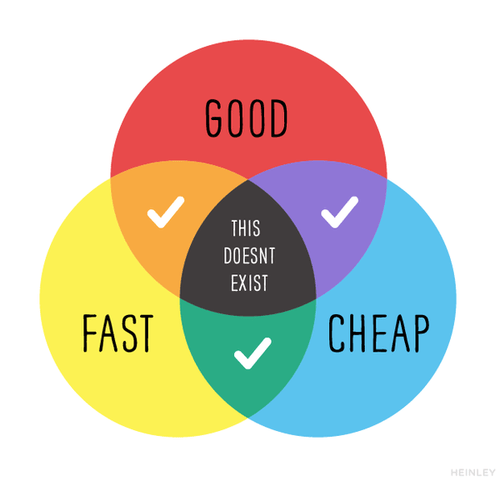
There is a popular meme that tells about the relationships between a job done fast, well, and cheap. You can do a job fast and well, you can do it well and cheap, you can do it cheap and fast. What you can’t do is fast, well, and cheap at the same time.

Source: The Developer Society, Good/Cheap/Fast

The meme fails to tell another truth, though. A bane to many companies. That is: you can’t do a job fast, well, or cheap if you want to maintain full control on the outcome.

You can’t do fast, because when the job is ready, there are still review phases to go through. Often featuring vague feedback, last minute changes, and unsubstantiated personal opinions.

You can’t do cheap, because all the layers you are adding have a cost. And even more expensive is the price you pay for the people who leave once they realize their talent comes after tenure.

You can’t do well, because by the time you get to the finish line, what you have is a frankestein that satisfies everyone and excites no one.

So, if your goal is to maintain full control on the outcome, any of the combinations in the meme is a much better path to execution. Change, or be prepared to be kicked out of the game.

The dumber marketer

Is being dumb giving you an edge in marketing?

I am not talking about a lack of intelligence, but rather of a genuine, näive ignorance around topics you probably can never be very sure about.

Why is this campaign working?

What do you mean by that word you are using so frequently in your copy?

What is our ideal customer? Where do they hang out? What do they care about?

Why is this blog post performing way above average?

Do our visitors approach our resources in terms of “case studies”, “videos”, and “whitepaper”, or are they seeking information about what type of customer, what use cases, what pain points?

Are we expressing our product this way because it is comfortable for us or because it makes sense to our target customers?

I am not sold on the idea that being certain and confident is a good thing in marketing. What worked yesterday, what is working today, will probably not work tomorrow. What worked for that campaign, will probably not work this time. What worked in one company, will probably not work in the new one.

So, is the dumber marketer the one who is going to ask those questions?

The receiver

In University, I was taught that communication, in its most basic form, is the cooperation between a sender and a receiver to get a message through a shared environment.

And while that certainly holds true still today, I am more and more convinced that in business, communication is in the hands of the receiver.

Think about marketing: the receiver is forced through a myriad of messages and decides what to dedicate attention to in a matter of seconds. Think about internal communication: the receiver can call bullshit on any message management is sharing if that does not reflect their day-to-day experience. Think about presentations: the receiver is so fed up with bullet points and animations (particularly after one year of virtual meetings) to the point they can check emails or write a report while you are struggling to make a case.

The receiver is central in any form of corporate communication.

And the fact that we spend so little time trying to figure them out is the most widely overlooked device a professional has to leverage to get their messages through.