If you feel like you’ve been losing for too long now, most likely it is the wrong game you are playing. There is a chance for you to reconsider all that is involved: the rules, the playing field, the competitors, even what winning eventually means. But you can do that only if you start by understanding who you are, what makes you stand out and what you want.
Different is better than better. If you put yourself in the small pond, how you think of yourself goes up. Most of us though live in a huge pond, and the feeling we get is we will never be good enough. Give yourself a game that you can win!
What happens when you fail the story you have so patiently and consistently crafted?
We all have ups and downs, yet some downs have the power to make us question the image of ourselves we have built. Perhaps we think of us as calm and patient, then we act irrationally and hastily. Perhaps we think of us as bold and innovative, then suddenly we are cautious and scared. Perhaps we think of us as caring and supporting, then we catch ourselves in a bitter and malicious mindset.
The beauty of stories, though, is that they are open enough to accept and welcome new behaviours without bending.
We still are calm and patient, but something unusual happened that made us act in an irrational and hasty way.
We still are bold and innovative, but with that new piece of information we felt it was worth it to be cautious and even scared.
We still are caring and supporting, but that person hurt us deeply and now we are in a bitter and malicious mindset.
If we accept this, it’s going to be easy to get back on track.
If we don’t, the thing we were not expecting will become what we expect of us next.
Lifting others, empowering them, making them feel listened and appreciated, ensuring they can do their best with their skills and motivating them enough to go find learnings in their failures.
All of this is possible only if we allow it to happen to ourselves first.
“I am shit and you are great” is a narrative that does not serve any of the above purposes.
Now more than ever, have your expectations clear and communicated to those around you.
As our personal, professional and family lives overlap for a necessary confinement, the worst thing that can happen is trying to keep all of them going at the same time.
Allocate the right amount of time to work, playing with the kids, relaxing, reading a book, exercising, cooking, and whatever else you have on your agenda, trying to maintain each activity separate from the others.
This is something you would benefit from in any time and circumstances, by the way.
Looking at the story you want to tell, the one that is going to place you in a different spot than the majority of people, means understanding two aspects about you: what you want and the set of skills you have.
What you want is complex to discern. It is a multi-layered finding, and it requires self-reflection to really unpack it. A question that well complements the research is why you want (what you want). There’s quite the difference between, for example, wanting a job because you need to sustain your family and wanting a job because you want to kick-off your career. Asking why helps finding out the actual want (family or career in the example), rather than just stopping at the supercial one (job).
The set of skills you have is also something not usually straighforward. We are quite used to think of skills in terms of degree we have achieved, positions we have covered in previous work experiences, titles we put on the CV. That is a narrow vision on what we can do. If you start writing down what you have actually done throughout your career, and also look at your non-professional activities, you will start seeing patterns emerging. Perhaps you’ll find out your are particularly good at understanding the needs of others, or you have done quite a deal of work across different deparments, or you can write a 3,000 words, deeply-researched and well written blog post. This is a much more granular way to look at what you can do rather than, say, thinking at your skills in terms of broad categories such as marketing or sales or product management.
If you do explore both what you want and your set of skills in such a way, and have good information about the playing field in which you are competing, then something interesting happens when you combine the two dimensions.
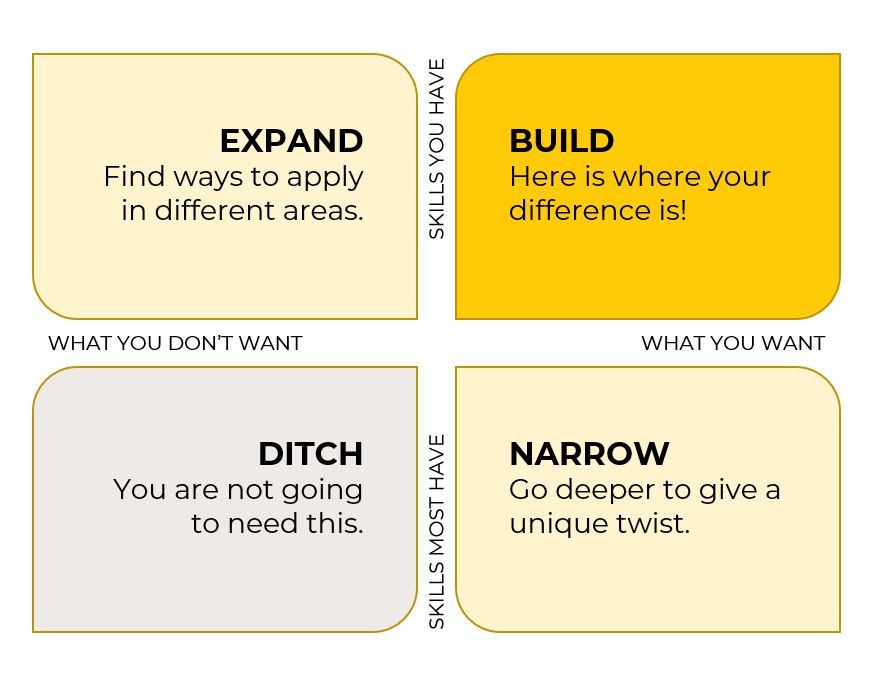
A framework to help build your unique story.
More in details.
You might come across some skills that most people have (in your community) and that belongs to a domain you do not want to explore. This is what you can essentially forget about, because it’s not going to add anything to your own unique story.
Then there are skills that have become distinctive of who you are, yet are typically associated with domains you are not interested in. You might be tempted to get rid of those as well, but actually you would do better checking if there’s any chance to EXPAND their application to areas that are interesting to you. Say for example you have been working with spreadsheets a lot for budgeting purposes, and you know the ins-and-outs of spreadsheet tools. Still, you are definitely done with figuring out how much stuff can cost, report the actual expenditure, consider the difference and update the forecast. There’s quite many other areas where this type of knowledge might come in handy, and some of them might actually be closer to what you want than you think.
On the other hand, there are skills that are fairly common (again, in your community) and are strictly related to the type of career you want to pursue. In this case, you might want to see if you can go deeper, either by specializing or by NARROWing the skill even further. Say you have experience in running email marketing campaigns, a skill you might struggle to differentiate for. Perhaps there’s an element of running such campaigns you are particularly good at (e.g. analytics, optimization, creative, copy-writing, etc.), or there’s a tool you can successfully set up blindfolded (e.g. Marketo, Mailchimp, Zoho, etc.). This might give you the edge you are looking for.
In most cases, most of the combinations you are going to come up with are in one of the two quadrants just described (EXPAND or NARROW). The final goal is of course to identify two to four skills that you have (and few others do) and that are in tight relation with what you want. That’s how you are going to find how to stand out, how to tell a story that can resonate with the right audience and that you can continue BUILDing upon.
This is all part of a workshop I am preparing for people who have relocated to Finland and that are looking for a way to get started professionally in this country. It is still rough, but I figured somebody might be interested in taking this approach to shed some light on how to build their unique story.