Meeting checklist

I don’t know how many people I have heard at different levels of any given organization complaining about meetings. And I don’t know how it is possible that despite this we are spending between 20 and 50% of our working time in meetings.

A study by Mroz et al. features a very useful checklist to make the best out of meetings – thanks to Ethan Mollick for sharing it.

Start with considering if the meeting is necessary or not – information sharing and updates are not valid reasons to have a meeting -, as well as who should be present – being a fly on the wall is a huge waste of time. Then have an agenda (and stick to it), avoid complaining (as in nothing ever works or this issue cannot be fixed), and follow up with a request for feedback, from which you commit to take ideas to improve future meetings.

We all want to get better at meetings. Who is taking the first step?
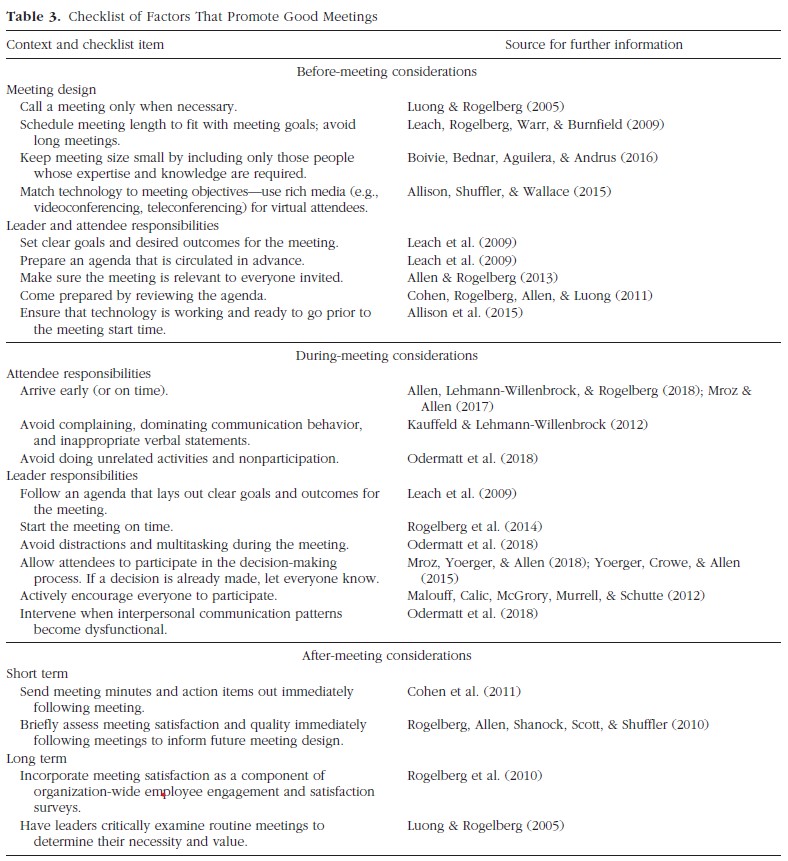
Mroz et al., checklist for a good meeting
Mroz et al., meeting checklist

Questions and answers

As a leader, the surest way to have your team contribute is to speak when a question is needed and to shut up in the process of finding the answer.

The problem is that we often get this all wrong. And so direct reports ask questions and managers give answers, nurturing an organization that is bottlenecked, does not grow, and demotivates.

Leaders, be vulnerable and let go.

Villain turned hero

Many business books (strategy books, leadership books, self-improvements books) present their ideas in a villain vs hero way.

On one side, there are undesirable strategies, leadership styles, behaviours, tactics and on the other are desirable strategies, leadership styles, behaviours, tactics.

And this is where they fail to inspire change, for two reasons mainly. First of all, very few people identify with the villain – I am not the villain, then why should I change?. And secondly, the positive features of the hero are presented as innate, almost magical – I am not a demi-god, so why bother?.

A villain turned hero approach would probably be more effective. It would humanize failure, introduce shades of grey, and make the whole story more approachable and relatable.

This is something to keep in mind also for the next story you are going to tell.

Dull and easy

The stigma around topics such as failure, ignorance, inexperience makes us hide the very same seed that would allow us to grow. We do not ask the question, we do not show the weakness, we do not seek guidance. Eventually we end up being the same, if not diminished.

We are more silent when we should be more vocal.

And on the other hand, we are met with silence when we should be cheered loudly.

How often do you share just to meet an embarrassed withdraw? How often do you ask just to meet an awkward silence? How often do you open up just to meet shameful rejection?

Everything is dull and easy on the surface.

It is when you go deep, and allow the others to go deep, that things start getting interesting.

Your winning way

This way of doing marketing does not work for everybody. In fact, it probably would not work for your company.

But it works for Balsamiq.

I guess the point of this story is the following.

Before jumping into a funnel carousel, before starting to talk about MQLs, SQLs, and SAOs, before paying an agency to figure out your business model and your brand, before running around optimizing the optimizable and hacking the hackable. Take a deep breath.

Find a way that works for your customers and for your business. A way that reflects your values, your purpose, the change you want to see in the world. A way that you are proud to promote, that your leadership is proud to promote, that your employees are proud to promote. A way that lets you build a sustainable business where you and your team are the ones defining success.

There is no other way. It’s your winning way.