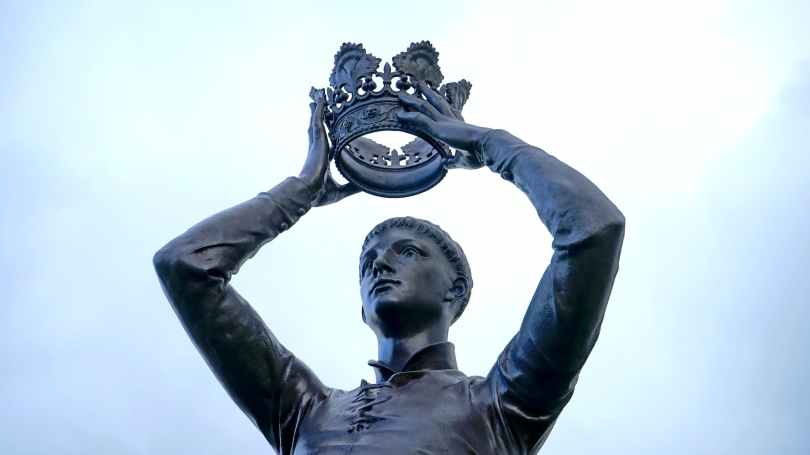
Not up to the task

So many of us do not feel up to the task. It’s a feeling that makes us shy away from achieving more, that makes us hide and retreat, that eventually feeds into a demotivating spiral from which it is difficult to escape.

But what is the task?

When we say we do not feel up to the task, we often refer to something ideal, some perfect outcome that we never really define. We imagine ourselves being in a position where we have everything under control, where we know everything, and where we can answer every question without fault and self-doubt.

The task is not that. Nobody in their sane mind would ask you to be up to that task.

The task is showing up and figuring it out as you go. Living and dealing with that kind of uncertainty and with that level of ignorance, while still being kind to others and willing to bring them along the way with you. Perhaps learning something from them and teaching them something.

It’s not an easy task, but it can be concrete and it is achievable.

So, if you feel like you are not up to the task, start by asking yourself what the task is. You might be relieved from a big stress.

Comfort

You know what you have to do, and there are three reasons why you are not doing it.

  1. You’ve never done it before
  2. You are not motivated
  3. You don’t have the skills

Some of that might be real, some of that might just be tricks your mind plays to keep you within your comfort zone, free from risks and safe.

But you know what you have to do.

So, understand what is keeping you from doing it and work around it.

Flat

A flat organization is an opportunity for employees to speak freely, to share their opinion, to make an impact.

A flat organization is not an excuse for managers to make jokes about employees, say whatever comes to their mind, pretend they are not in charge.

It’s a thin distinction, one that is good to remember often.

Blameless

Does the devil know he’s the devil?

Elizabeth Madox Roberts

That person you think is being mean to you, probably sees themselves as fair and balanced.

Because nobody thinks they are at fault. Nobody thinks that what they are doing is not the right thing to do in that particular time and place. Nobody wakes in the morning saying they will be the bad guy today, or they will hurt somebody, or they will make decisions that will put hundreds out of a job.

Most things merely happen. And while we like to think that there’s an hidden agenda behind them, that somebody’s masterplan is making it more difficult for us to be happy, that our antagonist is out there to get us, that’s just the delusion that comes from us being the main character to our own story.

Most things merely happen. Or at best, they are the consequence of years of inertia, of a series of actions that somebody has done without even thinking twice about them, of a lack of ownership or imagination in somebody’s writing of their own story.

Nobody can be really blamed for that.

When was it exactly that I became . . . this? By small degrees, I suppose. One act presses hard upon another, on a path we have no choice but to follow, and each time there are reasons. We do what we must, we do what we are told, we do what is easiest. What else can we do but solve one sordid problem at a time? Then one day we look up and find that we are . . . this.

Joe Abercrombie, The Last Argument of Kings

Magic

Have you ever waited for your turn to speak – and I mean truly waiting, not forming-the-next sentence-in-your-mind-while-waiting-for-the-other-to-slip waiting?

Have you ever given others the time to express themselves the way they want before correcting their annoying behaviour?

Have you ever wanted for others, sincerely, something you also wanted for yourself? Have you tried to help them achieve that rather than cutting their chances with petty complaints?

Have you ever just asked a question without immediately anticipating the answer?

If you have, you know it’s magic. And it’s just what the world needs more of.