Free trial

Does your audience want a free trial? Of course.

Do you have the resources to offer a free trial that delivers the right experience to the right audience, making them excited to continue on their journey to become champions of your own perspective?

Most companies would answer no.

And yet, they offer a free trial.

And that’s because a free trial, with the right form to capture the right information – credit card, of course – is very little about experience, about user journey, about changing minds and behaviors, while it is very much about boosting vanity metrics.

Your choice.
More rounded

We think of most things as linear experiences.

That’s certainly true in business. The funnel is linear. The go-to-market process is linear. The sales pipeline is linear. The launch of a new product or service is linear. The very same metaphors we use to describe those things (funnel, pipeline, launch) are linear.

And yet, success requires that you circle back and iterate with the new information you have acquired. That you adjust the trajectory continuously with the help of what you are learning as you go.

It turns out that to be succesful in what matters we need to apply more rounded thinking.

The shades of remote work

Fake dilemmas make the world flat.

To make decisions that are not impulsive and destructive, we need to be able to add shades (and data) in between the dichotomy.

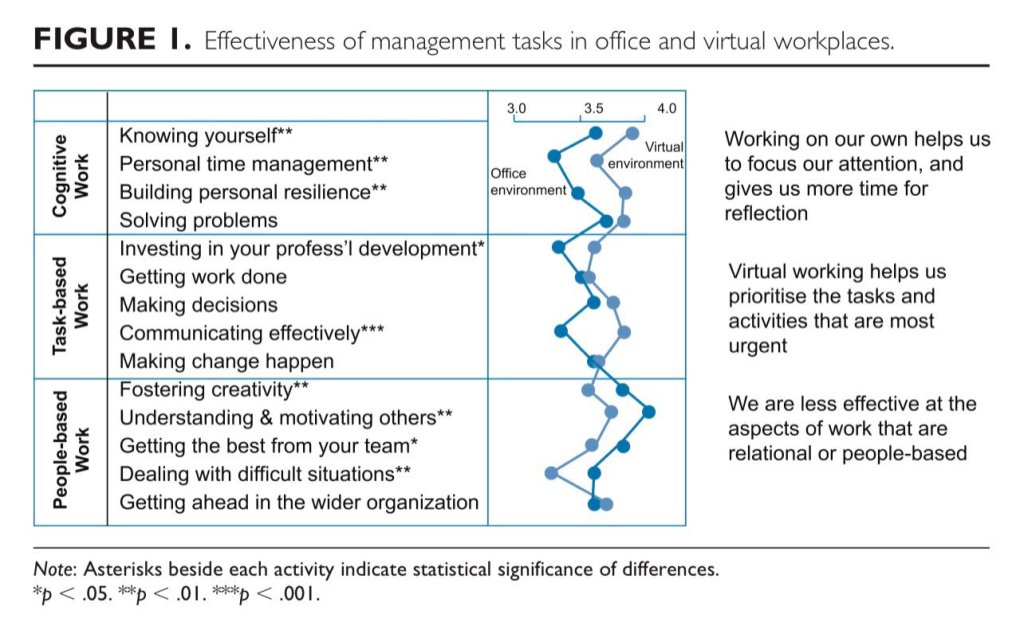
Some shades regarding remote work from three recent studies: The effects of remote work on collaboration among information workers; The Blinkered Boss: How Has Managerial Behavior Changed with the Shift to Virtual Working?; Work from Home & Productivity: Evidence from Personnel & Analytics Data on IT Professionals.

  • Remote work, when extended to the whole company, reduces the opportunities and the willingness to connect with people who are not directly working with you.
  • Hybrid work should probably not be about coming to the office whenever someone wants, but rather about organizing days in which certain teams, or the whole company, goes to the office.
  • Remote work does improve the individual’s capacity to focus and reflect, does improve the individual’s capacity to deliver on their own tasks, and has a negative impact on aspects of work that are relational or people-based (e.g., understanding and motivating others, or dealing with difficult situations).
  • Just because productivity does not take a hit from remote work, it doesn’t mean that individual productivity has not decreased. People might be simply putting in more hours, for example because they have to attend more meetings or because they have a stressful situation at home.
  • Remote work does decrease the opportunity for interaction with supervisors, and in particular the opportunities to get coached by one’s supervisor.

Note: thanks Ethan Mollick for sharing the studies in the first place.

Little future

Remember to balance your ability to get things your way with the fact that, on the other side, there is somebody who has just lost the trust in the relationship and their capacity.

You can push, you can order, you can yell, you can bypass, you can threaten, you can boss around. And you’ll eventually make it happen exactly how you wanted it to be.

There’s little future after that though.

Commit to delivering

What do you value most?

Being right or getting things done?

If you spend time proving you are right, searching for evidence to argue against others, making sure everyone understands and recognizes your contribution, hoping that others will fail, things will be slow.

If on the other hand you are committed to delivering, being right becomes a nonproblem. You accept things and let go of things for the sake of a greater purpose.

It won’t take long to realize you can’t have both.