Stay on point

If you are busy trying to understand whether your team should work remotely, in the office, or in an hybrid format, you are most likely busy with wrong kind of questions.

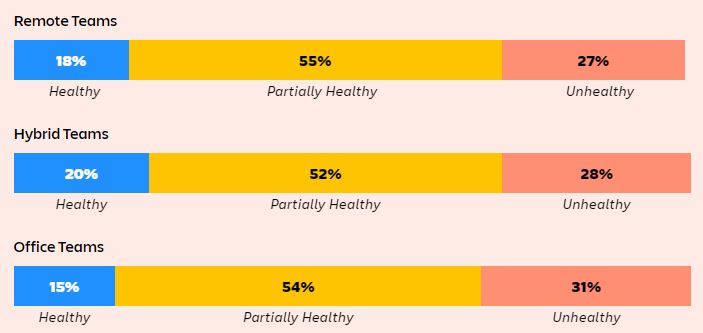
Atlassian, State of Teams report – There is no material difference in a team’s health based on where they work from.

It might be yet another issue that distracts from focusing on the need to reassess what management means and what people seeks in organisations and their work.

Let’s stay on point.

Making up

Saying that you are sorry is great, and of course when you do that often for the very same reason, then deep down you are not sorry anymore.

I am sorry I am always late.

I am sorry I never call.

I am sorry I keep getting mad.

If you catch yourself doing that, there are two options.

Either you realize that the thing you are always sorry for is not as important for you as something else.

I am always late (not important) because I like to arrive when everyone is already there (important).

I never call (not important) because I do not want to talk to you (important).

I keep getting mad (not important) because that is my go-to way to express discomfort (important).

It is legitimate, and you have got to accept that others might have a different set of priorities and decide to move on.

Or you might realize that, while you genuinely want to change the behaviour, you are stuck. And in that case, as you go through your own soul searching, there is one important question you need to answer: How can I make up with them?

I am sorry I am always late, I will take some time after the meeting to edit the notes and send them around.

I am sorry I never call, I will keep you updated by sending you an email every week.

I am sorry I keep getting mad, I will make it clear to others it is on me if we are not getting along.

Of course, you can always ask: How can I make up with you?

Compensation strategy

Data about average salaries at a company, combined with data about average salaries at similar companies, is a huge and underutilized opportunity for any organization.

And not because one has to match or surpass the others, ensuring that they offer the top rates in the market. Quite the opposite, in fact. It is an opportunity because it gives the company the chance to start a conversation about an important piece of their culture and identity, and about how that compares with the rest of the market.

Money is but one motivator for most people, and not even the most relevant in many cases. Offering lower salaries and more of the rest can be a powerful statement and a winning strategy when done intentionally.

The alternative is what already happens in most cases: money as the main leverage in individual, secretive, transactional negotiations that leave each employee with the conviction that they can leave as soon as somebody will pay them more.

It is wasted potential.

Two myths

There are two myths that new managers often fall for, and that have the potential to create immense damage to their teams and themselves.

Myth #1 – The manager knows everything. Of course, it is false. The easier it is for a manager to say that they do not know, even large chunks of what is considered their responsibility, the more their team will thrive (looking for answers) and the more they will enrich their experience (being exposed to things they had not done in the past). It is a myth that can be dispelled by asking and listening.

Myth #2 – The manager needs to protect the team from everything. Change, challenges, and crisis will be upon your team in no time. It is only by putting them on the front line that they will be able to learn (also to be a manager in the future) and that you will have the time to dedicate to what matters most (supporting them as they are out there). It is a myth that can be dispelled by opening doors and letting people roll.

The road to change

People might do what you ask them to do for a number of reasons. It might be your charisma, or the position you hold, or fear, or compliance, or perhaps a new rule you just came up with. It is possible to get people to do things they don’t want to do. In fact, it is not even that difficult. But that is not change.

For change to happen, for it to bring a positive impact on the people around you and your environment, there needs to be a conversation. To build rapport, to draft a common way to view the world, to list a series of actions that might make sense in that world, and to eventually agree on which ones we will pursue that will make that world better.

It is extremely difficult, and that’s why many take the shortcut and jump right into the actions that will make the world better – essentially a list of tasks that they think might be the right thing to do.

It never has a lasting impact.