Get out of the way

At your company, who is responsible for what?

Who do you go to when a new page needs to be added to the website? When a campaign is not performing well and needs changes? When you do not know if a campaign is performing well? When your new service might benefit from a repositioning? When you are considering whether to enter a new market? When a new policy needs to be reviewed?

The point is, it can’t be always the same person. That creates bottlenecks, and at the end of the day one person cannot have all the answers. Also, it can’t always be a group of people (typically the same, the management team). Seeking buy-in from everybody is in itself a bottleneck, and somebody who is good at product development is probably not the best person to advise on brand strategy.

Who is responsible for what – that is something that, as a leader, you need to figure out early on.

Once you have done that, once you have trusted somebody to make decisions, once you have agreed on how you are going to be kept in the loop, once you have defined the metrics to track to measure progress.

Just get out of the way.
Assumptions

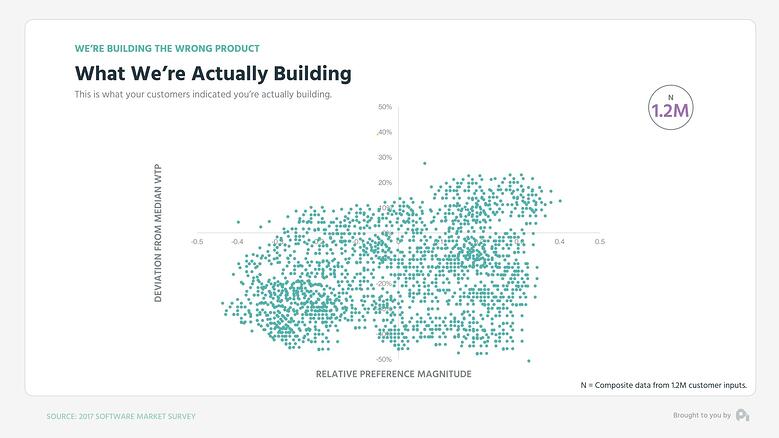
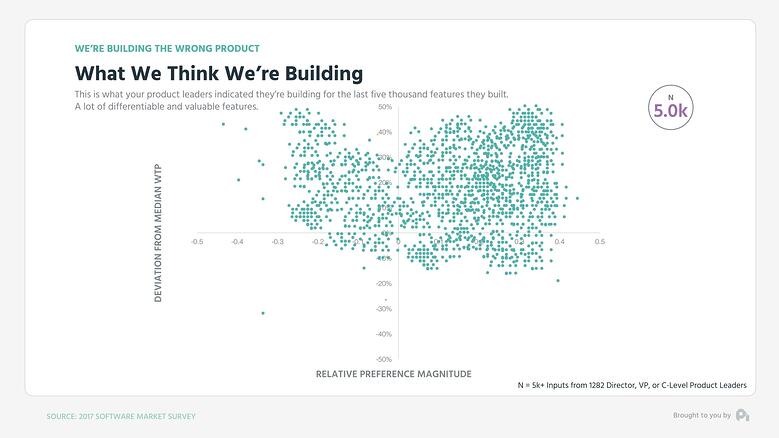
If you want to get an idea of how dangerous (for a business) assumptions and groupthink are, have a look at the two graphs below (research by Profitwell).

What 1,200 product leaders think of the last 5,000 features they released.
What 1.2M customers think of those features (in terms of Willingness to Pay and Preference).

We think we are building products and services that deliver high value and for which customers are willing to pay premium price. In reality, customers perceive those products and services as average and not particularly worth of their money.

The executives and leaders at a company are rarely the ideal audience for what they are buiilding. This is true when the company is young, and it is even more true once the company gets traction and grows.

You ought to free your decision-making process of assumptions and start looking at qualitative and quantitative data that come from customers. You should have done that yesterday. You can still make it happen today and have a huge competitive advantage nonetheless.

Culture is alive

Culture is not a statement.

It’s not a nice quote on the wall, a deck, or the list of principles on your website. It is not something you can decide in a meeting. It is not something you can survey. It is not something you can benchmark.

Culture lives in what you do. In the habits of the day to day, in what your leadership says, in the things that get rewarded. It’s in all the meetings, in the 1-1s, in the informal chats by the coffee machine. It’s in what you communicate, what you focus your attention on every time you stand in front of the camera and broadcast to the whole company. It’s in the details. It is there when nobody is watching.

What else?

There is no company in the world that does not want to increase their revenue.

So, if that is the main message you are giving your people, both internally and externally, be aware that your company is no different from any other company in the world.

What else do you stand for?

When coffee and kale compete

Every person wants progress, and when we design or market products and services we should focus on the progress we are enabling customers to make.

This is the foundation of Jobs To Be Done (JTBD).

With this approach, two things happen.

First, value is no longer seen as a transaction. It does not run out the moment a purchase is done or a service is delivered. Progress extends over time. The best way for a company to serve their customers is to understand the system of progress they are in – a good example being Weber, that does not stop at producing high-quality grills, and completes the offer with tools and resources to make the customer the grill master they want to be.

Design your product to deliver customers an ongoing feeling of progress – Alan Klement

Second, competition is no longer restricted to products or services that have a similar functionality or physical appearance. Anything that helps the customer achieve the progress they have envisioned (or might envision) for themselves is competition.

A Job To Be Done is the process a consumer goes through whenever she aims to transform her existing life-situation into a preferred one, but cannot because there are constraints that stop her

Alan Klement, When Coffee and Kale Compete
When Coffee and Kale Compete – Book Cover