We know what to do

We know what to do in most situations.

We know that when we approach a potential customer, we should focus on their story, not on our.

We know that when we plan which channels to use for our marketing tactics, we should be selective and carefully craft our messages.

We know that culture eats strategy for breakfast, and that employees are attracted by purpose and leadership, and that losing a talented person is much worse than losing the manager that made them quit.

We know we should be nice with each other, do not fill our calendars with appointments, be respectful of other people’s agendas, avoid showing up late and being distracted by our phone when somebody is sharing something with us.

We know a great deal of things. And yet, most of us fail at the same very things.

There are different reasons why this is so. It’s certainly partly due to our laziness. Partly it’s the fact our focus is misplaced. Partly it’s because we get carried away and we lose control.

And the biggest part, is us feeling we are special. There’s certainly something we know and that all others before us have missed. Our situation is unique, and we will succeed where everybody else has failed. This time, this time only, it is going to be different, and the rest of the world is going to see what I am, where I am at, why it’s important and follow me blindly.

Open your eyes. That is (almost) never the case. If you just stick to doing it, you will still end up a whole lot better off. And people around you will as well.
The worst thing that could happen

What is the worst thing that could happen?

I used to ask myself this question when I was younger, thinking of myself as a pessimist. Later on in life, I understood that it is actually a very stoic question to ask, and I have started sharing it also with people who seek my advice or are just kind enough to share their experience with me.

Fear should not stop us making the World a better place.

Most often, the difference between what we fear and what really is dangerous is immense. And so, what is the worst thing that could happen? is a great question to ask yourself when you start feeling some unrest in your body because you are in a situation that is not familiar to you. Or when you anticipate some crisis that might, or might not, come.

There are more things, Lucilius, likely to frighten us than there are to crush us; we suffer more often in imagination than in reality. I am not speaking with you in the Stoic strain but in my milder style. For it is our Stoic fashion to speak of all those things, which provoke cries and groans, as unimportant and beneath notice; but you and I must drop such great-sounding words, although, heaven knows, they are true enough. What I advise you to do is, not to be unhappy before the crisis comes; since it may be that the dangers before which you paled as if they were threatening you, will never come upon you; they certainly have not yet come.

Seneca, On Groundless Fear

Before the fear to speak up at the next meeting with senior managers stops you from sharing your idea or your concern, ask yourself what the worst thing that could happen is.

Before you avoid going to that place that you like, fearing to meet that unpleasant person, or to find yourself in an unpleasant situation, ask yourself what the worst thing that could happen is.

Before you surrender giving that speech, or sending that email, or making that call, or showing up, because sure, things could go wrong, ask yourself what the worst thing that could happen is.

When you give a shape, a smell, a contour, a name to what you fear, you will find you are unstoppable.

Take a step back

When you get stuck, your instinct tells you to find a way out.

And so you delve deeper into what you were doing and got you stuck in the first place, you wrestle with what you don’t get, tirelessly digging a path in the hope that the answer is at the end of it. You spend time, energy and focus looking at the problem, and the more you do it, the less it seems feasible. Not once I have managed to get untangled this way.

Instead, you could take a break. You could go for a walk, call a friend, have a cup of coffee. And then, when you go back, you could look at the problem’s contours, trying to refine them, make them more comfortable for you, even finish something around the problem you said you would have finished later. You are making it more presentable and ready to be tackled.

At this point, one of two things happen.

Perhaps you get your answer. It might come unexpected, as your mind was not really looking for it.

Or you realize that the problem was not really THE problem. That you had fears, expectations, doubts, concerns. All preventing you to look at things for what they really were. A mere block. And then you can continue with your work.

Until you get stuck again.

Repeat.

Perfect

This week, I have found this beautiful graphic depiction of how resistance works at times.

Do-Something-Ed-Batista

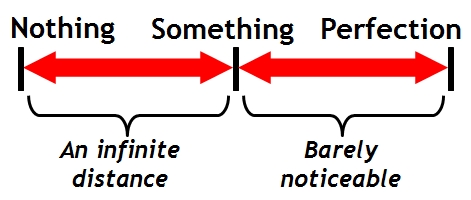
It’s from Ed Batista’s blog (that is strongly recommended, by the way), and it displays how it is incredibly more important to move from doing nothing to doing something, than it is to move from doing something to doing something perfect.

The greatest of intentions pale in comparison to the smallest of actions.

Noah Lomax

Very often, we get stuck in search of perfection. That is useless, as most of the time the difference between something and something perfect is barely noticeable. I like to represent it slightly differently with the following chart.

Do-Something

The fact is, perfection is often an excuse do escape doing. It’s been for me for years, it still is sometimes. But eventually, we’ll have to stop hiding and start shipping stuff that is As Close to Necessary to Perfect. Make a habit of it, it’ll be liberating.

Help and resistance

Resistance is a very interesting concept, one I knew I would talk about sooner or later. It is not mine, and it was very well developed by Steven Pressfield in his book The War of Art.

Resistance is a force that works against getting things done. It has different faces (rationalisation, fear, distraction, procrastination, self-criticism just to mention a few), but very generally speaking it is the story we tell ourselves to give us reasons not to do something we want to do.

If somebody offers their help, for example, in a generous and passionate way, the most rational part of us would say: “Thank you, I take it. Here is what you could do”.

But then resistance kicks in. And here is what it says. “They must be busy”, “Just offering their help to be kind”, “Don’t want to bother them”, “There’s no such thing like a free lunch”, “They don’t really care”, “I don’t have time to tell them what they are doing”, “This is not so important after all”, “I don’t even like them and their work”. And so on.

The point is, will you get what you wanted done or not? If the answer is no, be mindful of resistance. It’s the one talking, not you.