Assumptions

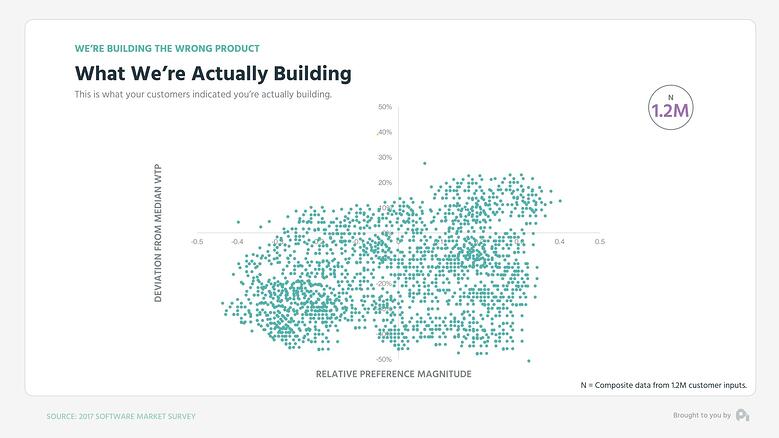
If you want to get an idea of how dangerous (for a business) assumptions and groupthink are, have a look at the two graphs below (research by Profitwell).
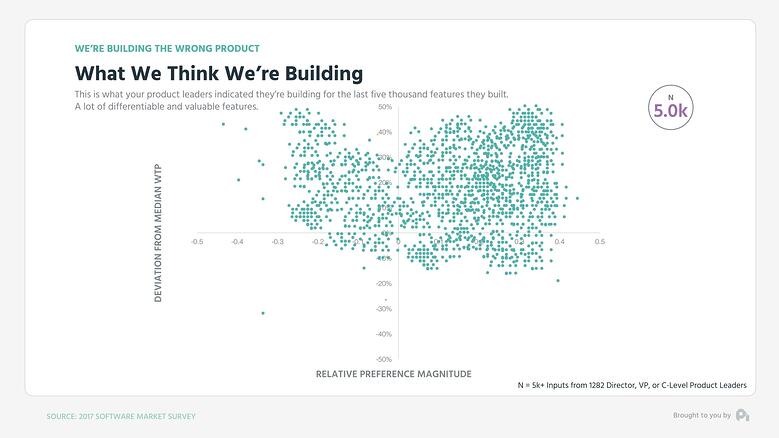
What 1,200 product leaders think of the last 5,000 features they released.
What 1.2M customers think of those features (in terms of Willingness to Pay and Preference).

We think we are building products and services that deliver high value and for which customers are willing to pay premium price. In reality, customers perceive those products and services as average and not particularly worth of their money.

The executives and leaders at a company are rarely the ideal audience for what they are buiilding. This is true when the company is young, and it is even more true once the company gets traction and grows.

You ought to free your decision-making process of assumptions and start looking at qualitative and quantitative data that come from customers. You should have done that yesterday. You can still make it happen today and have a huge competitive advantage nonetheless.

Slow down

We have gotten used to fast.

We want the world to move fast, we want change to happen overnight, we seek shortcuts and opportunities behind every corner.

We lose sight of the 99%.

And when that feeling is stronger, the only real thing we can do is look inside and ask how we can slow down.

Sleep.

Exercise.

Meditate.

Connect with those you care about.

Put technology aside.

Get rid of dopamine hits.

Trying to change the speed at which our world spins is pointless.

Trying to change the way we perceive such speed is wise.

Culture is alive

Culture is not a statement.

It’s not a nice quote on the wall, a deck, or the list of principles on your website. It is not something you can decide in a meeting. It is not something you can survey. It is not something you can benchmark.

Culture lives in what you do. In the habits of the day to day, in what your leadership says, in the things that get rewarded. It’s in all the meetings, in the 1-1s, in the informal chats by the coffee machine. It’s in what you communicate, what you focus your attention on every time you stand in front of the camera and broadcast to the whole company. It’s in the details. It is there when nobody is watching.

Reach out

When you are down, reach out.

Even if you don’t feel like it.

Even if you have nothing to say.

Even if you don’t know.

Even if your instict tells you not to risk it.

Even if you are sure nobody would understand.

Even when it’s pouring.

Even when you have been rejected before.

Even if they don’t care.

Connection might well be the single thing that will keep us afloat. Seek it and cultivate it. Even when you don’t feel like it.

Back on your feet

Fears build up within us. The reality is rarely as bad as we imagine it to be.

What is the worst thing that could happen? is always a very powerful question. We don’t need most of the things we want, and we don’t want most of the things we have.

Look your anxiety in the eyes and ask: What if I let it go? What if what I fear will materialize? What if the worst case scenario is what I will wake up to tomorrow?

I promise, more often then not, you will still be you.

And then you’ll have all the resources to get back on your feet.