Not every story needs a villain

Sometimes we make decisions that have a negative impact on our community, on the people around us, on the group.

We might break a rule, or demote someone, or take a controversial stance on a shared opinion.

And when we do that, it looks like the immediate need is to degrade the object of our decision.

The rule is stupid, the person is incompetent, the shared opinion is naive.

We end up creating friction and eventually the fracture is inevitable.

We could instead own the decision. Be straightforward about it. Acknowledge that perhaps, this time, we might be seen as the bad guy, and still we believe we are doing something that make sense for the purpose we want to achieve.

It is a better way to frame what’s happening, one that goes beyond a false sense of righteousness that we too often use to shield our own responsibilities.

Not every story needs a villain.

Being fair

A big problem with offering $85,000 for a position budgeted at $130,000 is that very soon the person to whom you are offering the position is going to find out (even if you do not tweet about the whole situation).

And when they do, two things will happen.

First, they will feel cheated, demotivated, disengaged. They won’t be able to perform at their best, because nobody does when the counterpart sees the relationship as a mere transaction.

Second, they will start spending most of their resources to be paid what it is fair for them to be paid, whether that is at the company or somewhere else.

Was the hustle worth it?

Figure it out

The current situation is unprecedented. The pandemic is putting a strain on everybody. A huge amount of people have suffered serious consequences.

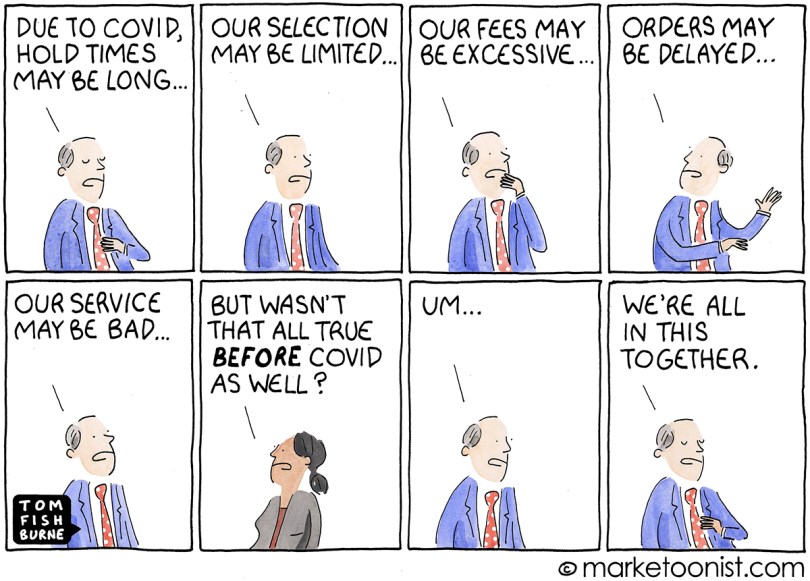
And if after two years your company is still using Covid as a tentative reason to excuse poor customer service, delayed deliveries, price increases, product shortages, it’s time for you to stop.

Rethink your business, instead, and figure out a way to provide the experience people expect.

That’s your responsibility.

Note: the image of this post is from Tom Fishburne @Marketoonist.

Goals

Give people goals that:

  • matter for the achievement of a more generic business goal;
  • they can impact with their own actions;
  • they can easily track and report on;
  • are clearly communicated and consistent across time.

It does not end here, but this is a fantastic place to start from when managing a team.

Ask instead

Approach every conversation with intention and clarity.

You might be in it because you need something: advice, listening, a hug?

You might be in it because something is needed of you.

One way or the other, making the need explicit increases the chances of actually having a successful conversation.

The alternative is to assume that something has happened when in fact it never did. We had a fantastic chat and we are perfectly aligned now. Except you are not.

Most often, you do not have the time to figure it out. So, ask instead.