Stay

There is value in staying with what makes you uncomfortable.

You get stronger, you understand more, you settle. Staying is a learning experience. It is by staying that eventually you begin to manage situations that initially seemed insurmountable.

Of course, staying is also a huge stress.

So pick a few things that matter, and stay.

Not exciting anymore

Three reasons why the new tool, system, process, structure rolled out in your organization is no longer as exciting as it initially seemed.

  1. The people making the decision are the not the ones impacted by the decision. Very often, the people impacted by the decision are not even consulted in the decision-making phase. Assumptions and second guessing are key criteria.
  2. There was a tacit expectation that the tool, system, process would have been welcomed by everybody as a cure for all that is bad. In other words, nobody really gave change management a thought – and if number 1 is true, you are most likely already drifting into number 2.
  3. There is no agreement on accountability and how success is going to be measured. People will do everything to avoid saying: “we failed (and we will not fail again)”. Flawed solutions will be around for years, until a new change can be sold internally. Putting the process back at number 1.

The shades of remote work

Fake dilemmas make the world flat.

To make decisions that are not impulsive and destructive, we need to be able to add shades (and data) in between the dichotomy.

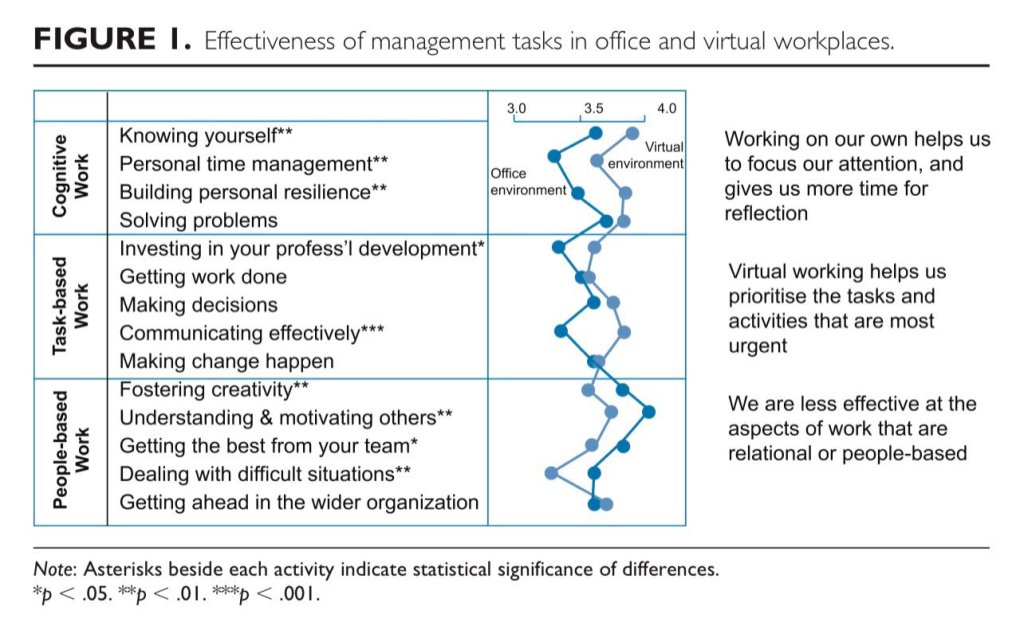
Some shades regarding remote work from three recent studies: The effects of remote work on collaboration among information workers; The Blinkered Boss: How Has Managerial Behavior Changed with the Shift to Virtual Working?; Work from Home & Productivity: Evidence from Personnel & Analytics Data on IT Professionals.

  • Remote work, when extended to the whole company, reduces the opportunities and the willingness to connect with people who are not directly working with you.
  • Hybrid work should probably not be about coming to the office whenever someone wants, but rather about organizing days in which certain teams, or the whole company, goes to the office.
  • Remote work does improve the individual’s capacity to focus and reflect, does improve the individual’s capacity to deliver on their own tasks, and has a negative impact on aspects of work that are relational or people-based (e.g., understanding and motivating others, or dealing with difficult situations).
  • Just because productivity does not take a hit from remote work, it doesn’t mean that individual productivity has not decreased. People might be simply putting in more hours, for example because they have to attend more meetings or because they have a stressful situation at home.
  • Remote work does decrease the opportunity for interaction with supervisors, and in particular the opportunities to get coached by one’s supervisor.

Note: thanks Ethan Mollick for sharing the studies in the first place.

Easing

Sometimes we get annoyed at people and situations merely because they are not where they want them to be.

We might have spotted potential in someone, or we might just have grown sensitive to a behaviour that repeats over time.

We might have envisioned a better world, or we might just have had enough of a culture where we feel we don’t fit.

Easing into what is will give us and the others the opportunity to change, to grow closer, to eventually meet in a place where we are better and they are better.

That’s true improvement.

The right muscles

Once you’ve identified your triggers, the point is not to stay away from them or drown in the anticipation of the pain they will expose you to. The point is to find ways to manage them and gradually master them.

If you are comfortable around somebody you can’t avoid, take control of your encounters and suggest whatever makes you feel at ease.

If presenting in front of a vast audience is too much for you, volunteer every time there is a small presentation to give.

If you are afraid your boss might ask questions about a delicate issue, make sure you will be the first to raise the topic, at a time convenient for you, with the words you have chosen and rehearsed.

You can prepare for almost everything, as long as you choose to train the right muscles.