A practical take

Looking at the story you want to tell, the one that is going to place you in a different spot than the majority of people, means understanding two aspects about you: what you want and the set of skills you have.

What you want is complex to discern. It is a multi-layered finding, and it requires self-reflection to really unpack it. A question that well complements the research is why you want (what you want). There’s quite the difference between, for example, wanting a job because you need to sustain your family and wanting a job because you want to kick-off your career. Asking why helps finding out the actual want (family or career in the example), rather than just stopping at the supercial one (job).

The set of skills you have is also something not usually straighforward. We are quite used to think of skills in terms of degree we have achieved, positions we have covered in previous work experiences, titles we put on the CV. That is a narrow vision on what we can do. If you start writing down what you have actually done throughout your career, and also look at your non-professional activities, you will start seeing patterns emerging. Perhaps you’ll find out your are particularly good at understanding the needs of others, or you have done quite a deal of work across different deparments, or you can write a 3,000 words, deeply-researched and well written blog post. This is a much more granular way to look at what you can do rather than, say, thinking at your skills in terms of broad categories such as marketing or sales or product management.

If you do explore both what you want and your set of skills in such a way, and have good information about the playing field in which you are competing, then something interesting happens when you combine the two dimensions.
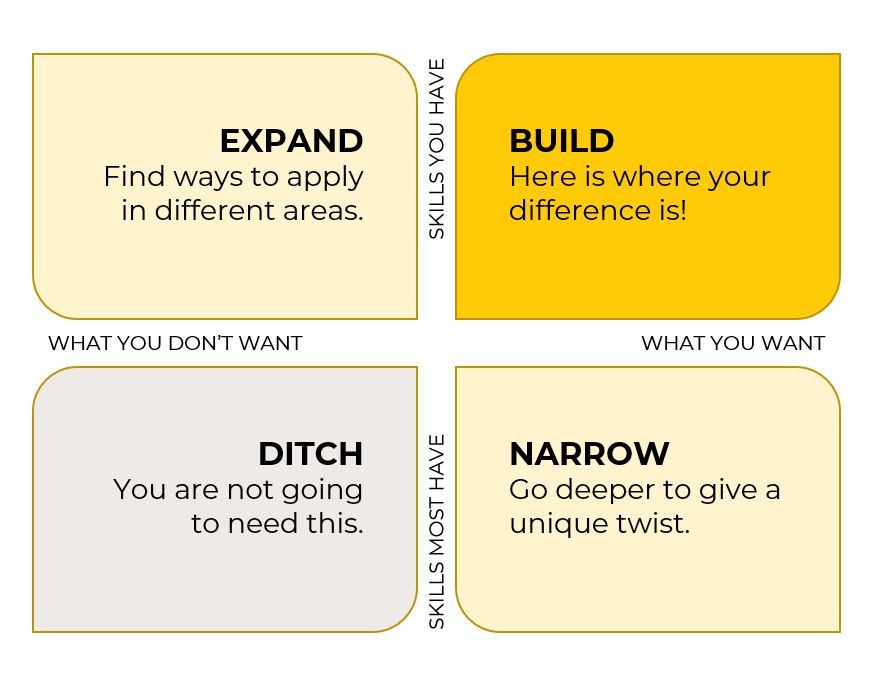
A framework to help build your unique story.

More in details.

  • You might come across some skills that most people have (in your community) and that belongs to a domain you do not want to explore. This is what you can essentially forget about, because it’s not going to add anything to your own unique story.
  • Then there are skills that have become distinctive of who you are, yet are typically associated with domains you are not interested in. You might be tempted to get rid of those as well, but actually you would do better checking if there’s any chance to EXPAND their application to areas that are interesting to you. Say for example you have been working with spreadsheets a lot for budgeting purposes, and you know the ins-and-outs of spreadsheet tools. Still, you are definitely done with figuring out how much stuff can cost, report the actual expenditure, consider the difference and update the forecast. There’s quite many other areas where this type of knowledge might come in handy, and some of them might actually be closer to what you want than you think.
  • On the other hand, there are skills that are fairly common (again, in your community) and are strictly related to the type of career you want to pursue. In this case, you might want to see if you can go deeper, either by specializing or by NARROWing the skill even further. Say you have experience in running email marketing campaigns, a skill you might struggle to differentiate for. Perhaps there’s an element of running such campaigns you are particularly good at (e.g. analytics, optimization, creative, copy-writing, etc.), or there’s a tool you can successfully set up blindfolded (e.g. Marketo, Mailchimp, Zoho, etc.). This might give you the edge you are looking for.
  • In most cases, most of the combinations you are going to come up with are in one of the two quadrants just described (EXPAND or NARROW). The final goal is of course to identify two to four skills that you have (and few others do) and that are in tight relation with what you want. That’s how you are going to find how to stand out, how to tell a story that can resonate with the right audience and that you can continue BUILDing upon.

This is all part of a workshop I am preparing for people who have relocated to Finland and that are looking for a way to get started professionally in this country. It is still rough, but I figured somebody might be interested in taking this approach to shed some light on how to build their unique story.

No cogs

When looking back at our career, all we see is often company names, titles and dates.

But in those periods, in those roles, at those organisations, we have done stuff. Often, a lot of stuff. And that is much more important than the rest.

If you invest time writing down what you have done at one company, it is likely you are going to identify two or three skills you had no idea how to word and present. Do this for all of your past experiences, and you’ll have a pretty good picture of what you are good at and what you like to do.

The following step is to build a story around that, a narrative that matches the characteristics of the market you are in and the needs of the company you want to be hired from.

If you do not want to be treated like a cog, step out of the machine and go find your way.

Cover letters

There are four key elements to any cover letter, and they are often missing or misunderstood.

First, the appeal of the company. The question you are trying to answer is why do I want to work for this company?. You might not have a reason when you see the job ad, but you better find one soon. This require some research online. Look for stories that might resonate with who you are and what you stand for, or even for characteristics the company has that meet some of your outstanding experience. “I have heard a lot about company X”, or “I have always wanted to work for company Y” does not really cut it anymore. Basically anybody can claim the same, and you should start singalling uniquess from the very beginning.

Second, the passion for the role. The question you are trying to answer is what makes this position important for me?. Here is where you start telling about your passion for the field, about the times you have worked in the same role elsewhere and have excelled, about how you have tailored your curriculum to exactly arrive at this moment, applying for this position. Even if you are a new graduate, you probably have some passions or preferences for one field or another, and expessing them is always better than “I am just ok with any job you could offer me”.

Third, your experience. This is what most people get wrong. It’s not about making a list of places you have worked, roles you have covered, skills you have accumulated. There’s a CV for that. The question you are answering here is what have I done so far that matches the requirements listed in the job ad?. Many applicants preach to the wind, figuring that their experience would be good enough for most jobs. But actually, you want to look at the list of requirements carefully, think at what you have done so far (professionally, academically, personally, in order of importance), and see what you have learned that might be applicable in the role you are applying for. It will take a while, and you really have a chance to stand out in this section. It helps if you look at your career horizontally rather than vetically. Pick two, maximum three, relevant examples, and use a story format: “We had this problem at company X, we tried this and that, we eventually achieved a x% improvement in A, and this tought be the importance of B” (where B is what the target company is looking for).

Fourth, and last, the deabreakers. In this final section, you want to list things that are a must for you. “What could the company fail to provide that would make me change my mind about all of the above?”. Here is where you list availability to travel or relocate, salary requests, need to work remotely, and so on. If you have more than two or three items, carefully think if they are all _so_ important that you really want to point them out in the cover letter. Eventually, you do this to avoid a waste of time, but you also want to signal some sort of flexibility to further underscore that this role at this company is truly what you want.

Few thoughts

A bunch of random thoughts, further reflecting on my story as an expat job seeker in Finland.

When you are in a new situation, use where you’ve been to fuel the journey ahead, not as a reminder of the journey it could have been.

People need somebody who believes in them, and while you are waiting for that somebody yourself, it’s easy to forget you could be the one believing (in you and in others).

Being aware of luck is tremendously important, and helping others with the luck you are given is a great way to keep your feet on the ground.

If you are thinking about mentoring, helping, volunteering, the best thing to do is to just stop talking about it and start doing it. It’s generous, rewarding, and it does make a difference.

Vertical and horizontal

How do you think at your career?

If you think at it vertically, it means you see it as a (more or less) straight line. It’s a progression, you look at where you were yesterday and make expectations about where you will be tomorrow. Of course, there might be hiccups, that we perceive as overwhelmingly negative and that we do our best to avoid. But in general what you care about is advancing, going forward.

Traditionally, careers are built vertically. Since school, we are used to approach things in terms of levels (first grade, second grade, …; primary school, secondary school, high school, …), and at certain points we are given particularly difficult tasks (exams) that might get us promoted.

This system is partially based on the assumption that what you do will stay with you, and actually accumulate throughout the years. It’s the reason why people who stay with a company for ten years are more likely to get promoted or to have a higher salary, or people that have 20-30 years of experience are more valuable on the job market than new graduates.

The alternative is to think at career horizontally. In this case, rather than looking at where you were yesterday, you think about what you have learned, achieved, experienced. Where do your skills fit best in this particular time? What type of company could use your experience with this or that? What role would really allow to put the best you at the service of the community?

There is no straight line in this sense, rather a wide variety of opportunities. You might find yourself in a position you would have not considered, just because that’s what make sense right now. You might have to accept a lower salary, just because you understand that you are needed, here and now. You might have to make a long detour, just because you want to refine a certain skill or learn a new art. I’d go as far as say that if you approach your career horizontally, all these things would not even matter in the first place.

All this becomes particularly relevant when you are looking for a new job.

If you approach the search for a job with a vertical mindset, you are narrowing down the options quite a lot. Say you have been some sort of Marketing Manager in the past four years: you’ll most likely look for some a senior marketing leadership positions, possibly at larger companies, probably in the field you already have experience with (B2B, Saas, B2C, etc.).

If instead you look at the situation from a horizontal perspective, the Marketing Manager role loses its importance, and you could for example focus on the fact you have learned how to lead people to solve difficult problems, how to present in front of a wide audience, and how to work across departments to align vision and strategy. These are all skills that are applicable to many more positions, fields, companies, industries than a simple job title is.

I am not implying that one way is easier than the other. Certainly, most of the current job market is designed with verticality in mind, both on the demand and on the offer side. And for this very reason, people often struggle to find a different way: they hit their head on the wall, they get rejected, over and over again, they feel drained and demotivated, and eventually they give up.

The way you approach things changes the way you see things. And sometimes, all you need is some more opportunities.