Simplify

This is a very well crafted video that tells of how ahrefs went about redesigning their home page.

It is about the company, but it is not about the product. It is something the target audience wants to know about (web page redesign). It has a twist right at the beginning (the 3 copywriters) that makes sticking around until the end more likely.

And by the way, if you plan to redesign your website, three questions worth asking.

1. When do we show the product? It is a fairly common practice in B2B to feature loads of videos and screenshots on the website, but as the guys at ahrefs realised, perhaps opening the home page with a hero screenshot of a dashboard might put off many visitors who are just problem-aware.

2. How much information is enough? Getting lost in details is easy, and getting lost trying to expres details is even easier. A waste of space and attention, so just stick to what is needed to catch the interest of your target audience.
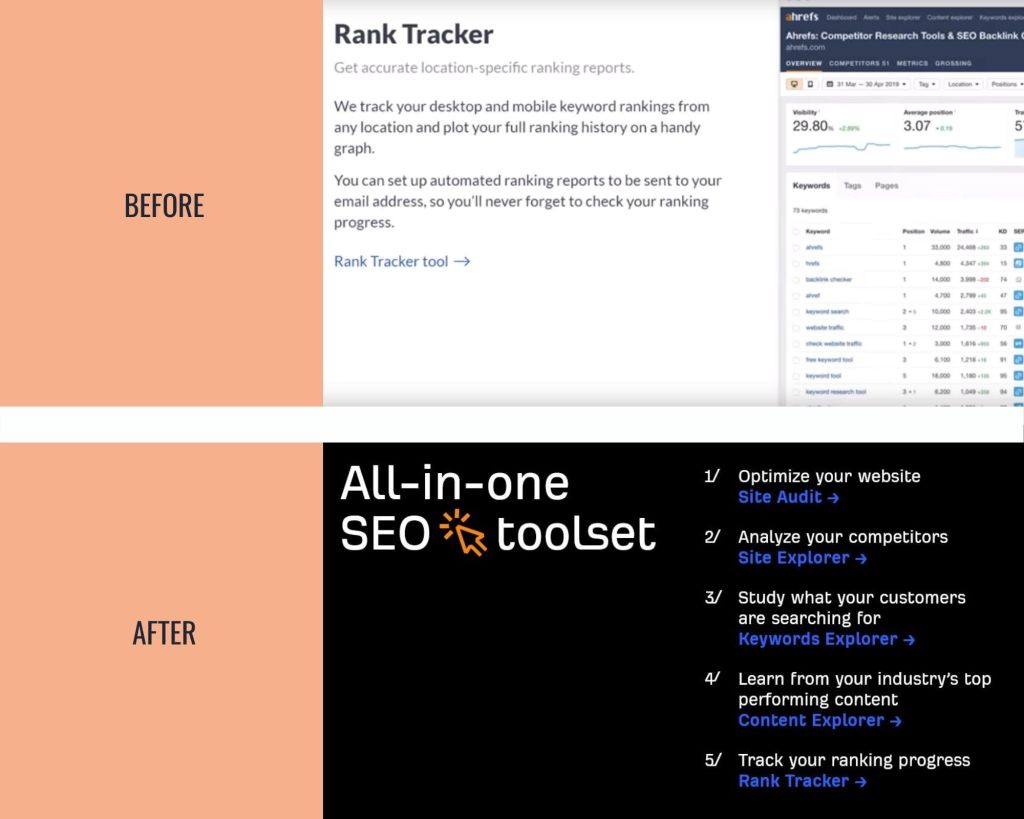
3. How long should a A/B test be? For many things, measuring the real impact on business metrics takes time. A/B testing in 1-2 week-long sprints is probably focusing on the wrong metrics. Marketing is a long A/B test.

Mantra

This is a mantra worth reminding, as marketers seem to forget it all the time.

No one wants to hear about your product.

And there are beautiful examples of what can be achieved when this becomes an assumption underlying your content strategy.

It also works, by the way.

The distance

You have spent resources improving your product with features analysts said are necessary in your category.

You have hired hundreds of new employees and built an organization that can sustain higher revenue.

You have rolled out a new tool because the old one was clunky and not providing enough flexibility.

You have gone all-in on that campaign because your experience and guts told you that was the right thing to do.

You have increased your marketing spend to better feed sales pipeline, investing in ads that interrupt people and are clicked only by robots.

You have changed your management team because the targets were not met.

And in the meantime, out there a potential customer is still wondering how to fix the issue your product is supposed to solve.

The distance between what happens within companies and what happens in the market is often shocking. Organisations and the people they are supposed to serve play in different fields, sometimes in completely different sports. The only way to fill such gap is to religiously do two things over time: figuring out who your customer is and understanding their world better than they do.

It is a strategy, not a tactic. And for this reason the distance continues to grow. And grow. And grow.

Advertising trends

A couple of considerations looking at the charts in the tweet below.

The growth of Facebook (including Instagram) is surprising, in that it comes at least in part from erosion of the share of Google (including YouTube). That means, of course, that Zuckerberg and friends will change very little of what has made that growth possible, even if at the expenses of social and civic well-being.

It is quite a thing that print still gets 7-8% of ad spending, despite people spending just 1-2% of their time with print. Considering a similar ratio was also valid in 2010, print had probably been seen for a while as a cheap option to spread the brand. And perhaps one that can get pretty granular (niche and lifestyle magazines) in front of a pretty high level of control (that companies lose with programmatic, for example).

Despite the attempts of innovating and the limitless potential of the platforms, advertising on digital (both mobile and desktop) is still pretty much a copy of what was previously happening on television, radio and print: interrupting the attention of somebody who is there to do something else. Nothing particularly new regarding what advertisers are looking for.

From old to new

When you hear about something new, make sure it is actually new by relating it to what is already known, done, accepted in your field.

It happens quite often, in marketing for example, that a new concept is a mere rebranding of old tactics. This is done, more or less unconsciously, in part to ensure tactics stay relevant, in part to appeal to a new wave of workers, in part to protect the work of marketers (who are by definition creative and innovative).

The basics of marketing have not changed much in the past decades. The best way for you to be in marketing these days is to start from them and build your way to what is new, not the other way around.