Full control

There is a popular meme that tells about the relationships between a job done fast, well, and cheap. You can do a job fast and well, you can do it well and cheap, you can do it cheap and fast. What you can’t do is fast, well, and cheap at the same time.
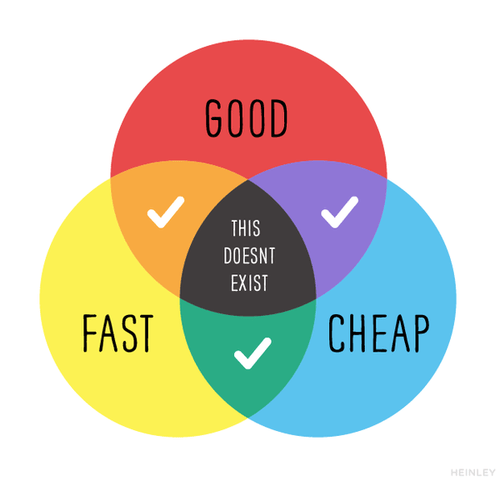
Source: The Developer Society, Good/Cheap/Fast

The meme fails to tell another truth, though. A bane to many companies. That is: you can’t do a job fast, well, or cheap if you want to maintain full control on the outcome.

You can’t do fast, because when the job is ready, there are still review phases to go through. Often featuring vague feedback, last minute changes, and unsubstantiated personal opinions.

You can’t do cheap, because all the layers you are adding have a cost. And even more expensive is the price you pay for the people who leave once they realize their talent comes after tenure.

You can’t do well, because by the time you get to the finish line, what you have is a frankestein that satisfies everyone and excites no one.

So, if your goal is to maintain full control on the outcome, any of the combinations in the meme is a much better path to execution. Change, or be prepared to be kicked out of the game.

Support

What do you do when someone comes to you with an idea you find hopeless or inadequate?

You denigrate the idea, saying it is a bad one and it does not deserve any of your time.

You force change onto the idea to make it fit with what you think might be a better idea.

You begin a conversation and try to compromise to get the idea nearer to you.

You support the idea and say you will do your best to help.

I guess much depends on how invested you are in the topic. A manager might find it difficult to support something that might take time and resources and return no results; a friend might be more open to keep their opinions to themselves and help instead.

Relationships are built and broken on these type of choices. Get to them with intention and care.

Protect

We want to protect others.

We don’t want to hurt feelings, share unpleasant truths, give negative feedback. We refrain from difficult conversations, and we let issues escalate until they become too big to be tackled. We rarely push. We almost never ask. We always assume it is not the right time.

We want to protect others. And by doing that, we protect ourselves.

It is a noble intention. Let’s just not take cover behind it every time we are not ready to leap.

Companions

After one year (and counting) dealing with social distancing, isolation, uncertainty, fear of sickness and death, confinment, lack of freedom, impossibility to meet family and friends, video-conferencing, constant worrying.

We are all exhausted.

So if you are too, that is fine.

If you struggle to find motivation, if you do not want to get started, if you would rather call in sick, if you start thinking it’s not worth it.

You are not alone.

Reach out to somebody today. Tell them about how you feel. Listen as they tell you how they feel. And find a companion.

We all need that now.

Questions and answers

As a leader, the surest way to have your team contribute is to speak when a question is needed and to shut up in the process of finding the answer.

The problem is that we often get this all wrong. And so direct reports ask questions and managers give answers, nurturing an organization that is bottlenecked, does not grow, and demotivates.

Leaders, be vulnerable and let go.