Brand

A part of marketing is generating sales. And a part of marketing is fostering brand.

There are some myths around this that should be debunked.

Starting with the fact that the two things are separated and can live independently. Perhaps that is true in the short term, but building a business is a long term effort, and eventually brand and sales need to go hand in hand. Brand is what gets you your best-fit customers after all.

Then, there is the idea that sales is (mainly) for the early stages of a company, and brand is for when a company already controls a certain share of the market. This is a belief that comes from an era (and we are talking about probably 10-15 years ago) when markets featured a bunch of players (say between 10 and 50 – now there are hundreds, thousands in some cases). It is also backed by the assumption that investing in brand is something only bigger companies can afford, probably because when talking about brand one thinks at tactics.

Finally, there are many who argue that generating sales is infinitely more measurable than fostering brand. And there is some true to it. But of course, the reality is that most sales-focused activities end up being not measured, mismeasured, unoptimised, and eventually most organisations just throw money at a problem without really understanding what is going on. And on the other hand, we still get emotional in front of marvellously crafted brands and often decide to buy A instead of B in the heat of the moment.

So, perhaps instead of saying that a part of marketing is generating sales and a part of marketing is fostering brand, we could say that marketing is both.

The sooner we get to look at the two things together, the sooner we will stop wondering why the 105th whitepaper is not driving pipeline or why the new logo is not resonating with our audience.

That is a waste of time.
Patches

Many organisations mistake customer centricity for customer support or customer success.

Yet, having the customer at the core of what you do is not about being there when they need help and collecting high scores on a satisfaction survey. It is actually more about aiming at getting rid of those things, because when the customer is embedded in the business, you know already if they need help and when, whether they are happy or not, what they want to see in the product next and how their businesses are developing.

You actually know, in many cases, before they do.

So, instead of putting patches on the relationship with those who determine your (organisation’s) success, start investing time and resources in crafting the relationship. Listen. The rest will follow.

Simplify

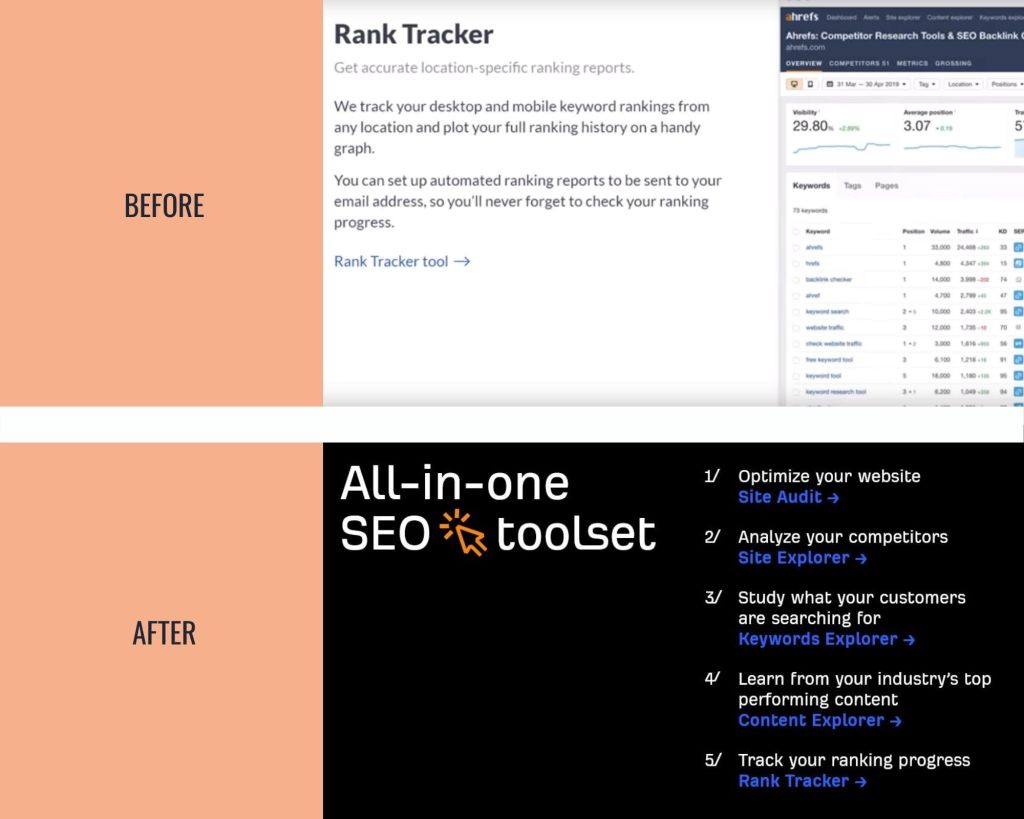
This is a very well crafted video that tells of how ahrefs went about redesigning their home page.

It is about the company, but it is not about the product. It is something the target audience wants to know about (web page redesign). It has a twist right at the beginning (the 3 copywriters) that makes sticking around until the end more likely.

And by the way, if you plan to redesign your website, three questions worth asking.

1. When do we show the product? It is a fairly common practice in B2B to feature loads of videos and screenshots on the website, but as the guys at ahrefs realised, perhaps opening the home page with a hero screenshot of a dashboard might put off many visitors who are just problem-aware.

2. How much information is enough? Getting lost in details is easy, and getting lost trying to expres details is even easier. A waste of space and attention, so just stick to what is needed to catch the interest of your target audience.

3. How long should a A/B test be? For many things, measuring the real impact on business metrics takes time. A/B testing in 1-2 week-long sprints is probably focusing on the wrong metrics. Marketing is a long A/B test.

Today and tomorrow

Success is about aligning the actions of today to the desired outcomes of tomorrow.

This is where most of us fail.

Because the short-term adrenaline rush, the immediate reward, is very attractive when compared to something that might (or not) come at some point in the future. And what if when we are there we will not like it? And what if this shiny thing right here, right now will actually become a once in a lifetime opportunity?

It never does.

We spend our days moving from one distraction to the next, and it is only when we look back at our day, at our week, at our year, (at our life?) that we realize we are not a step closer to where we want to go.

It is natural, common and accepted. And we need to stop it.

Things done right

The moment we think: “if you want things done right, do it yourself”. That is the moment things actually stop being done.

No matter the level we reach in our career, we are not responsible for everything and we are not capable of doing everything. The illusion that telling others what needs to be done would take simply too much time, or that what lands on our desk is something we need to take care of in person, is just an excuse to postpone that difficult conversation, that report that requires your full attention, that speaking engagement you always wanted to take.

It is resistance.

By being unwilling to delegate tasks that others could reasonably help with, we fail to make progress on the important or tricky things that only we can do.

How to have a good day, Caroline Webb

P.S.: This is as true as it gets even for managers who still cling to completing tasks instead of taking responsibility for the development of their team.