There is no such thing as a free social media platform

We are hitting our heads against a wall.

For years, we have believed in the myth of “free”. Listening to music was free, watching a video was free, posting your piece of content was free. Whether you were an individual or a company, you could get in front of a fairly wide audience with a very small investment of energy and time, and essentially without spending any money. And of course, as we were getting blinded by the allure of “free”, we forgot about a very important fundamental.

There is no such thing as a free lunch.

Even when things appear to be free, they are not.

While we have not paid a dime to publish and distribute our content for the past decade or so, we have most likely contributed to the impoverishment of our society and to the extremization of the public discourse.

Furthermore, as marketers we keep banging our heads against the wall every time a platform curbs our potential to reach our audience (current or wanted). We might just understand and accept that those platforms do not exist to allow us to spread our message to whoever we want. And instead we first spend weeks over weeks complaining about how our posts used to get 1000 and now gets 200. Then, we try to game the algorithms, we hack a bit further to try to squeeze more, we ask strangers of dubious reputation to publish or click on links just to try to increase our content’s rank, we use shortcuts to boost metrics that have absolutely no business relevance.

The basics of marketing have been the same for decades, and if we manage to stop our head just for a second, we can see that is what still matters nowadays.

  1. Understand who your audience is.
  2. Ask what they need help with.
  3. Match your product or service to the help needed.

The rest is noise. It distracts us from achieving things that matter and from delivering meaningful change.

Details matter

Details matter. Nowadays more than ever.

Particularly in marketing, in content marketing, details are a big part of the story your brand wishes to tell. It is difficult to fake details, and so they end up being the best representation of what an organisation stands for. They are what you do when nobody is watching.

Details set the tone for the conversation with your audience, they are how others look at you and remember you. And equally important, they are what makes you feel better about the work you do.

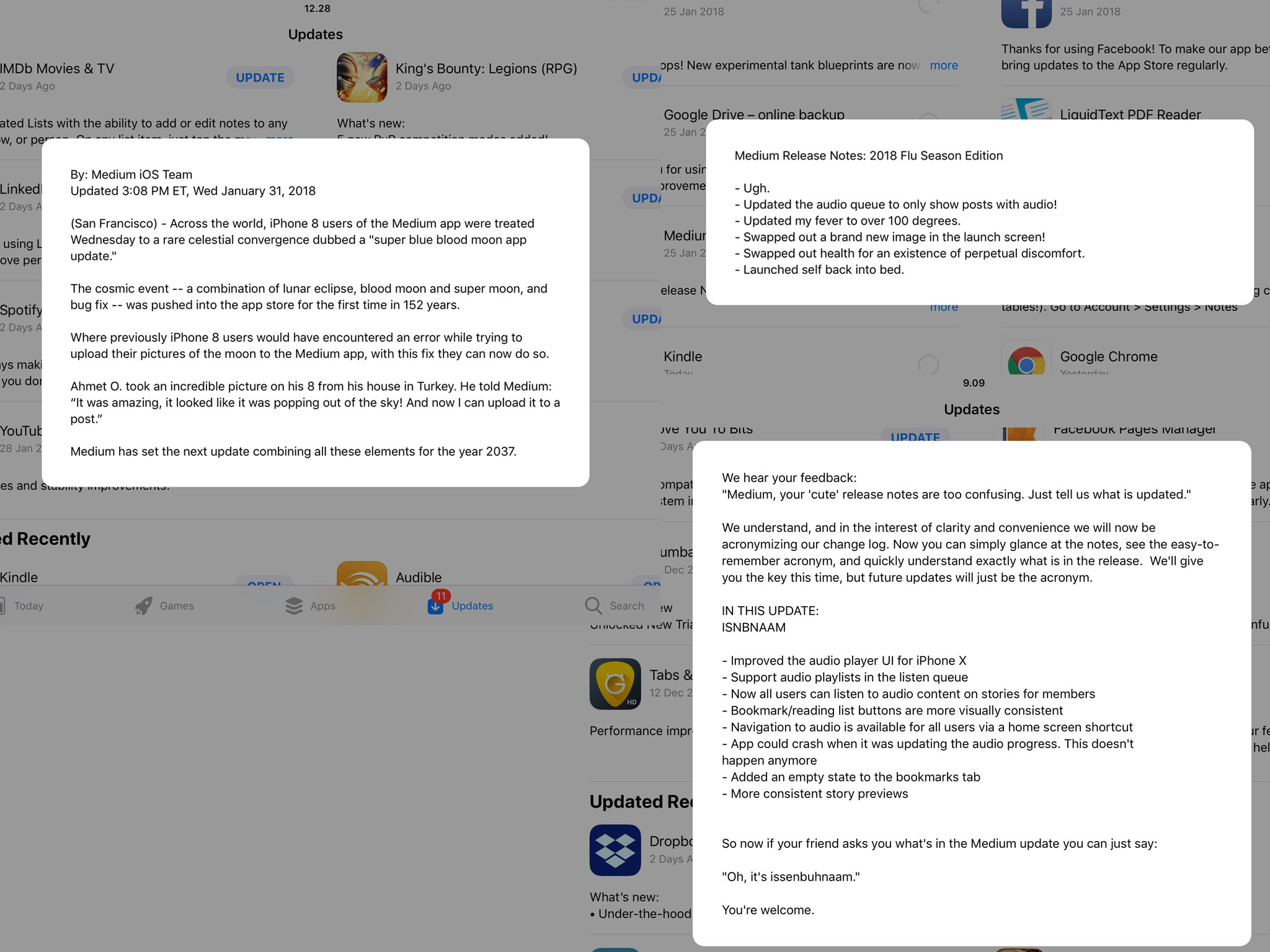
This is why I stop in awe when I see examples such as these.

Velocity-Partners-Email-Subscribtion
Velocity Partners – Mailing List Subscription
Medium-App-Store-Release-Notes
Medium.com – App Store Release Notes

The trap of doing

Urgency is a myth, so before you start taking action, make sure you understand what you are acting upon.

In marketing, for example, it is very easy to fall in the trap of doing. You start a new job, there is a pressure to get more visits to the website, more content, more leads, and so you begin with tactical actions already on your second week on the job (if you have been good enough to last that long). You do not know anything about the customer, very little about the product, even less about your colleagues, what they do, what their challenges are, and why you are in the job in the fist place.

No wonder many are dissatisfied with their marketing efforts. There is a reason if tactics, channels, messages change all the time, while strategic marketing is essentially the same from decades. Start with the basics, make sure you clearly understand who you are serving (internally and externally), and what you can do for them. Where they are found, why they should care, whether there are alternative solutions to their pains and why yours is better.

If your boss does not understand that, you might be in the wrong place. You need to build solid foundation if you want to build anything that stands the test of marketing fads.

What marketing is not

The inability to listen. The idea that by interrupting and telling your story people will be amazed. The practice of segmenting into hundreds of small niches to feed them whatever they want today. The ideas of optimization, hacking, ranking, fans and followers. The belief that data is better than interactions. The effort to second-guess needs and wants to stay clear of the risk of asking. The easy shortcut of personalised and automated user journey. The unrelentless focus on growth.

Marketing is not ruining the world. The things above are. And at the same time they set expectations, both for marketers and customers, that cannot be met, leading to inevitable dissatisfaction.

Key insights and themes from the research include:

  • Data is a dilemma. But “big data” isn’t marketing’s biggest challenge. It is actually the “small data” – the data used to describe the small, specific attributes delivered directly from the customer through, as an example, the Internet of Things. 36 percent of respondents believe that small data will be the greatest challenge for the organization.
  • We’ve lost the ability to be human, and we can’t blame the machines. Some 41 percent admit that they are overly focused on driving campaigns, forgetting that they are building relationships. Nearly 30 percent admit they think of their customers in terms of targets, records and opportunities – interestingly an equal amount admit that they are also struggling to define and deliver returns from customer experience strategies.
  • Going small could bring our humanity back. Marketers believe small data will help extract better signal from the noise (45 percent), reveal the “why” behind customer actions and behaviors (41 percent), help focus on the people behind the data to deliver more human interactions (35 percent) and aid in filling key gaps across the customer journey (35 percent.)

CMO Council Research


Renewing trust

The automatic renewal feature, enabled by default in plans that seal an agreement between a service company and the final consumer, is not designed to improved the user experience.

Despite the bullshit about “continuity of service”, that particular feature is designed (and enabled by default) to leverage our tendency to forget, and therefore fictitiously increase the recurring revenue metric.

It feels like yet another instance in which companies that invest loads of money in second-guessing personalisation of marketing messages (ads, newsletters, offers, etc.), fail to design their services and operations in a personal way when it would actually be easy.

Hi there, we have noticed that your plan is expiring in 30 days.

We do not do automatic renewal, as we believe in how good our service is. And on this note, this is what we have done for you this past 11 months (*list of features that the user has used, articles the user has read, videos the user has watched, …).

We’d like to continue delivering this and more, and to renew we ask you to answer two questions on this online form (the questions being: Do you want to renew? Is your credit card still valid?).

On the other hand, if you decide not to continue with us, we respect your decision and hope to have you back soon. We would still like to know if it’s something we’ve done (link to online feedback for churn).

Thanks for being a valuable member of our community. For any question on renewals, just reply to this message or call us at xxx.xxxxxxx.

Have a wonderful day!