Your winning way

This way of doing marketing does not work for everybody. In fact, it probably would not work for your company.

But it works for Balsamiq.

I guess the point of this story is the following.

Before jumping into a funnel carousel, before starting to talk about MQLs, SQLs, and SAOs, before paying an agency to figure out your business model and your brand, before running around optimizing the optimizable and hacking the hackable. Take a deep breath.

Find a way that works for your customers and for your business. A way that reflects your values, your purpose, the change you want to see in the world. A way that you are proud to promote, that your leadership is proud to promote, that your employees are proud to promote. A way that lets you build a sustainable business where you and your team are the ones defining success.

There is no other way. It’s your winning way.

The first question

If you have an idea to spread, a change you care to see happening, a product to market, the first question should not be “where is my audience?”.

The first question should be “who is my audience?”.

It is a shift in perspective.

From desperately moving from one channel to the next (and mastering none), with messages that are ineffective (because they are either about you or they aim to appeal to too many), to already knowing where you will be tomorrow.

It is the way to become master of your own future.

Many call it strategy.

Elements of value

It is not enough to say that your company focuses on delivering values to customers.

What is value?

If you don’t stop for a long moment considering this question, you are not focused on value. Value is economical, and it is also technical, social, personal, functional, aspirational. Value takes into consideration material costs, and also possible issues, adoption, expansion, scale. Value is transactional and relational. Value is co-operative.

And once you have identified all the elements that make up your value, you still have two steps to take.

First, you have to understand the why of value. Why does it matter. Not tomorrow, not one year from now, not one day maybe. But now.

Then, you have to build a system that constantly delivers on the elements across the various departments, that captures and measures the elements, that continues assessing them, that creates incremental evidence for them, and that ensures that they are not replicated by competitors and new entrants.

Value is a complex concept, not another organisational buzz word.

The marketer’s dilemma

Got an interesting newsletter from Peep Laja at Wynter.com this morning, that got me thinking of the marketer’s dilemma.

If a marketer does boring and safe, nobody will object. If they do as it’s always been done. If they use terms like productivity, efficiency, streamlined, best-in-class, seamless. Even when every one at the table has a different understanding and a different experience of what those terms mean, nobody will object. Because who is going to stand up and say “what is productivity?”.

If a marketer does specific and unusual, on the other hand, everyone will panic.

Of course, boring and safe will bring you nowhere, because boring and safe is what 94.97% of companies do. So, the marketer’s dilemma is really between being accepted among their peers in the short term and being well received by the market in the long term.

It is a difficult choice.

Overestimating

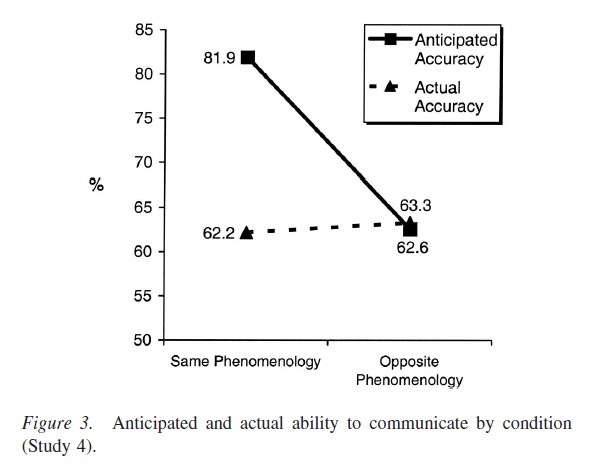
We are bad at communicating in written form.

We overestimate our capability to share meaning via a written message, and most importantly to share the underlying emotions, mainly because we fail to understand that our audience is often in a different state of mind.

Two considerations.

If you are about to send a written message, and even more so if you do that for a living (as is the case for marketers), you will increase the chances to be effective when you spend enough time understanding who you are sending to. Also, if you plan to add some color to the message (anger, sadness, sarcasm, humor), use visual cues (emoticons, GIFs, images).

If you are responsible for the internal communication of an organization, you will increase the chances for your employees to be effective by providing more training and tools that support visual communication rather than written communication.