Stand out

One of the things that will make you stand out most in business (and not only) is to close the circle on your promises.

This is true for individual contributors, teams, departments, and organizations as a whole.

If you promise something that you know you can’t deliver, or that you consistently don’t deliver over a period of time, the promise is most likely a way for you to get out of a difficult conversation, an awkward moment, a temporary discomfort.

It is not worth it.

Say only what you know you’ll do. And if you end up not doing it, give a reason and follow up.

When you meet your commitments, you build trust, gain confidence — look, you really can do it! — and grow the kind of backbone needed to say no when you truly can’t take something on.

Whitney Johnson, You Have to Stop Canceling and Rescheduling Things. Really.
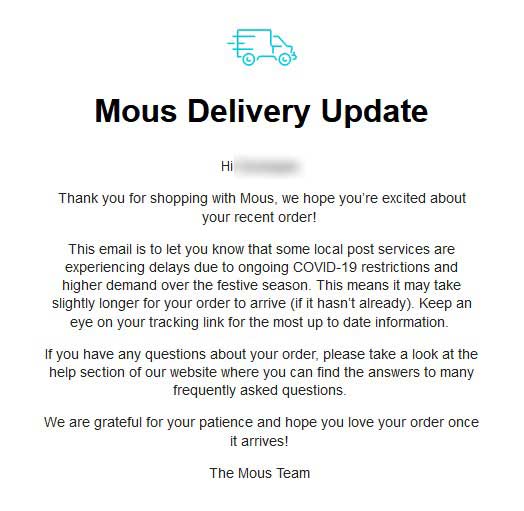
Make it better

Customer communication is an opportunity to establish and strengthen a relationship. Not just a way to deflect a possible inquiry.

You should know (and tell) whether a package has been delivered or not. And if it has, spare the customer the clutter in their inbox.

You could add the link to track the delivery. And spare the customer the trouble to dig into their incoming messages to find it.

You could suggest a direct way to ask a question. And spare the customer the time to go through the website, the help section, the knowledge base articles, and the feedback form.

Good customer communication often goes unnoticed, because it makes the experiences smooth and does not impose additional tasks on the receiver.

It’s not impossible, and can be achieved with some intention.

Come together

Three things to consider when you write new marketing content.

  1. It needs to be relevant to your audience – “me” is not relevant.
  2. It needs to be different from what is out there.
  3. It needs to be distributed in a channel where your audience hangs out.

All of the above needs research, so writing marketing content never starts with a blank page and very rarely starts with a brilliant idea. It starts with questions, data, insights, and the right expectations about how long it takes to make it all come together.

Cause and effect

Not every cause leads to an effect. Not every effect can be immediately linked to a cause.

The fact is, we are not rational beings and we merely use reason to find an explanation to things that have already happened, to decisions that have already been made.

That’s why brands and stories have so much power. They don’t engage with reason and they leverage the most tribal and innate of our insticts.

Belonging.

If your company wants to measure brands and stories, if they want to find the thread that links brands and stories to material results, they are probably missing the whole point. And the opportunity to establish relationships with employees, customers, stakeholders that can determine long-term competitive advantage.

You got to have faith not to miss this opportunity.

Windows

Recruitment is customer service.

For many employees, their first contact with your organisation is via your recruitment function. For most people, the only interaction with your organisation is with your recruitment function.

Both recruitment and customer service deal with a high volume of traffic that makes it difficult to identify what matters. And in both cases, this challenge often translates in poor service and missed opportunities.

The fact is, recruitment and customer service are windows through which people look inside the organisation. They might become employees or not, they might become customers or not. But for sure they will leave with a clear impression of what you stand for – an impression that will spread to the people with whom they will share the experience.

Recruitment and customer service are powerful tools for word-of-mouth.

It is worth investing in them with intention and strategy.