Overestimating

We are bad at communicating in written form.

We overestimate our capability to share meaning via a written message, and most importantly to share the underlying emotions, mainly because we fail to understand that our audience is often in a different state of mind.

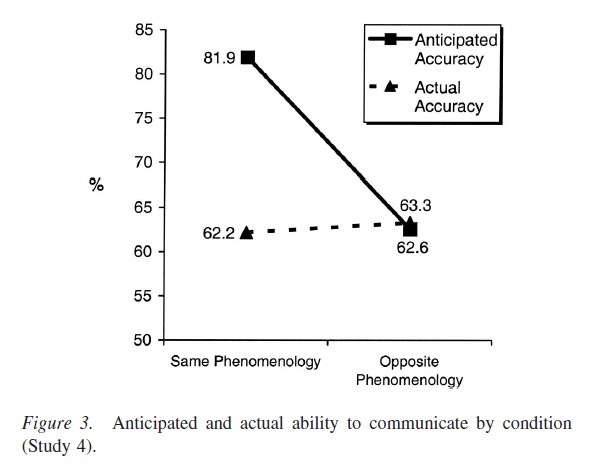
Two considerations.

If you are about to send a written message, and even more so if you do that for a living (as is the case for marketers), you will increase the chances to be effective when you spend enough time understanding who you are sending to. Also, if you plan to add some color to the message (anger, sadness, sarcasm, humor), use visual cues (emoticons, GIFs, images).

If you are responsible for the internal communication of an organization, you will increase the chances for your employees to be effective by providing more training and tools that support visual communication rather than written communication.

On hold

When we hear, read, or consume content, all we get is often about us.

Our fears, expectations, experience, knowledge. What we think about the author, about the medium, about the source. The day we are having, the day we are not having. Likes and dislikes. How confident we are today, what we have been told yesterday, where we are going tomorrow.

In order for us to learn, we need to be able to put all that on hold. To make it about the one delivering the message. To suspend our reaction and just be hearing, reading, consuming content in the moment.

If we do not that, everything will just be a confirmation of what we already know.

Templates

I used to start working on presentations by opening PowerPoint (or Google Slide). Now I start on a piece of paper, perhaps with the aid of some post-its.

The reason is simple. When I started planning my presentation on a set of slides, or on a template, I always ended up twisting the message to make it fit. Of course, I could always change the slide or the template, but the reality is that by approaching presentations this way I would always always tend to have the visual dictate what I would say.

If you start on a piece of paper, instead, you have the freedom to choose the topics you want to cover, the points you want to make, the pace you want to sustain. You can jot down ideas, scratch them, link them, expand on them, and already come up with a pretty solid backbone for what your telling is going to feel like.

From there on, it is all details. And that is when templates, slides, pictures, styles, animations should come into the scene.

The outcome of your presentation will depend a lot on your audience, your message, and the change you seek to make. None of that is accounted for in any PowerPoint template.

Positioning Bernie

If you have been around the internet in the past week, you have certainly seen it.

One of the greatest example of positioning in recent times.

The informal attire of Bernie Sanders to last week’s presidential inaguration, the meme-frenzy that followed, and the way him and his team promptly reacted. All of it has put on display a fantastic positioning exercise.

  1. It has set the product clearly apart from the competition (in this case, other personalities or politicians). Just look at this picture to see what I mean. Or this one. Sanders has built his brand on being against the establishment and close to the average Joe, and spotting him at the inauguration was just a clear, immediate confirmation of exactly that.
  2. It has demonstrated a wonderful knowledge of the target market. Many commentators might have said that he was out of place, that it was even offensive to show up at such a formal event dressed like that. And the answer from Sanders and his team would have probably been: who cares?! Because the point of positioning, at the end of the day, is not to appeal to everybody, but to appeal to your best customer. Wearing mittens hand made from recycled material by a Vermont school teacher and a jacket by a Vermont outerware company sounds pretty on point for a progressive senator from Vermont.
  3. It inspired action. A part from the meme, the story has been shared, liked, commented infinite times on social media in the past few days (you can find a collection of the funniest Bernie posts in this article). And on top of it, Sanders’ team has double down on positioning by creating merchandise and selling it to support Meals on Wheels.

There is nothing better than great marketing, whether it is intentional or not.

Squeezed or integrated

There are two ways to do product marketing.

Reactive product marketing is when product marketing is squeezed between departments. Product marketing managers react to the needs of the other parts of the organization. When product releases a feature, product marketing has to find a way to communicate that feature. When sales targets a new type of customers, product marketing has to come up with a custom presentation. When marketing is running a specific campaign, product marketing has to come up with some content for mid and bottom of the funnel.

Proactive product marketing is when product marketing is integrated across departments. Product marketing managers engage other parts of the organization to coordinate the whole flow of information: from customers to product, moving through marketing, customer success, customer support, sales. And the other way around. In this scenario, when product releases a new feature, how to communicate it is already known, because the feature was actually developed following to research promoted by product marketing. When sales targets a new type of customers, custom presentation are already in place, because the new strategy was recommended by research promoted by product marketing. When marketing runs a specific campaign, product marketing is actively involved in planning what content is needed, as well as who to distribute it to and where.

I understand most product marketing organizations are probably somewhere in the middle. Just always be aware of what type of product marketing you aim to be.

One is execution, the other is the cornerstore of go-to-market.

Which one are you?