The shades of remote work

Fake dilemmas make the world flat.

To make decisions that are not impulsive and destructive, we need to be able to add shades (and data) in between the dichotomy.

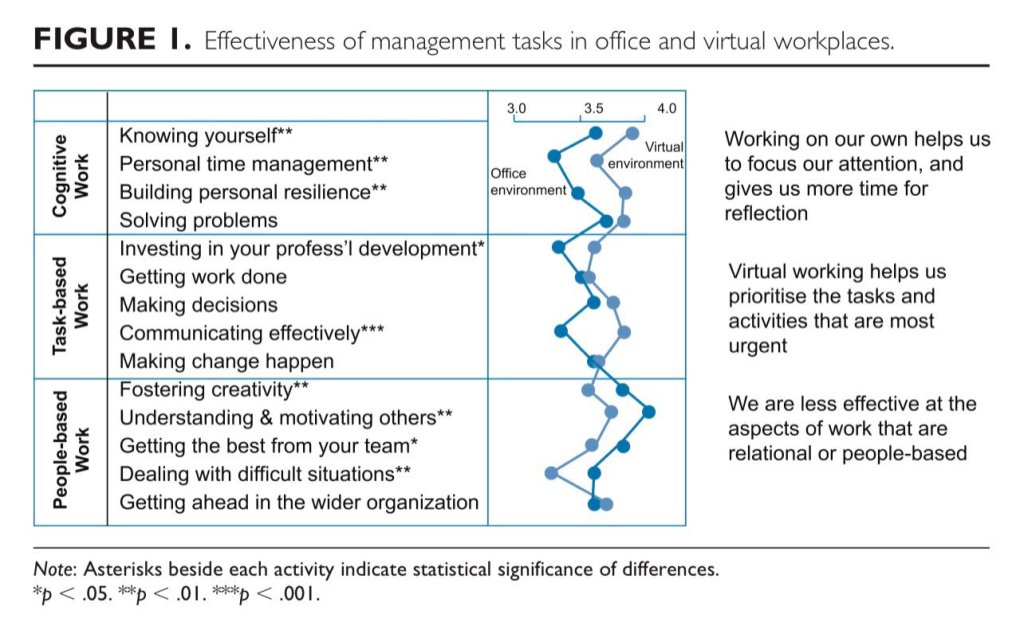
Some shades regarding remote work from three recent studies: The effects of remote work on collaboration among information workers; The Blinkered Boss: How Has Managerial Behavior Changed with the Shift to Virtual Working?; Work from Home & Productivity: Evidence from Personnel & Analytics Data on IT Professionals.

  • Remote work, when extended to the whole company, reduces the opportunities and the willingness to connect with people who are not directly working with you.
  • Hybrid work should probably not be about coming to the office whenever someone wants, but rather about organizing days in which certain teams, or the whole company, goes to the office.
  • Remote work does improve the individual’s capacity to focus and reflect, does improve the individual’s capacity to deliver on their own tasks, and has a negative impact on aspects of work that are relational or people-based (e.g., understanding and motivating others, or dealing with difficult situations).
  • Just because productivity does not take a hit from remote work, it doesn’t mean that individual productivity has not decreased. People might be simply putting in more hours, for example because they have to attend more meetings or because they have a stressful situation at home.
  • Remote work does decrease the opportunity for interaction with supervisors, and in particular the opportunities to get coached by one’s supervisor.
Note: thanks Ethan Mollick for sharing the studies in the first place.

Lazy sales

The laziest sales approach must certainly be the following.

I have just came across your company on LinkedIn. Not sure you are the right person to talk to, in case could you connect me to one of your colleagues?

You don’t know my company.

You don’t know me.

You are asking me to do work for you.

I hope you’ll never be asked to resort to this.

The best bargain

Free stuff is not easy to give away online, and that’s true for second hand clothes as it is true for learning programs.

It’s probably because the buyer does not perceive any value. It’s easy enough to raise one’s hand and say “I am in”. But as soon as life gets in the way, something that is free is just not worth any hassle.

If you have something you need to get rid of, or an idea you are proud of and want to spread, that’s something to take into account.

For as counterintuitive as it might sound, free is not always the best bargain.

Written exchanges

As most of the interactions with colleagues, peers, and managers happen nowadays in written form – chat, email, articles -, this study provides a good guidance on how to avoid that a conversation will turn awry.

Being direct, starting with “you”, and focusing on facts are sure ways to make an exchange heated. On the other hand, being polite, using opinions, and expressing gratitude will keep an argument on track.

Kindness pays off.

Even when writing.

Impulse

The impulse to control, dictate, micro-manage is strong.

We just have to think carefully at what happens when we do it.

Example: a colleague is planning to send out an important email. You submit to the impulse and ask to review it first. The colleague obliges and shares a draft with you. You once again submit to the impulse and, since you do not really have time for this, give them some broad feedback about tone of voice and points to make. They edit the draft and send it back. For the third time, you submit to the impulse and go deep with comments, edits, and formatting. They end up sending your version.

The results.

  1. You are exhausted and you have lost the chance to focus on something that was truly your responsibility.
  2. They are demotivated, because they are probably good to write an email on their own.
  3. The outcome is most likely not going to be what either of you expected, adding to exhaustion and demotivation.

That is a lot of negativity spread around just because you once sent out an email that – in that particular context – turned out to get a pretty positive response.

Get out of the way.