Messages that spread and stick

Few days back, I was skimming through a book I found at work (Lencioni’s The Advantage), and I found a very appropriate metaphor for how communication works in the workplace. According to the author, it’s like in the old sketch where the wife is mad at her husband since he never says that he loves her.

“I told you once when we got married”, he retorts. “I’ll let you know if things change!”.

Very often, this is how people communicate in a professional setting. There is a meeting in which something is announced and it is expected for everyone to be on the same page and working toward the same goal. An email is sent to inform of a major change, and employees are supposed to know of the change, of what it implies for their work, of what repercussions it will have on their department, and so on. In more informal settings, it is not unusual to hear of a manager informing a team member in the office kitchen that the project the team was working on has been postponed, and then imagine that they would know exactly how to react to that and what to focus their attention on next.

Interpersonal communication is complex and fragile. Even more so when multiple people are involved. If we have a message that touches many and needs to spread and stick, we should follow few generic rules.

First of all, be ready to repeat. Nobody likes to be repetitive, and yet that is the best way to have a message stick. Neither does anybody like to be boring, and that is why we should avoid a “copy-pasting” effect and find different ways to deliver the core message we want to share. The core message – it could be summarised with “what” and “why” – needs to be very clear to the messenger. It might sound trivial, yet think about the difficulties many experienced people have in elaborating on the reasoning behind their decisions.

Then, be ready to experiment, with different channels and different formats. People have variegated ways to absorb information. Some like to read, some prefer a face-to-face interaction, some like meetings, some informal conversations, some need a visual representation of what is being discussed. Be bold, do not stick to what is usually done in the organisation. It’s worth it if you believe your message is really important. And try to put some video in the mix, particularly if you want to reach wide.

Finally, be ready to ask. Any type of communication is usually accompanied by the assumption that we have been understood and action will follow. That is almost never true. Ask if people have got it, if they are clear on the different implications of your message, touch base with them after one, three, six months and see if they still remember the “what” and the “why”. And if you have a doubt, go back to repeat and experiment until you are more than sure.

I know it sounds like a lot of job, yet we all need to embrace our role as Chief Reminding Officer when we have something we deeply care about to share within our organisation. If we do not do that, we risk to be rowing the boat by ourselves, and that is much tougher in the long term.

Details matter

Details matter. Nowadays more than ever.

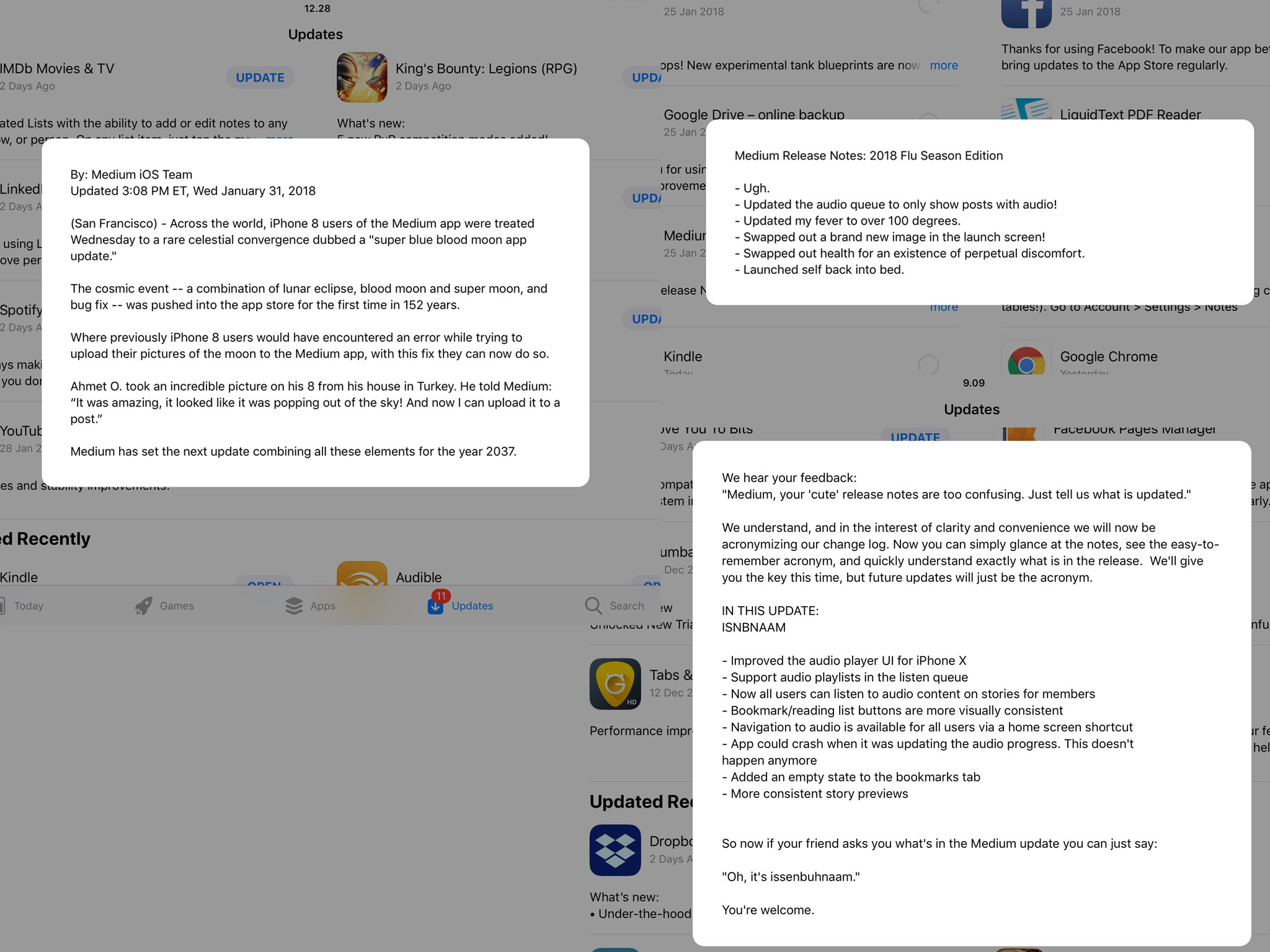
Particularly in marketing, in content marketing, details are a big part of the story your brand wishes to tell. It is difficult to fake details, and so they end up being the best representation of what an organisation stands for. They are what you do when nobody is watching.

Details set the tone for the conversation with your audience, they are how others look at you and remember you. And equally important, they are what makes you feel better about the work you do.

This is why I stop in awe when I see examples such as these.

Velocity-Partners-Email-Subscribtion
Velocity Partners – Mailing List Subscription
Medium-App-Store-Release-Notes
Medium.com – App Store Release Notes

Labelling

Labels stick.

This is why we get defensive when we are assigned one we do not like, as well as why we should be careful when assigning one to others.

It happens a lot when we deliver feedback. Things like “it does not seem you are committed enough” (label = “indifferent”), or “you could do so much more if only..” (label = “underperformer”), or “you are very aggressive in meetings”, trigger defensiveness in others. And they tend to be profoundly ineffective. After all, would you be motivated in changing your behaviour if somebody would tell you that, or would you rather assume a defensive stance?

And unfortunately it is a tendency permeating much of the public discussion nowadays, both online and offline. More and more, we see people attacking each others on a personal level, labelling each others for life, defining each others’ set of values, beliefs, needs and motives based on a single action or word. In most circumstances, this is gratuitous.

It’s worth remembering that when we interact with somebody, all we see is what they do, all we hear is what they say and, in the case of the internet, all we know is what they write. We have no way to know their intentions. If we want to create some type of change, it might be more effective to approach the issue from our perspective, and elaborate on what we actually feel. This is the only other thing that we know.

When I hear that, I feel like my heritage and history is not being respected.
If I come across that type of comments, I feel sadness as we might never find a common way.
When I see a behaviour that does not respect others’ boundaries, I feel as if mine have been violated as well.

P.S.: today’s thought was sparked by this post of Ed Batista on feedback, and by the work of David Bradford and Mary Ann Huckabay on the metaphor of “the net”.


Meetings

Few rules to get the most out of meetings.

Come prepared. A meeting should have a clear agenda, make sure you know what it is about and you have an important contribution to give. If you don’t, you can sit this out and be updated later. For 1-1 meetings, be sure you have reviewed previous history and have at least a couple of points that move the relationship forward.

Come on time. Should go without saying, yet it still happens most of the times that people are late. Actually, do not come on time. Be a few minutes early. Feel the room, exchange a word with others, make sure you are all set for the starting time.

Let the talking flow. Your turn will come, no need to rush it. Make sure you listen carefully to what is being said and are ready to speak when the time is right. Avoid interrupting, or jumping in. And if something is absolutely, incredibly urgent and needs to be said right now, get the attention of who’s speaking with body language (e.g. raise your hand) rather than by talking a higher tone.

Be polite and behave. Most likely, jokes are not welcomed. Rants aren’t as well. Stay on topic. Speak in a normal tone of voice, avoid bursting out in laugh or random hysteria. If you are leading the meeting, make sure everybody gets a fair chance to voice their opinion, yet avoid going around the room. Again, flow is important.

Keep technology to a minimum. Can’t think of a reason why phones should be allowed. If you or somebody is waiting for an important phone call, postpone the meeting. As per notebooks, if somebody has anything to present ok. Otherwise, notebooks are not necessary. In the best case scenario, they are a distraction waiting to happen (and no, your mind will to refocus on the topic discussed right after you have noticed the notification). In the worst case scenario, they create a lot of personal barriers behind which to take cover and avoid meaningful conversations. You got to take notes, you probably know how to write: take a notepad and a pen with you. And while you take notes, particularly in 1-1s, say it out loud: “I am writing this down as I feel it’s important”.

Keep it short. I am not sure what the right length of a meeting is. I can tell you, it is never more than 60 minutes. Nobody, nowadays, can be focused on one single topic, or on one single speaker, for 60 minutes. If you have multiple things to discuss, schedule multiple shorter meetings, only with the people that needs to be there. If you have to go through a lengthy document, there are probably better ways than to lock yourself in a room together. Well-prepared workshops are a great alternative. Make sure attention is high, and for this reason, keep it short. And then, make it shorter.

The trap of doing

Urgency is a myth, so before you start taking action, make sure you understand what you are acting upon.

In marketing, for example, it is very easy to fall in the trap of doing. You start a new job, there is a pressure to get more visits to the website, more content, more leads, and so you begin with tactical actions already on your second week on the job (if you have been good enough to last that long). You do not know anything about the customer, very little about the product, even less about your colleagues, what they do, what their challenges are, and why you are in the job in the fist place.

No wonder many are dissatisfied with their marketing efforts. There is a reason if tactics, channels, messages change all the time, while strategic marketing is essentially the same from decades. Start with the basics, make sure you clearly understand who you are serving (internally and externally), and what you can do for them. Where they are found, why they should care, whether there are alternative solutions to their pains and why yours is better.

If your boss does not understand that, you might be in the wrong place. You need to build solid foundation if you want to build anything that stands the test of marketing fads.