Two gifts

The two greatest gifts a leader can give their team are the following

  • An interesting problem to solve – Something that looks at the future, a new path to discover, a way to improve on what has been done so far.
  • The support and resources to help them solve it – Tools, budget, attention, care, shielding, buy-in.

If you consider this, how many of the managers you’ve met in your career, how many of those you are working with now, how many of the ones that are in charge of the well-being of hundreds of people, can genuinely be called leaders?

Have you ever considered starting to demand that they behave as such?

Time to leap

When most of your time is spent doing things you were doing yesterday.

When the most common answer to ideas is “something to keep in mind for the future”.

When you get lost in planning and details, postponing what matters in search of perfect.

When you and those around you are busy, and yet that busyness does not bring you any closer to what you want to achieve.

It’s time to leap.

Smoothing

If we would be better at communicating change underlying its benefits for the target, we could perhaps make transitions smoother.

A mistake that is often made in corporate communication is telling the customer:

Here, we changed this, it’s good for you, trust us. And this is the list of things you have to do, on your own, to make the change effective.

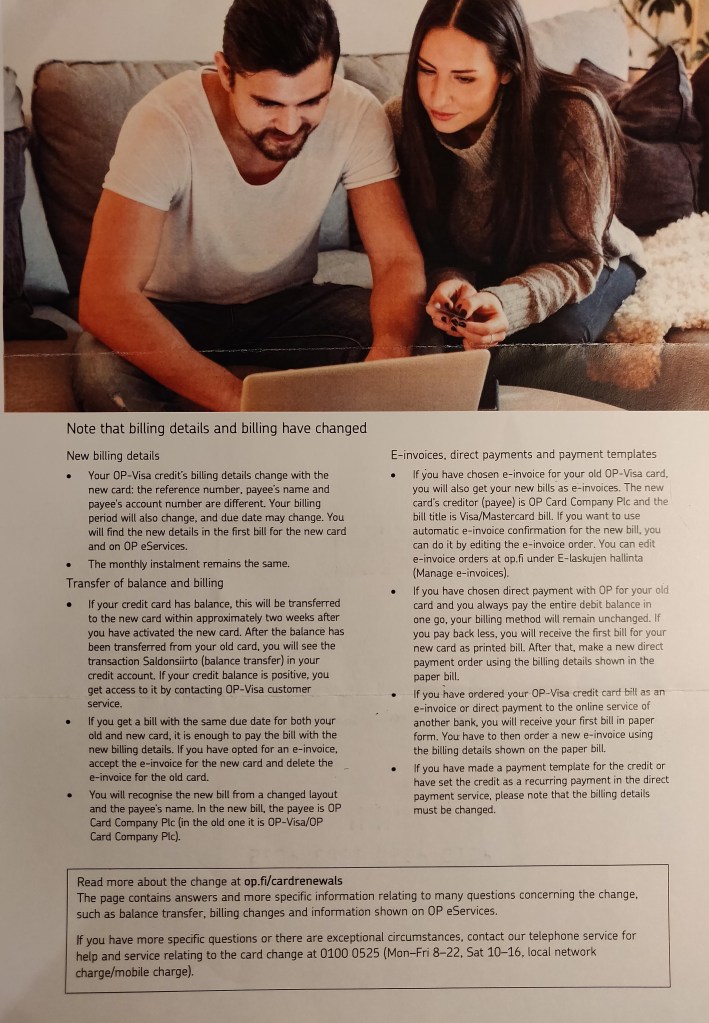
You can see a good example at the end of this post. One line to tell “more versatile services” will be offered (when? to whom? which services? do they matter?), and two pages full of things I have to do, or I have to check, or applicable to me in case I have this or that service (don’t you know which services I have subscribed? or if my card has balance? or if I have chosen e-invoice?).

Of course, we can see this type of messages as something that “needs to be done”.

Or, we could approach them as an opportunity to strengthen the relationship with our audience. A way to make it personal without second-guessing, to be of service, to establish our brand as helpful, relatable, trustworthy, even indispensable in the long term.

What’s your choice?

Following and picking

Repeatedly, over the course of your career, you will be asked to conform to certain standards or rules.

You need to meet certain requirements to get a job, for specific roles you will be asked specific qualifications, if you get to be a manager there are certain procedures you will have to adhere to. It is normal, and that’s what makes things somewhat reliable, trustworthy, known.

The fact is, there are two ways to go about standards and rules.

The first is to follow them. If they say you have to study a certain language to get a job, you do study it. If they say you need a certificate to be promoted, you do get the certificate. If they say you have to follow a procedure to advance your purpose, you do follow it.

The second is to pick them. Does it make sense? is the key question on this path. Will study that language add something to my value as an employee? Will it add to my story and my strengths? Will it make me more frustrated, because once I am done with that role, I will never be asked to use that language ever again?

You will probably surf between the two ways at different stages in your career. What matters most though, is that you understand that there are two ways, not one only.

Once you get to know what you are here for, what your value is, what your strengths are, what you have to offer and what you don’t have to offer, what sets you apart from the rest of us. Does it make sense to follow a rule that does not serve all of this?

What you do

Culture is what you do.

It is how you treat people around you, the times you say yes to a request of help, the way you say no to preserve focus, the work you deliver every day, the amount of hours you dedicate to things that nurture your cause, the decisions you make and how you make them, the people you carry with you and those that are never part of it. It is, first and foremost, the journey and not the destination.

Not only.

Culture is what you do when no one is watching.

It’s impossible to fake culture, and so you might be on the wrong track if you regret helping others the very moment you say yes, if you get distracted from new and shiny things that lead you astray, if you surround yourself with people that are like you, think like you and act like you.

And.

Culture is what you do when things are dire.

Most are good sharing when they have plenty, cheering people up when life is wonderful, leading when the cash comes in, giving freedom when there’s not much at stake, asking people to contribute when the decision has already been taken.

Think about this as you go through history and think of examples that well represent and tell your culture. It will make it stronger.