Building a StoryBrand

Despite thousands of years of evolution, we are still pretty primitive in our behavior. We seek what makes us survive and thrive, and we stay away from what puts our lives through any kind of hassle.

And so, companies do two big mistakes when they talk about what they do. First, they forget that they are not the hero. Second, they ask prospects to burn too many calories to understand why they should become customers.

The result is that people run.

The way companies tell their story can follow a consolidated way of storytelling.

A CHARACTER who wants something encounters a PROBLEM before they can get it. At the peak of their despair, a GUIDE steps into their lives, gives them a PLAN, and CALLS THEM TO ACTION. That action helps them avoid FAILURE and ends in a SUCCESS.

Donald Miller, Building a StoryBrand

The character is the customer. And the engine of the story (the story gap) is the thing the customer wants. Of course, you need to know your customer very well to start from here. In particular, you need to know:

  • What do they want to become?
  • What kind of person do they want to be?
  • What is their aspirational identity? (i.e., How do they want their friends to talk about them?)

Once this research is done, it should become clear that what they want is something relevant for them. They do care deeply about closing the gap and joining with the object of their desire (if they do not, there is no story).

The problem is both external (e.g., a bomb, skyrocketing costs, increased competition) and internal (e.g., failed detective, inability to grow, staff leaving). In fact, companies should strive to frame their product as a resolution for both the external and the internal problem.

The guide is you (finally!). For your product to be a reliable guide, it needs to communicate empathy – we understand how it feels ..; like you, we are frustrated by .. – and competence – we know what we are doing (testimonials, logos, statistics).

The plan can either be a process plan, that describes the steps the hero needs to take to buy the product (and achieve success), or an agreement plan, that lists the major concerns of the hero and counters them with agreements that alleviate the fear – if you buy our product, we will do this; in case you need help, we offer 24/7 service.

The call to action can either be direct – buy now, schedule an appointment – or transitional – download the whitepaper, get started with the free trial.

The dodged failure needs to be expressed. Many refrain from doing this, because they feel they might be perceived as negative guides. Yet people are motivated by loss aversion: if there is no loss your product helps them avoid, they will avoid the loss (i.e. expenditure) represented by buying your product.

And finally, the success. Just be very clear what it looks like, how it feels like, what the end vision is. You can’t get too specific.
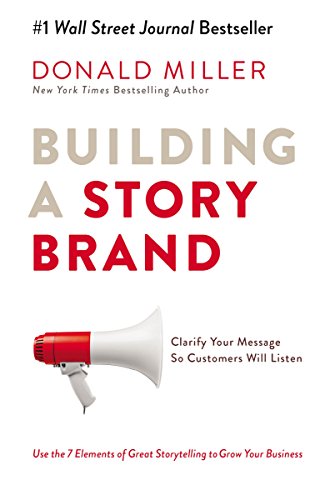
Donald Miller, Building a StoryBrand book cover

Multipliers

If you run a company that aspires to grow, you have two ways to support said growth.

You can either try to amass more resources (often translating into hiring more), or you can aim at achieving more with the resources that you have at your disposal.

And while following the logic of addition (add resources) instead of the logic of multiplication (same resources) might seem more humane (nobody wants their people to burn out), it turns out people who work for multipliers are more motivated, more engaged, more satisfied, and eventually turn out achieving more. Both for their organizations and for themselves.

Multipliers understand the power of continuous development.

They are talent magnets. Not only because people want to work with them, but also because multipliers are capable of appreciating different types of talent across the boundaries imposed by organizational charts. They can identify what people can do easily (without effort) and freely (without conditions), and they then find opportunities to employ this natural genius, allowing people to grow beyond their current capabilities.

They are liberators. They resist the temptation to take things in their hands, and they create space. They focus on the execution rather than the outcome, and by doing so they allow people to learn from mistakes. Indeed, they often talk themselves about their own mistakes.

They are challengers. Instead of giving answers, they provide just enough information to provoke thinking, and they then establish the challenge so that it represents a (possible) stretch to the current capabilities. They create a vacuum. Not between what they know and what others know, as many managers do, but between what people know and what they need to know to complete the challenge.

They are debate makers. They spark debate by framing the issue, setting the rules (and reiterating whenever necessary), creating safety (they encourage opposing views even when there are none, and they speak last), and demanding rigor (evidence is the price to pay for having an opinion). As for those who should participate in the debate: those with needed knowledge, those with a stake in the decision to make, those who are responsible to drive the outcome.

They are investors. They give ownership, they spend time teaching and coaching, and nonetheless they hold people accountable. So much so that they respect natural consequences: instead of jumping in to fix things, they talk about what has happened and focus on the next thing.

If you are a multiplier, or want to be one, you will probably find yourself asking these questions a lot.

In what way is this person smart?

What is the next challenge for you?

What other roles could this person shine in?

Thanks for sharing this criticism, what does it look like when I do that? How do I avoid this?

What if this would happen, instead?

In a perfect world, what would you do?

What do you need from me as you lead this?

How do you propose we solve this?

Being a multiplier does not usually come natural. Most cultures have a different ideas of leadership and it is easier for us to think we are better and we could do things better than others in most circumstances.

It is an investment, though, that comes with a pretty high return.

Multipliers don’t necessarily get more with less. They get more by using more—more of people’s intelligence and capability. As one CEO put it, “Eighty people can either operate with the productivity of fifty or they can operate as though they were five hundred.” And because these Multipliers achieve better resource efficiency, they enjoy a strengthened competitive position against companies entrenched in the logic of addition.

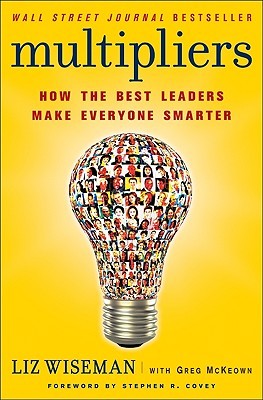
Liz Wiseman, Multipliers – How the best leaders make everyone smarter
Multipliers, book cover

Persuadable

Being persuadable is about actively open-minded thinking. That is to say, it is not enough to be open to evidence that goes against our own beliefs. One has to seek that out.

Some good ways to practice that.

  • Ask yourself why you think a certain way, how you could be wrong, what alternative explanations might there be.
  • Think in shades of gray rather than in black and white – it is easier to update your beliefs incrementally, it is more difficult to completely change your mind.
  • Prepare to kill your beliefs by decatastrophizing – asking what is the worst thing that could happen? has the power to bring catastrophic outcomes down to earth.
  • Make time to consider other people’s perspective (before a meeting, before a talk, before a difficult conversation).

If you do that consistently, you gain in accuracy (getting closer to “reality”), agility (overcoming the status quo bias and the sunk cost fallacy), and growth (using feedback to improve).

And, contrary to common belief, you will not give up autonomy and self-determination.

Autonomy doesn’t mean reflexively resisting all external influences. That would be impossible, not to mention foolish. It means taking actions that “are both personally valued and well synthesized with the totality of one’s values and beliefs” regardless of who suggests those actions.

Al Pittampalli, Persuadable
Persuadable, by Al Pittampalli - Book Cover
Persuadable, by Al Pittampalli – Book Cover

Kindness

Kindness starts from understanding that we are not alone.

That despite our uniqueness, the pain we feel, the challenges we face, the preoccupations that keep our mind busy are common.

That what we are going through is the reflection of what our neighbour has lived for the past six months.

That the person who does not reply to our message is not having a better day.

That it is difficult for our partner to figure us out, just as it is difficult for us to figure them out.

Kindness is an act directed at ourselves first.

Kindness is for every day of the year.

Merry Christmas!

P.S.: I have not read many books this year, but one I enjoyed is Storynomics, by Robert McKee and Thomas Gerace. I am giving away 5 Kindle copies of the book, to the first 5 people who leave a comment to this post and share one thing they got from my blog.

Lessons

You can find great lessons everywhere, even in books you are just reading for pleasure and enjoyment.

“There is satisfaction,” he said to Dalinar, “in creating a list of things you can actually accomplish, then removing them one at a time. As I said, a simple joy.”

“Unfortunately, I’m needed for bigger things than shopping.”

“Isn’t that always the problem? Tell me, my friend. You talk about your burdens and the difficulty of the decision. What is the cost of a principle?”

“The cost? There shouldn’t be a cost to being principled.”

“Oh? […] Isn’t a principle about what you give up, not what you gain?”

“So it’s all negative?” Dalinar said. “Are you implying that nobody should have principles, because there’s no benefit to them?”

“Hardly,” Nohadon said. “But maybe you shouldn’t be looking for life to be easier because you choose to do something that is right! Personally, I think life is fair. It’s merely that often, you can’t immediately see what balances it.”

Brandon Sanderson, Oathbringer