Details matter

Details matter. Nowadays more than ever.

Particularly in marketing, in content marketing, details are a big part of the story your brand wishes to tell. It is difficult to fake details, and so they end up being the best representation of what an organisation stands for. They are what you do when nobody is watching.

Details set the tone for the conversation with your audience, they are how others look at you and remember you. And equally important, they are what makes you feel better about the work you do.

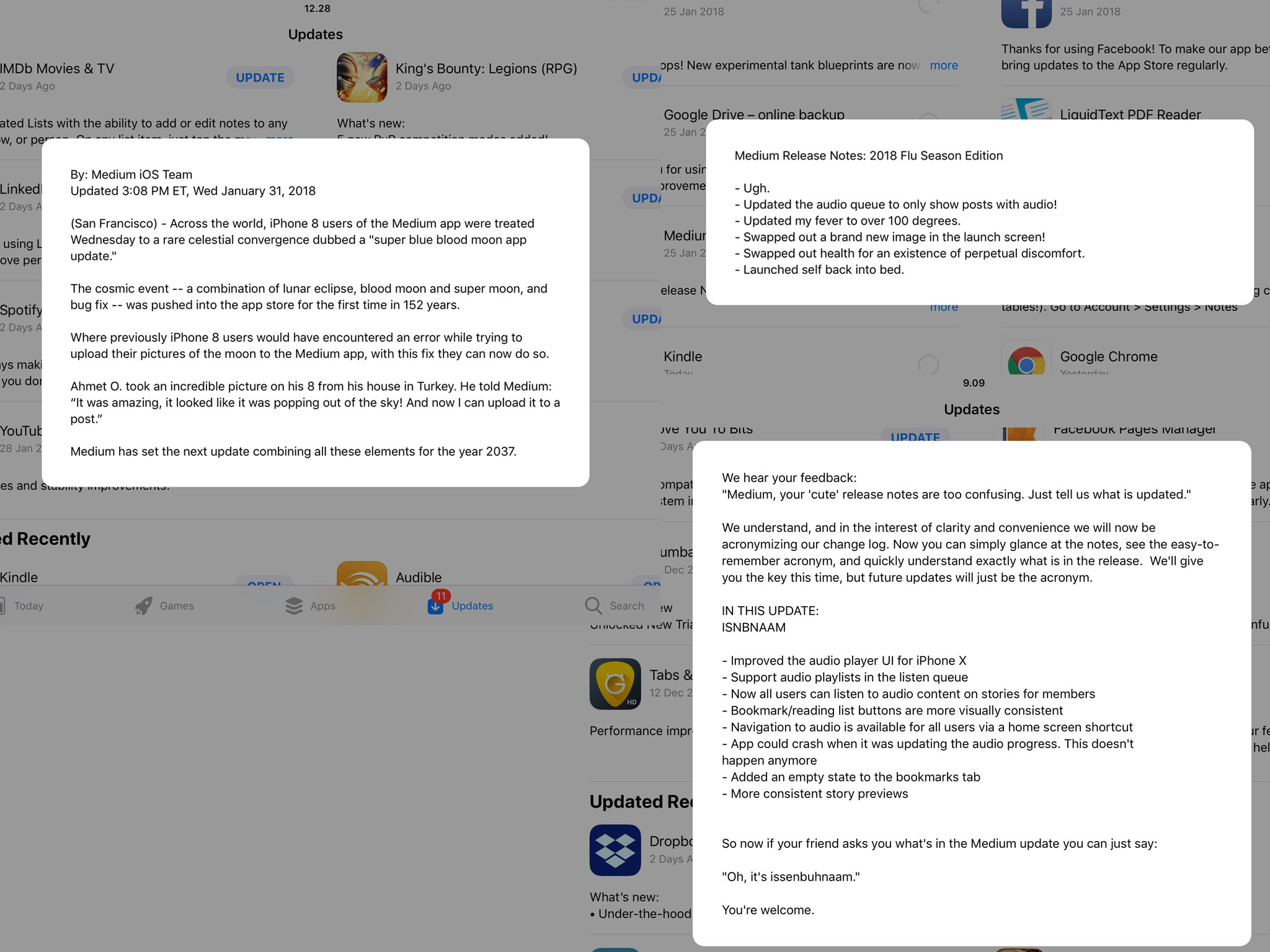
This is why I stop in awe when I see examples such as these.

Velocity-Partners-Email-Subscribtion
Velocity Partners – Mailing List Subscription
Medium-App-Store-Release-Notes
Medium.com – App Store Release Notes

Near-enemies

I love the concept of near-enemies.

In Buddhism, near-enemies are manifestations that are quite close to a desired state, yet are actually a whole lot different. So different, they are actually dangerous.

A desired state of Buddhists, for example, is equanimity. That is to say, a way of being calm and focused no matter what happens around you. It is “stability in the face of the fluctuations of worldly fortune“.

Equanimity has a clear enemy, a “far-enemy”. That is restlesness, anxiety, the desire to have things the way we want them to be. The near-enemy, though, is indifference.

From the outside, equanimity and indifference look perhaps the same. Yet they are substantially different: equanimity is not desiring things to be one way or the other; indifference is not caring whether things are one way or the other. With equanimity, we feel everything: the good, the bad, the ugly, the despair, the difficulties, the joy, the sorrow. We are simply not stuck there. With indifference, we feel nothing.

This makes me think of how much we are nowadays focused on near-enemies.

Activity, for example, that is an active force, a state in which things happen and are being done, is often mistaken for its near-enemy busyness, that rarely leads to any progress.

In the same way, our popularity (definitely not a Buddhist concept), that is the condition in which we are liked, admired, supported by others, is often mistaken for its modern near-enemies likes, fans, followers, visits, clicks or any other vanity metric of your choice.

If we expand the concept a little, we can also see how easily we are distracted by near-enemies in our pursue of something we deem important. We do not want our community to be racist or bigot or closed, we want to pursue an ideal of openness. And to do that, we aim at a target, we attack, we label and brand, we separate. Ending up in a community that is even more close than it was before.

Near-enemies are an incredibly powerful concept. If we manage to go behind their seduction, if we do not fall for their attractiveness and easiness of reach, if we force ourselves to open to the real objective of our journey. That is when the highest states that we want to achieve – for us, our families, companies, communities – become not only attainable, but also natural.

The trap of doing

Urgency is a myth, so before you start taking action, make sure you understand what you are acting upon.

In marketing, for example, it is very easy to fall in the trap of doing. You start a new job, there is a pressure to get more visits to the website, more content, more leads, and so you begin with tactical actions already on your second week on the job (if you have been good enough to last that long). You do not know anything about the customer, very little about the product, even less about your colleagues, what they do, what their challenges are, and why you are in the job in the fist place.

No wonder many are dissatisfied with their marketing efforts. There is a reason if tactics, channels, messages change all the time, while strategic marketing is essentially the same from decades. Start with the basics, make sure you clearly understand who you are serving (internally and externally), and what you can do for them. Where they are found, why they should care, whether there are alternative solutions to their pains and why yours is better.

If your boss does not understand that, you might be in the wrong place. You need to build solid foundation if you want to build anything that stands the test of marketing fads.

What marketing is not

The inability to listen. The idea that by interrupting and telling your story people will be amazed. The practice of segmenting into hundreds of small niches to feed them whatever they want today. The ideas of optimization, hacking, ranking, fans and followers. The belief that data is better than interactions. The effort to second-guess needs and wants to stay clear of the risk of asking. The easy shortcut of personalised and automated user journey. The unrelentless focus on growth.

Marketing is not ruining the world. The things above are. And at the same time they set expectations, both for marketers and customers, that cannot be met, leading to inevitable dissatisfaction.

Key insights and themes from the research include:

  • Data is a dilemma. But “big data” isn’t marketing’s biggest challenge. It is actually the “small data” – the data used to describe the small, specific attributes delivered directly from the customer through, as an example, the Internet of Things. 36 percent of respondents believe that small data will be the greatest challenge for the organization.
  • We’ve lost the ability to be human, and we can’t blame the machines. Some 41 percent admit that they are overly focused on driving campaigns, forgetting that they are building relationships. Nearly 30 percent admit they think of their customers in terms of targets, records and opportunities – interestingly an equal amount admit that they are also struggling to define and deliver returns from customer experience strategies.
  • Going small could bring our humanity back. Marketers believe small data will help extract better signal from the noise (45 percent), reveal the “why” behind customer actions and behaviors (41 percent), help focus on the people behind the data to deliver more human interactions (35 percent) and aid in filling key gaps across the customer journey (35 percent.)

CMO Council Research


Some things work

Before you set out to change something, make sure it needs changing.

Elevators, for example, probably do not need dramatic improvements. Particularly in their user experience, they work fairly well. You are at a certain floor, you press a button to call the elevator, you enter it, you select the floor you want to go to, it moves and stop, you exit the elevator, done. It is a pretty well oiled dynamic, and trying to make it more efficient – say by asking people to select the floor they are going to at the same time they call the elevator – might create funny confusion and make the process slower.

Similarly, the process of listening to music on a mobile phone was fairly smooth without needing to remove the jack and forcing people to use bluetooth headphones. Of course, improving the user experience was not primary in this case, and so eventually the whole process now feels more clunky and unreliable.

Not everything needs changing, not everything needs improvement. And if eventually your decision is that yes, this thing does really need to be better, put the users first when designing the betterment.