Never be the same

The best way to approach anything new is by putting aside what you know about it.

We have been taught that experience matters more than anything else. And since today everything needs to happen now (even better, yesterday), we augment the importance of experience and try to get farther by doing more of what we have done so far.

That rarely works.

Experience matters, for sure, but it is not a good predictor of the success you are going to have in your next endeavor. And it does make sense, since the world is complex and ever-changing. What you truly need is not experience, but the capacity to put that aside and learn something new over and over again.

Your next gig might be similar to the previous one. It will never be the same.
Full control

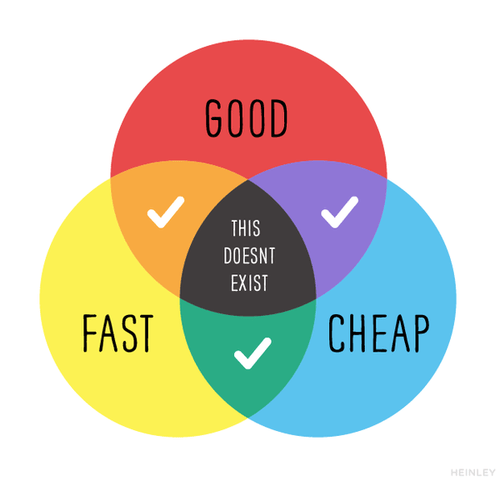
There is a popular meme that tells about the relationships between a job done fast, well, and cheap. You can do a job fast and well, you can do it well and cheap, you can do it cheap and fast. What you can’t do is fast, well, and cheap at the same time.

Source: The Developer Society, Good/Cheap/Fast

The meme fails to tell another truth, though. A bane to many companies. That is: you can’t do a job fast, well, or cheap if you want to maintain full control on the outcome.

You can’t do fast, because when the job is ready, there are still review phases to go through. Often featuring vague feedback, last minute changes, and unsubstantiated personal opinions.

You can’t do cheap, because all the layers you are adding have a cost. And even more expensive is the price you pay for the people who leave once they realize their talent comes after tenure.

You can’t do well, because by the time you get to the finish line, what you have is a frankestein that satisfies everyone and excites no one.

So, if your goal is to maintain full control on the outcome, any of the combinations in the meme is a much better path to execution. Change, or be prepared to be kicked out of the game.

False dichotomies

Two reasons why many arguments fail to move the conversation forward and develop the relationship – from the beautiful book by Steven Pinker, The Sense of Style.

  1. We approach the argument as if it were a dichotomy. Black or white. Right or wrong. Good or evil. For as much as this is convenient to survive, it is not a great representation of how things actually are. And it is certainly not a path to understanding.
  2. We make it personal. It is rarely about finding the truth or the better course of action. It is about beating your opponent. Who is motivated by the wrong values, less intelligent, and not as refined.

When we avoid falling into these traps, we find the place for learning and growth.

Arguments should be based on reasons, not people.

Steven Pinker

Support

What do you do when someone comes to you with an idea you find hopeless or inadequate?

You denigrate the idea, saying it is a bad one and it does not deserve any of your time.

You force change onto the idea to make it fit with what you think might be a better idea.

You begin a conversation and try to compromise to get the idea nearer to you.

You support the idea and say you will do your best to help.

I guess much depends on how invested you are in the topic. A manager might find it difficult to support something that might take time and resources and return no results; a friend might be more open to keep their opinions to themselves and help instead.

Relationships are built and broken on these type of choices. Get to them with intention and care.

Not many people

After becoming a leader, there is a choice you have to make.

As you are in the middle, many think the choice is between siding with management and siding with your team. But the truth is, the two sides are not at war. And a huge part of your responsibilities as a leader is to not act as if they were.

The tension is instead between you and your team.

Every request from the people you lead will cut into your time, energy, and focus. You will not be able to do what you were doing before, what you were good at before. They will ask, demand, pretend, guess, second guess, and ask some more. They will push you to do things you are not used to. They will force you to have conversations you would normally avoid. They will expect that you raise above yourself, often without any guidance, and act as the leader you are paid to be.

And so the choice is between being who you are and being who your team wants and needs you to be.

Not many people are willing to let go – of their ideas, of their ways, of their habits, of their responsibilites, of their work, of their ego.

Not many people are good leaders.