Used to boredom

The positive consequence of getting used to boredom is that you allow time for things to happen.

You do not check every other day if something is happening, you do not ask for a new report, a new deadline, a new update, you do not seek daily rewards, you do not rush to change the inputs hoping for a faster outcome.

You have a plan and you stick to it.

You’ll let me know if the plan changes.
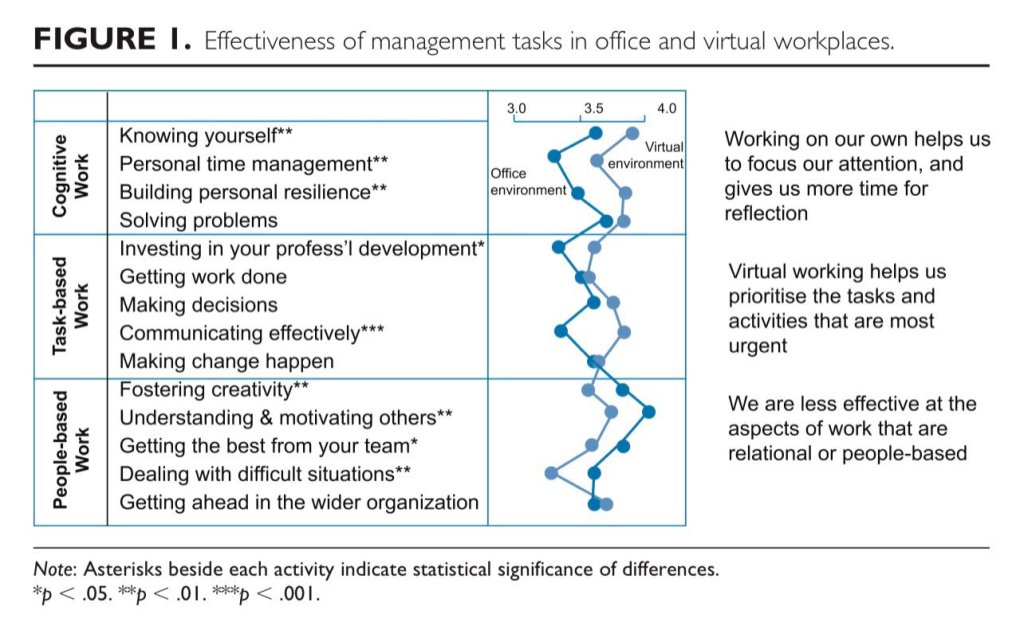
The shades of remote work

Fake dilemmas make the world flat.

To make decisions that are not impulsive and destructive, we need to be able to add shades (and data) in between the dichotomy.

Some shades regarding remote work from three recent studies: The effects of remote work on collaboration among information workers; The Blinkered Boss: How Has Managerial Behavior Changed with the Shift to Virtual Working?; Work from Home & Productivity: Evidence from Personnel & Analytics Data on IT Professionals.

  • Remote work, when extended to the whole company, reduces the opportunities and the willingness to connect with people who are not directly working with you.
  • Hybrid work should probably not be about coming to the office whenever someone wants, but rather about organizing days in which certain teams, or the whole company, goes to the office.
  • Remote work does improve the individual’s capacity to focus and reflect, does improve the individual’s capacity to deliver on their own tasks, and has a negative impact on aspects of work that are relational or people-based (e.g., understanding and motivating others, or dealing with difficult situations).
  • Just because productivity does not take a hit from remote work, it doesn’t mean that individual productivity has not decreased. People might be simply putting in more hours, for example because they have to attend more meetings or because they have a stressful situation at home.
  • Remote work does decrease the opportunity for interaction with supervisors, and in particular the opportunities to get coached by one’s supervisor.

Note: thanks Ethan Mollick for sharing the studies in the first place.

Unique personality

In whatever you do that matters to you, make sure to put a touch of your own unique personality.

When you apply for a job, when you write a blog post, when you deliver a speech, when you interact with others, when you are in a meeting, when you are bringing your boss up to speed, when you are out with your kids or talk to your parents. In every single situation there are many rules that have but one job: to make things predictable and dull.

Rules are important, and you should follow them. Few people are happy when all of their expectations are disregarded.

But remember to add a touch of your own unique personality. Few people are happy when all they see around is predictable and dull.

It is a difficult balance to strike. Just don’t forget who you are and what you stand for.

Lazy sales

The laziest sales approach must certainly be the following.

I have just came across your company on LinkedIn. Not sure you are the right person to talk to, in case could you connect me to one of your colleagues?

You don’t know my company.

You don’t know me.

You are asking me to do work for you.

I hope you’ll never be asked to resort to this.

Legendary

You can’t start with great.

You might start with average, decent, ok. Or more often, you will start with poor, näive, ineffectual.

And that’s where you will have to continue from. One step after the next. From horrible to passable, from decent to respectable, from good to fantastic.

You can’t start with great.

You can, though, end with legendary.