Episode nine of the second season of Parks and Recreation presents a plot that many will find familiar.
The boss wants to win a competition and calls for the whole team to come up with ideas. Despite the general disengagement, each one of them presents a proposal; and when failing to agree on which one to put forward for the prize, they come together and combine them all into one. The result is a camel – in the sense of a horse designed by committee – that leaves them with slim chances to win, and yet it is a team effort. Unsatisfied and driven by possible reward, the boss calls the external consultant, who comes up with something that would most likely take the first prize. While further disengaging the team.
The point is that it is more important to achieve something together, anything really. This is how team, morale, and bond are built.
There are very few circumstances when winning matters more then the way you compete. Very few.
It’s great advice. But if feels difficult, sometimes vague, often out of reach.
To make it more concrete, consider this.
You work at a company that fosters a toxic environment. Everyone is only focused on achieving a reward, to the extent that people barely greet each other when they meet in the corridors, actively hide information to get some edge, and only put a smile on their faces in the presence of a manager.
You can’t take it anymore. You are close to burn out, you are tired of being treated as a machine, and you dread the meeting to set your next goals way more than failing at them.
You have some options.
You can quit. Some do that, not many though.
You can muscle through. Most do that, and of course while doing that they lose energy, enthusiasm, well-being.
You can put up a shield of cynicism and sarcasm. I have done it myself many times. Become the one who has a witty response at the ready, a negative comment for every situation, a superior attitude that eventually will make it impossible for others to take you seriously.
Or you can reach out and ask: “how are you?” Very few do that. Despite the awful situation, very few understand that what is most needed in difficult circumstances is connection. Very few understand that they can be the initiator of something that is going to grow around them. Very few understand that they can indeed be the change they want to see in their world.
We know that people prefer to work for leaders who give a sense of security, who distribute responsibilities, who show a genuine interest in their direct reports, who care, who have integrity, who listen.
Yet, very few leaders do any of that.
And that could be for three reasons.
They might be not skilled enough. Many top performers are promoted into leadership roles and they simply have no experience creating an environment where people can develop and feel secure. The idea is that if you are good at making things happen, you will eventually figure that out. Of course, it rarely happens.
They might believe that those things will come when _______ (fill in the blank). When the recession is over, when the urgency of the moment has passed, when the company will grow, when the next campaign will fix everything, when the new year will come. It’s never a good time for them to take ownership.
They might be genuinely interested in themselves more than in anything else. They move from one role to the next, from one company to the next, achieving above average results, and then leaving fear and destruction behind.
There are certainly other reasons, and other types of dysfunctional leadership.
But the main point for you is that you are not going to change that. You will not convince your team lead that they need training, that the time is now, or that putting their needs second will actually serve them in the long term.
None of that is going to happen.
All you can do is decide what type of leader you want to follow and where you draw the line.
The best way to approach anything new is by putting aside what you know about it.
We have been taught that experience matters more than anything else. And since today everything needs to happen now (even better, yesterday), we augment the importance of experience and try to get farther by doing more of what we have done so far.
That rarely works.
Experience matters, for sure, but it is not a good predictor of the success you are going to have in your next endeavor. And it does make sense, since the world is complex and ever-changing. What you truly need is not experience, but the capacity to put that aside and learn something new over and over again.
Your next gig might be similar to the previous one. It will never be the same.
Despite thousands of years of evolution, we are still pretty primitive in our behavior. We seek what makes us survive and thrive, and we stay away from what puts our lives through any kind of hassle.
And so, companies do two big mistakes when they talk about what they do. First, they forget that they are not the hero. Second, they ask prospects to burn too many calories to understand why they should become customers.
The result is that people run.
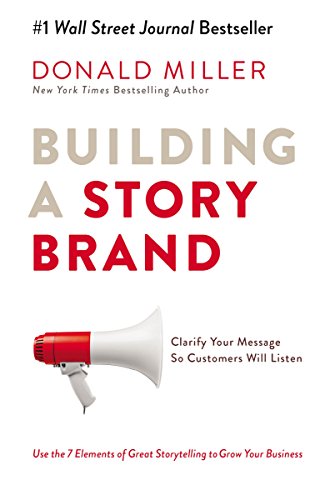
The way companies tell their story can follow a consolidated way of storytelling.
A CHARACTER who wants something encounters a PROBLEM before they can get it. At the peak of their despair, a GUIDE steps into their lives, gives them a PLAN, and CALLS THEM TO ACTION. That action helps them avoid FAILURE and ends in a SUCCESS.
The character is the customer. And the engine of the story (the story gap) is the thing the customer wants. Of course, you need to know your customer very well to start from here. In particular, you need to know:
What do they want to become?
What kind of person do they want to be?
What is their aspirational identity? (i.e., How do they want their friends to talk about them?)
Once this research is done, it should become clear that what they want is something relevant for them. They do care deeply about closing the gap and joining with the object of their desire (if they do not, there is no story).
The problem is both external (e.g., a bomb, skyrocketing costs, increased competition) and internal (e.g., failed detective, inability to grow, staff leaving). In fact, companies should strive to frame their product as a resolution for both the external and the internal problem.
The guide is you (finally!). For your product to be a reliable guide, it needs to communicate empathy – we understand how it feels ..; like you, we are frustrated by .. – and competence – we know what we are doing (testimonials, logos, statistics).
The plan can either be a process plan, that describes the steps the hero needs to take to buy the product (and achieve success), or an agreement plan, that lists the major concerns of the hero and counters them with agreements that alleviate the fear – if you buy our product, we will do this; in case you need help, we offer 24/7 service.
The call to action can either be direct – buy now, schedule an appointment – or transitional – download the whitepaper, get started with the free trial.
The dodged failure needs to be expressed. Many refrain from doing this, because they feel they might be perceived as negative guides. Yet people are motivated by loss aversion: if there is no loss your product helps them avoid, they will avoid the loss (i.e. expenditure) represented by buying your product.
And finally, the success. Just be very clear what it looks like, how it feels like, what the end vision is. You can’t get too specific.
 You've got this