The theory of empathy

To most people, empathy does not come natural. It certainly does not come natural to me. For many years, I have had the tendency to put myself at the centre of the World. Everything that happened was, to some extent, because of me.

People were certainly acting in a certain way because they wanted to signal something to me. My friend had stopped calling because for sure they did not want to hang out with me any more. My boss was being cranky because she did not like my job and was about to fire me. My girlfriend was being cold because clearly she was not interested in me anymore. And so on.

This slowly built up a worldview according to which it was very difficult for me to be empathic. On one side, the others were mostly being negative. On the other, they were being negative because of me, and so I was also unworthy of their interest, friendship, trust, love.

Raise you hand if this situation sounds familiar.

I had to train myself in empathy. Here is what Wikipedia says about empathy.

Empathy is the capacity to understand or feel what another person is experiencing from within their frame of reference, that is, the capacity to place oneself in another’s position.

Sounds intimidating just by reading it.

The first step I took was to start asking people about their motives. What I found floored me. In 99.9% of the cases, I was not the reason why they were acting in a certain way. I found, actually, that most people had feelings that I was very familiar with, or were living through situations that I had also lived through in the past.

After I started approaching meditation, and to some extent a more Buddhist take on life, one theme resonated with me. We are all going through the same distress. Even though our lives are different, even if some have more and some have less, even if some are alone and some are not, even if some live in some place and some in another. We are all challenged by the attempt to make sense of a World that is senseless.

When you understand that what you feel, what you think, what you live is an experience you have in common with other human beings, that is the moment empathy unlocks.

I am still learning, and it is easy to fall back to certain patterns, easier than one would care to admit. Real empathy is one of the most needed characteristics in today’s World, and what is incredible about it, is that it expands in a sense of belonging like no other I ever experienced before.

Good luck on your path.
Take a step back

When you get stuck, your instinct tells you to find a way out.

And so you delve deeper into what you were doing and got you stuck in the first place, you wrestle with what you don’t get, tirelessly digging a path in the hope that the answer is at the end of it. You spend time, energy and focus looking at the problem, and the more you do it, the less it seems feasible. Not once I have managed to get untangled this way.

Instead, you could take a break. You could go for a walk, call a friend, have a cup of coffee. And then, when you go back, you could look at the problem’s contours, trying to refine them, make them more comfortable for you, even finish something around the problem you said you would have finished later. You are making it more presentable and ready to be tackled.

At this point, one of two things happen.

Perhaps you get your answer. It might come unexpected, as your mind was not really looking for it.

Or you realize that the problem was not really THE problem. That you had fears, expectations, doubts, concerns. All preventing you to look at things for what they really were. A mere block. And then you can continue with your work.

Until you get stuck again.

Repeat.

Bias

It takes mental effort to identify our own bias.

Few months ago, I was putting together a presentation about Coaching and Leadership. I wanted to have one slide to stimulate some discussion, and I wanted to ask people in the audience to describe leadership with one single word.

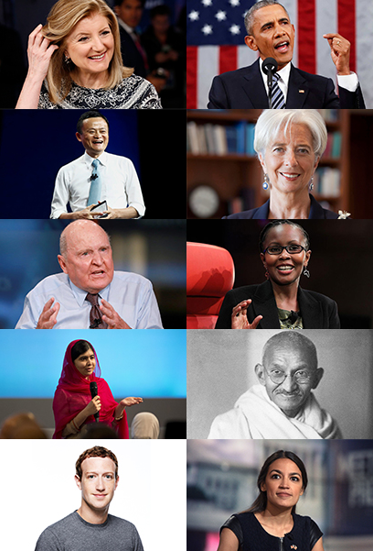
Along with the question, the slide was supposed to feature a collage of known leaders. To my dismay, I quickly realised I was victim to bias. The first few names that came to mind were (in order) Steve Job, Mark Zuckerberg, Barack Obama and Jack Welch. All male. All American.

I could have certainly stuck with those, and probably nobody would have complained. Yet, as I knew by then I was biased, I forced myself to do a better research (both in my memory and on the Internet), and eventually came up with the following collage.

Leadership-bias

It was great to do that. Not only because I had a far better depiction of what a leader is and might be, but also because I had the chance to identify bias at work. At least, a certain type of bias. Perhaps next time, this list will come more naturally. And perhaps, I will be able to identify similar bias in other situations more easily.

By the way, in case you are wondering who some of the leaders in the collage are, here is the full list (from top left).

Perfect

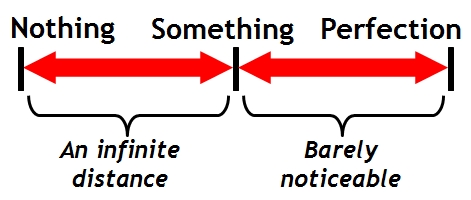
This week, I have found this beautiful graphic depiction of how resistance works at times.

Do-Something-Ed-Batista

It’s from Ed Batista’s blog (that is strongly recommended, by the way), and it displays how it is incredibly more important to move from doing nothing to doing something, than it is to move from doing something to doing something perfect.

The greatest of intentions pale in comparison to the smallest of actions.

Noah Lomax

Very often, we get stuck in search of perfection. That is useless, as most of the time the difference between something and something perfect is barely noticeable. I like to represent it slightly differently with the following chart.

Do-Something

The fact is, perfection is often an excuse do escape doing. It’s been for me for years, it still is sometimes. But eventually, we’ll have to stop hiding and start shipping stuff that is As Close to Necessary to Perfect. Make a habit of it, it’ll be liberating.

Happiness and satisfaction

Last year, I had the chance to finally read Thinking, Fast and Slow, by Daniel Kahneman. It is a wonderful book about how our mind works, and I will at some point share my notes about it on this blog.

One of the most fascinating ideas by Kahneman is the distinction between happiness and satisfaction – or between experience and memory (as presented in his must-watch TedTalk).

We often worry about being happy, but according to Kahneman we first need to agree on what happiness is. Happiness is a short-term, experiential concept. We can be happy (or unhappy) as we live in the moment. But as we move past it (and this happens quite fast), what really matters is the memory we have of the experience. That is, in a way, a more complex idea. It has to do with the experience itself, particularly with how it ended (on a positive vs on a negative note), but it also has to do with the story we tell about the experience, the way we elaborate what happened and we fit it in the broader story of our life.

Happiness feels good in the moment. What you’re left with are your memories. And that’s a very striking thing — that memories stay with you, and the reality of life is gone in an instant. So memory has a disproportionate weight because it’s with us. It’s the only thing we get to keep.

Daniel Kahneman, in Conversations with Tyler

I find this to be extremely fascinating. My opinion is that it represents a clear shift of responsibility from the external and experiential world to the internal and narrative self.

We all have a story. A story of who we are and who we are not, of who we want to be and of how we are getting there. This story would help pick situations and contexts that align with the broader narrative.

So that, for example, if I think of myself as a considerate and careful father and husband, I would probably try to avoid situations that would have me end up drunk and naked in public.

But also, and probably more importantly, the main story arc of our life could be an anchoring frame for experiences and circumstances that go beyond our will. When something good or bad happens to us, that is not a result of our choices, I feel we can elaborate it so that it better fits with the view we have of our lives. And in doing that, we increase our general degree of satisfaction.

The same considerate and careful father and husband that is stuck in a job he does not like, for example, could frame the situation as a way to provide for his family, as well as spend time with his kids and wife without additional job-related worries (instead of beating himself up because he needs to find a better job to match a view of himself as an ambitious and career-driven professional, that is clearly not primary in his life).