There’s a time for everything

In the past, we used to go the office from 9 to 5. Most had very little responsibilities, as they were told what to do. Our professional life was figured out at graduation (for some, even earlier), and the personal life was fairly standard for the majority of people. We were closely in touch with our colleagues, friends and family, and the number of acquaintances was quite low. The most we got into an argument was probably once a year, perhaps at Christmas over some sport-related topic.

Today our lives are infinitely more fluid. Personal and professional are mixed. We answer work emails while we sit on the sofa close to our dear one, watching the latest episode of True Detective. At the same time we have an ongoing conversation on Instagram with a friend we have not met since high school, and we are arguing on Twitter on who is the best Democratic candidate for 2020. We are acquainted to many more people than we are closely in touch with, and we are constantly asked to make decisions, take responsibilities, change who we are and the context in which we live.

In this scenario, we have to be careful to pick only the battles that make sense for us in a specific period, as we cannot deplete our mental and physical energy on many different fronts simultaneously. Chances are that if you are going through a divorce, or having a kid, or moving to a new town, you will not be able to give your best at work or to come up with the ultimate idea for your next novel. The opposite is true as well.

The bad news is, there’s not time for everything.

The good news is, there’s a time for everything.

Despite what the sense of urgency that is imposed on us for any little unimportant thing, if we can discern what really matters and give it our attention to the highest possible level, we’ll eventually get it done and be able to pass on to what’s next. And of course, we need to be able to say a whole lot of “no, thanks”. Some things are simply not for us. It is ok to be able to say it out loud.
Distracted

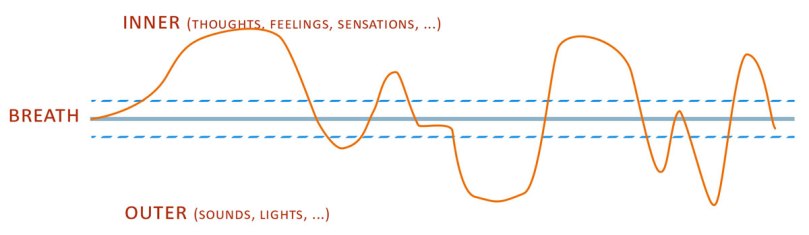
A typical meditation session looks something like the following.

fabrizio-trotti-blog-meditation

You set out to meditate, and you begin by putting your attention on your focus (breath in my case, for some it’s a mantra, or the body, or something else).

Very soon, a distraction appears. This might be something coming from within you, for example a thought (“I’ll do this after I am done”, “Why did I say something so stupid?”, “What am I going to do about that?”), a feeling (tiredness, sadness, anger, disappointment, hunger, thirst), a sensation (“My back hurts”, “My foot is sore”, “The cat is on my lap”, “The sun is warm today”). Or something that comes from the outside world, for example your phone ringing, somebody suddenly switching the light on, your kids shouting your name as the episode of their favorite cartoon series has ended and the new one does not start automatically.

Some distractions are stronger, some are weaker. Some are longer, some are shorter. Eventually, what you are supposed to do is to gently acknowledge the distraction, letting it go, and go back to the source of attention, your focus.

If you think about it, this is something that happens everytime we set out to do anything. Even if we are very careful managing our attention (for example by sitting without our phone in view, or by chosing to work from a library), distractions will happen. All the time. The quality of what you do and the amount of time you spend doing it depends on how good you will become at acknowledging the distraction, letting it go and going back. And meditation is an excellent exercise.

In meditation and in our daily lives there are three qualities that we can nurture, cultivate, and bring out. We already possess these, but they can be ripened: precision, gentleness, and the ability to let go.

Pema Chödrön

I’ll do it later

There are three pitfalls of “I’ll do it later”.

The first one in that “later” rarely comes. When we are in the present and we say “I’ll do it later”, we expect a future moment in which we will not only recall that we have that thing to do, but we will also be sufficiently free, awake, willing, energetic to actually do it. As our lives go by, we very rarely get to those moments, various different things getting in the way.

The second one is that as we postpone things, we end up increasing the clutter. Mental and material clutter alike. Keeping things in mind drains energy, and we can only remember a limited amount of things at any given moment. We then use to-do lists, productivity apps, calendars, email inboxes, reminders. And when we defer an item, we end up making it more and more difficult to see and act upon it. It’s what happens when your inbox unread list grows above ten emails.

The third one is that the thing we were supposed to “do later” will certainly pop up in a moment when we can’t do anything about it. Say, when we are already in bed, or while we are driving to work, or when we have just started playing with our kids. And we will feel a little more miserable, and probably end up doubling down on the “I’ll do it later”, resetting to number one of this list.

It turns out, many of the things we push to “later” can actually be done now, without to much of a distraction or effort. And if there are too many of those, than it is probably time to rethink priorities and what is important. Keeping many balls in the air will eventually make you drop all of them.

Who is empathy for?

We commonly believe that empathy is for the person on the receiving end. And that is, at least in part, true. It gives them the space to be with their feelings, thoughts, discomfort, free of the burden of judgement and scrutiny.

We need to be aware that empathy is not for the person on the giving end. Sure, they get an enriched view of the world by being empathetic. Yet, they should not fall in the trap of heroism and self-praising, and even less in the pit of entitlement (“I am doing this, so you owe me that”). At the bottom of that pit is resentment, and it is not possible to be empathetic when resenting someone.

Most of all, I believe, empathy is for the situation, the context, the environment. It gets things unstuck, it moves things forward, it works towards some form of progress. The alternative is banging our heads against the wall. It takes a lot of time, and pain, to get anywhere by just doing that.

First principles

If you get stuck with a problem, it’s good to go back to the foundations of the problem itself to see if you are approaching it the best possible way.

One example. If you want to grow your business, one common way to go about it is to get some funding and hire more people. Of course, hiring more people brings more business in, and for this to be sustained, you need even more people. And even more funding.

On the other hand, one could go to the foundations of the problem, its first principles, and try to understand the type of growth the company needs (not all of the new business that comes in, for example, will be profitable or valuable), or if it needs growth at all, or if growth could be achieved in a healthier way by re-structuring the company, or improving the service, or re-designing the processes.

Another example is reducing car usage. Local governments, for very good reasons, tend to think at the problem mainly in terms of disincentive. Taxes on cars, increase cost of parking, lanes reserved to public transport only, additional fees to access certain areas of the city

On the other hand, the foundation of the problem is that people need to move from one place to another multiple times a day. What are the alternatives we provide to meet this need? Could we make them cheaper (or free) instead of continuosly raising their costs? Could we make them more easily accessible? And the same could go for addressing the fact that to many people a car is a status symbol.

When you go back to first principles thinking, you unlock a whole new spectrum of possibilities you had not considered at first simply because you were thinking by analogy.

Through most of our life, we get through life by reasoning by analogy, which essentially means copying what other people do with slight variations. And you have to do that. Otherwise, mentally, you wouldn’t be able to get through the day. But when you want to do something new, you have to apply the physics approach.

Elon Musk