Gentleness

Understanding what is happening within has one sole purpose.

Gentleness.

When it becomes clear where your actions and reactions come from, what’s behind the patterns you keep falling in, why it is so difficult to be a certain way and do a certain thing. Then you can relax.

That is not the same as giving up, or finding excuses. Actually, the moment you accept the trigger for what it is (a thought, a situation, a feeling, a sensation) and refuse to label it as “me” and “reality”, is the moment you can open to proactivity. Good thing will come from it.

Just a small part

When faced with bad news, there’s a natural reaction that almost automatically kicks in.

It’s about making the bad news the totality of our reality. We feel discomfort, pain, despair, because we have just been told that something does not conform to the idea(s) we had about our life. And we often take this to the extreme. We amplify the discomfort, the pain, the despair. It becomes all we see around us and perceive within us. We go to a dark place.

And that is fine.

As long as we know that is not true. The discomfort, the pain, the despair, they are just a part of our reality. A small part indeed. So the following step, that is all but automatic and instictive, is to look at things around us for what they really are.

Ok, we did not get the job, and still we have that hobby we always wanted to dedicate time to.

Ok, our relationship is shattered, and still we have a dear friend that deeply cares about us.

Ok, our body is not working as it should, and still our mind is present, vibrant, open.

The second step is not about being optimistic. It’s about realizing that things happen to us all the time, a neverending flow. And that focusing all our attention, energy, commitment to a single one of them, no matter how bad, is a limit to expressing the potential of each life.

The bad news is you’re falling through the air, nothing to hang on to, no parachute. The good news is, there’s no ground.

Chögyam Trungpa

Peak performance

The message of Peak Performance, by Brad Stulberg and Steve Magness, is as simple to understand as it is difficult to apply in practice.

Stress + rest = growth

That is to say, if you alternate periods of intense work, work that takes you a little beyond your limits, yet not too much, with periods of relax and rest, your potential will increase. And this is true both for athletes and knowledge workers.

The illusion of “always busy“, then, is not only bad for your narrative and your relationships, but also for your possibility to deliver your best work and to incrementally and progressively increase what “best” is to you.

If you think at all the times you came up with a solution to your problems, or a new idea, or a different approach to a tricky situation during moments of break (in the shower, during a walk outside, while playing with your kids), the message should easily resonate with you. On the other hand, think about how often you have managed to overcome a difficult situation by continuing to work relentlessly. Never, right?

And yet, we often fall in that trap. Sometimes because of peer pressure, sometimes because we feel guilty, more often simply because we are not sure what we are doing is good work, and we try to compensate by doing a lot. We end up being over-stressed, and this is never a very good idea.

Stress can be positive, triggering desirable adaptations in the body; or stress can be negative, causing grave damage and harm. The effects of stress depend almost entirely on the dose.

The book is full of examples of high performers, in different areas, and all seem to respect the growth equation that is the foundation of Peak Performance. And on top of that, they have pretty rigid and established routines.

Routines help keeping you focused on what you are doing in different moments of the day. They leave little space for excuses and resistance, they force you to show up and to be present with body and mind.

There’s a pretty good example on how to apply this principle for day-to-day work: the authors suggest to split your days in chunks of 50 to 90 minutes (depending on the type of work), followed by 7 to 20 minutes of rest.

In the words of the writer James Clear, “The single greatest skill in any endeavor is doing the work. Not doing the work that is easy for you. Not doing the work that makes you look good. Not doing the work when you feel inspired. Just doing the work.”

The final part of the book is dedicated to a very important part of performance: purpose. There’s quite a lot of evidence that having a purpose that “transcends ourselves”, that goes beyond the immediate, short-term gains, makes us bring out the best work we could possibly do. And more than that, it increases our capability to accept stress, widening the growth leaps in the equation.

In situations that feel scary or overwhelming, our brain—our central governor, our ego, our “self”—automatically tries to protect us from failure. It shuts us down and tells us to turn in the other direction. Even if failure doesn’t mean physical injury, our ego doesn’t like emotional injury, either—it doesn’t want to risk getting embarrassed, so it ushers us down the safe route. It’s only when we transcend our “self” that we can break through our self-imposed limits.
 

Distracted

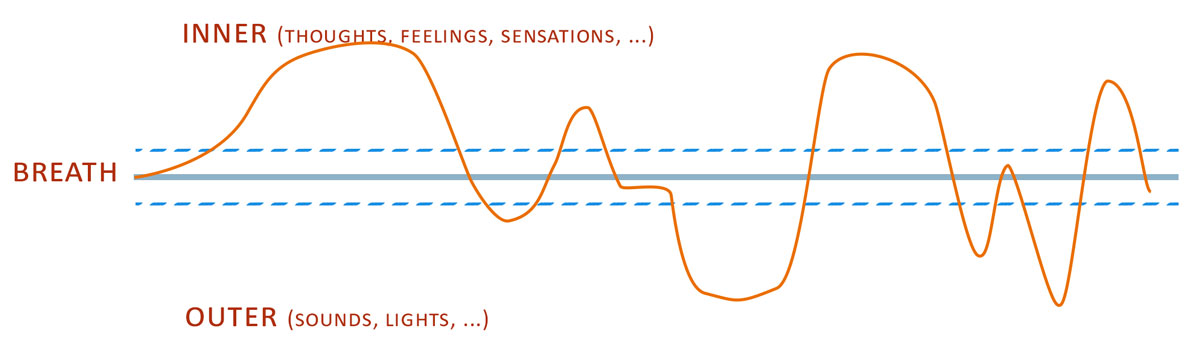
A typical meditation session looks something like the following.

fabrizio-trotti-blog-meditation

You set out to meditate, and you begin by putting your attention on your focus (breath in my case, for some it’s a mantra, or the body, or something else).

Very soon, a distraction appears. This might be something coming from within you, for example a thought (“I’ll do this after I am done”, “Why did I say something so stupid?”, “What am I going to do about that?”), a feeling (tiredness, sadness, anger, disappointment, hunger, thirst), a sensation (“My back hurts”, “My foot is sore”, “The cat is on my lap”, “The sun is warm today”). Or something that comes from the outside world, for example your phone ringing, somebody suddenly switching the light on, your kids shouting your name as the episode of their favorite cartoon series has ended and the new one does not start automatically.

Some distractions are stronger, some are weaker. Some are longer, some are shorter. Eventually, what you are supposed to do is to gently acknowledge the distraction, letting it go, and go back to the source of attention, your focus.

If you think about it, this is something that happens everytime we set out to do anything. Even if we are very careful managing our attention (for example by sitting without our phone in view, or by chosing to work from a library), distractions will happen. All the time. The quality of what you do and the amount of time you spend doing it depends on how good you will become at acknowledging the distraction, letting it go and going back. And meditation is an excellent exercise.

In meditation and in our daily lives there are three qualities that we can nurture, cultivate, and bring out. We already possess these, but they can be ripened: precision, gentleness, and the ability to let go.

Pema Chödrön

I still go “ouch!”

When things go bad, I still go “ouch!”.

When my daughter (rarely) or my son (more often) throw a tantrum, I still go “ouch!”. When my work gets rejected, the neighbour does not say “hi!”, a stranger cuts my way, the weather is not the way I had planned it to be, a bee flies a little too close to me, the canteen has nothing decent to offer, or somebody close tells me something that hurts, I still go “ouch!”. And sometimes, I go a little beyond “ouch!”.

What meditation is gently teaching me, though, is to stop there. To understand that disappointment, anger, anxiety, frustration, fear, loneliness are feelings that can be identified, appreciated and let go. That it is ok to complain (a little bit) when the grand scheme of things is not in line with your desires, and that you can still continue living and doing just as you were a moment earlier. And that no, nobody is plotting against my happiness or success.

Meditation is a great gift, and if you are as inclined as I am to see the dark side of things, it is going to help you appreciate that as well as the brightness that is just few steps ahead.