The idea that a country can solve its problems by closing its borders is as pointless as the idea that a person can heal their wounds by confining to their own room.

The idea that a country can solve its problems by closing its borders is as pointless as the idea that a person can heal their wounds by confining to their own room.

“Hi, this is me from my company. I understand you are using my competitor.”
“Correct. Now is not a good time, could you drop me an email?”
“Sure. I understand you are using my competitor, would you be interested in evaluating my company at renewal.”
“Sorry, it really is not a good time. Could you send an email?”
“Would you be interested in evaluating my company.”
“I keep saying it’s not a good time. Send me an email.”
I understand there’s a script to follow, some boxes to check, a grumpy supervisor. But if this is the job, then sure, AI will take it.

Two take-aways from this clip from the interview between Elon Musk and BBC reporter James Clayton.

When you are under pressure, mistakes happen.
Luckily, not all mistakes will cost you $100 billion. And most importantly, you are the one deciding what pressure to bow to. Not everything is worth pursuing, not all chances are worth taking, not all competitors are worth following.
Sometimes the wise response is to slow down and let go. It’s always a viable option.

Hubspot and Intercom are very successful companies. And on the exact same type of communication to their customer, they choose two completely different approaches.

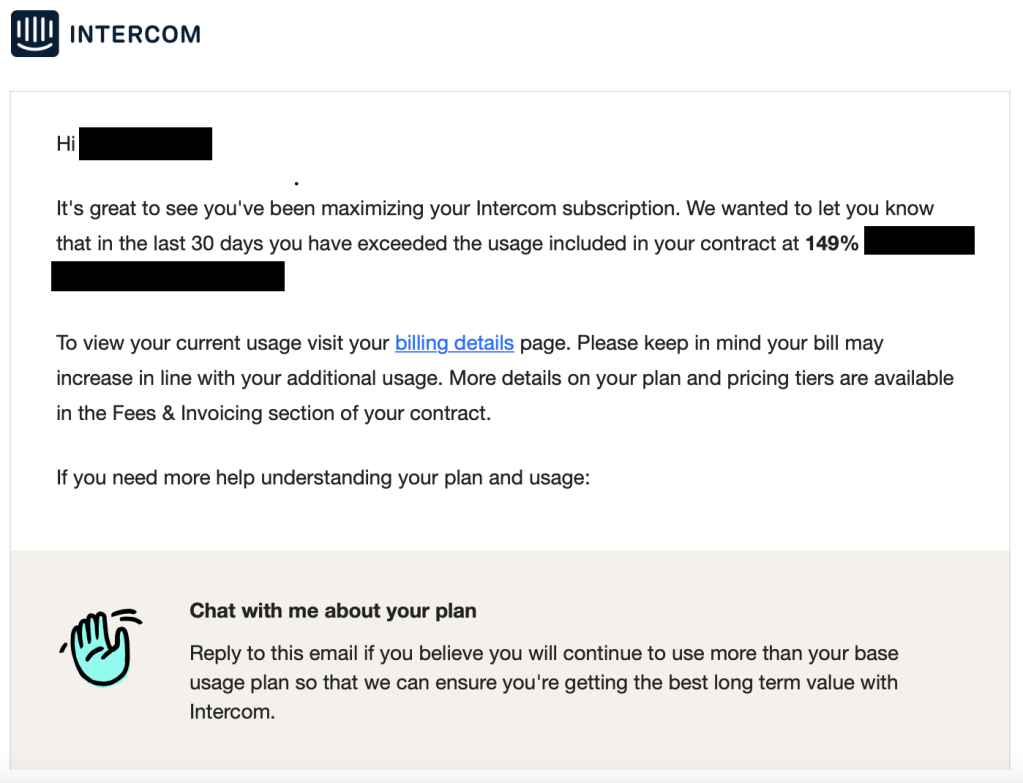
One is before, the other is after.
One raises awareness, the other raises alarm.
One gives you agency, the other takes it away.
One is about hope (“Your contacts database is growing”), the other is about failure (“You’ve exceeded the usage”).
Also (you can’t say that from the message alone, but I’ll ask you to trust me), one is true, the other is not.
There is no right or wrong way to do stuff.
But the choices you make say a lot about who you are and what you stand for.
 You've got this